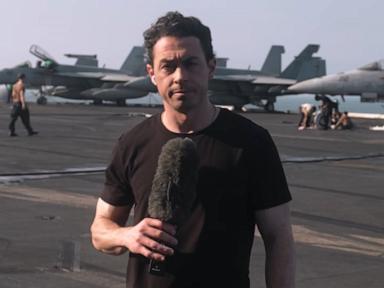
Moving a nuclear-powered supercarrier from the Pacific into the Middle East does not happen in a vacuum. When USS George Washington deployed westward in 2026—arriving in the US 5th Fleet area in August before departing back toward the US 7th Fleet in mid-November—the move exposed a hard truth about modern naval power: every extra carrier sent to confront Iran leaves an open gap somewhere else on the map.
Competitor coverage often treats a carrier deployment like a cable-news spectacle. Deck launches, roaring jets, tense standoff headlines. What gets lost in that spectacle is the brutal math of fleet availability, sailor fatigue, maritime chokepoints, and regional deterrence.
The Shell Game Behind a Three-Carrier Surge
Naval commanders love talking about "presence." Realists look at hull counts.
Over the course of 2026, escalation following the February 28 outbreak of the US-Israeli war with Iran turned the Persian Gulf and Arabian Sea into a magnet for American naval firepower. Brief overlaps pushed the number of US aircraft carriers operating in the region to three—a concentration rarely seen since the 2003 invasion of Iraq—alongside USS George H.W. Bush and USS Theodore Roosevelt, supported by more than a dozen destroyers, cruisers, and smaller surface combatants.
That surge looks imposing on a briefing slide. It also strains everything beneath the waterline.
A supercarrier is not a lone gunfighter cruising between crises. Each carrier anchors a strike group of escort ships, logistics vessels, intelligence platforms, and hundreds of strike and support aircraft. Pulling USS George Washington—forward-deployed out of Yokosuka, Japan—into Central Command waters after it had already begun its late-May deployment with stops in the Indo-Pacific meant stretching the Navy's coverage thin across the Western Pacific.
Every crisis absorbed in the Arabian Sea has to be paid for somewhere else, usually in delayed maintenance, extended sea time, or thinner patrols in another theater.
Even when a carrier rotates out, the underlying strain remains visible across the fleet. Earlier in 2026, USS Abraham Lincoln logged a 321-day deployment before wrapping up in October, while USS Gerald R. Ford pushed past 320 days at sea after being redirected. Surface escorts have faced similar marathons, with destroyers like USS Michael Murphy and USS Spruance returning from deployments stretching close to a full year.
Why Carrier Rotations Never Feel Routine
Ask any seasoned defense analyst about "routine rotations" and you will hear a wry laugh. There is nothing routine about keeping thousands of sailors living and working inside steel compartments for months on end while maritime threats stay active.
Longer deployments compound smaller frictions. Supply chains take longer. Spare parts compete for airlift and sealift slots. Crew rest shrinks when watch bills stay heavy.
Reports surrounding USS Abraham Lincoln during its extended Middle East stretch—pointing to supply bottlenecks and crew mental health strain after hundreds of days away—underscored a basic operational limit. A nuclear reactor can run for decades without refueling. Human beings cannot run on fumes for a year without paying a price in readiness, morale, and retention.
Chokepoints, Blockades, and the Hormuz Squeeze
Why does Washington keep pouring capital-intensive naval assets into these waters despite the wear and tear? Follow the shipping lanes.
Roughly a third of global seaborne oil moved through the Strait of Hormuz before the war erupted on February 28. Once hostilities escalated and diplomatic efforts—including a June memorandum of understanding that stalled over maritime navigation guarantees—failed to lock in lasting calm, energy markets felt the shockwaves immediately.
US naval forces in the region have been tied up enforcing a blockade on merchant shipping tied to Iran while carrying out limited strikes against Iranian targets in and around the strait. That mission requires constant vigilance. Asymmetric threats—anti-ship missiles, drones, fast-attack craft, naval mines, and electronic warfare—turn narrow waterways into high-tension corridors where a single miscalculation can spike crude prices or draw in regional partners.
Deterrence Versus Escalation Traps
Heavy naval deployments aim to do two things at once. They deter adversaries from closing lanes or widening attacks, and they reassure allies facing missile and drone pressure.
Yet heavy force concentrations carry a built-in paradox. The more American firepower clusters in one confined theater, the more tempting a target it becomes for adversaries looking to claim a symbolic or material blow, and the narrower the margin for error when tensions flare.
Consider a hypothetical scenario to see how fragile that balance can be. Suppose a merchant vessel is struck near the entrance to the Strait of Hormuz while two carrier strike groups are operating nearby. Even if naval air defenses and escorts respond cleanly, commanders still have to weigh immediate retaliatory strikes against the risk of triggering wider regional retaliation on ports, shipping, or energy infrastructure. Deterrence only holds as long as both sides read the signals accurately—and crises are notorious for distorting signals.
What Competitors Miss About Naval Power
Surface-level coverage tends to treat a warship like a static symbol. In reality, a carrier strike group is a mobile logistics and combat system governed by physics, geography, and human endurance.
To judge what a deployment like USS George Washington actually achieves, readers should look past dramatic footage and ask sharper questions:
- Duration over arrival: A three-month stretch in one theater tells only half the story; what matters is how long the broader force stays surged and how fast ships cycle back into depot maintenance.
- Opportunity cost: When a Pacific-based carrier heads west, regional allies and competitors in East Asia notice the shift in posture immediately.
- Sustainment friction: Fuel, munitions, food, and parts keep the flight deck moving far more than speeches from the bridge.
- Escalation off-ramps: Naval blockades and strikes can squeeze an adversary economically and militarily, yet naval power alone rarely settles political disputes over nuclear programs, regional proxies, or waterway security.
None of this means carrier aviation lacks utility. When a crisis demands rapid air power, persistent intelligence and surveillance, or credible backing for maritime restrictions, few platforms match a nuclear carrier strike group.
Still, treating a carrier deployment as a cure-all confuses presence with strategy. Steel on the horizon buys time and leverage, not permanent stability, and every day those hulls stay stretched across distant seas brings the next maintenance bill and the next readiness test closer.