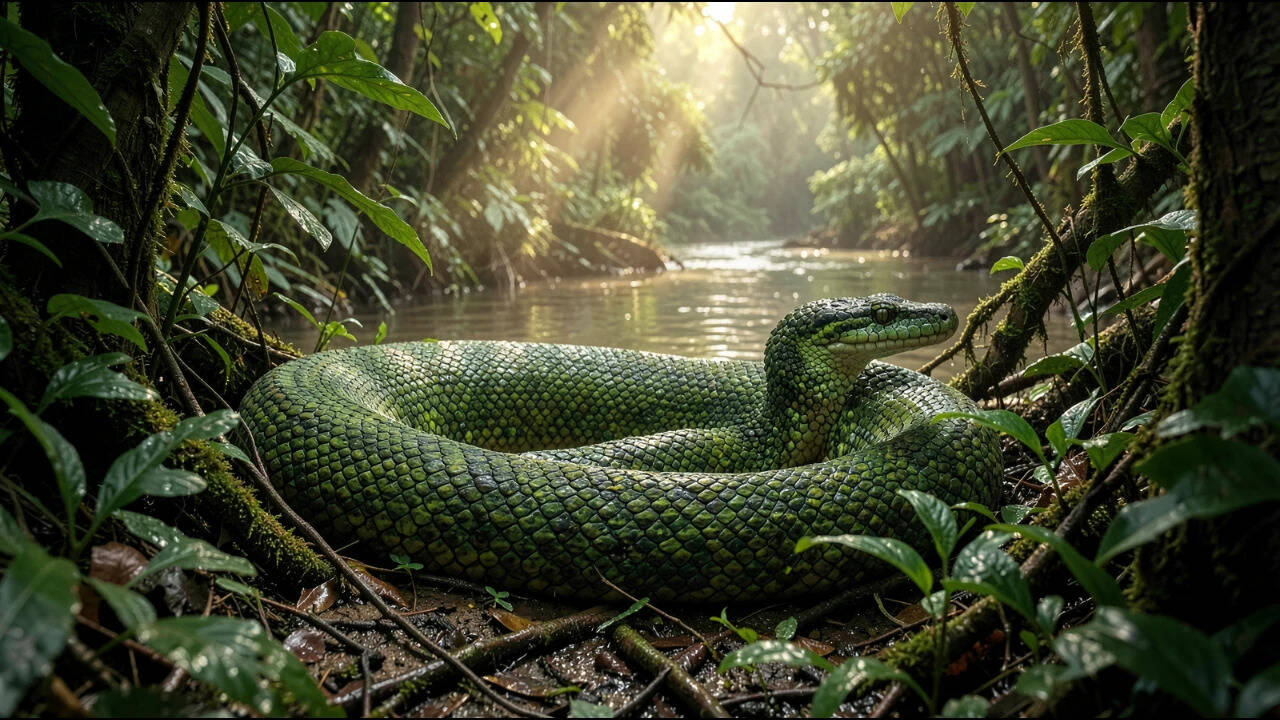
Silence. That is the first thing you notice when the outboard motor dies in a flooded Amazonian backwater, leaving only the heavy, rhythmic slap of tea-colored water against aluminum and the distant, metallic rasp of cicadas.
You hold a directional antenna up toward the dripping canopy. You turn the receiver dial. Click. Static. Another click. Then, out of the humid air, a faint, steady beep... beep... beep.
A green anaconda is right there. Somewhere inside a ten-meter radius of mud, tangled roots, and floating mururé grass, one of the heaviest snakes on Earth is holding its breath.
And you cannot see it.
In fact, if you are working from standard visual surveys alone, you will miss it more than four times out of five. Research using radio tags has shown that tracked Amazon anacondas were visually spotted at just 17.7% of their tracked locations. Let that number sit in the hot, thick air for a second. Seventeen point seven percent. More than eighty-two percent of the time when researchers knew—via an electronic pulse—that an anaconda was present at a given spot, the snake remained completely invisible to human eyes.
I have stood in boats where seasoned river guides, men who can read a ripple on a five-mile-wide channel the way a city driver reads brake lights, squinted into shallow lagoons and saw nothing but logs and shadows. When you spend enough days with wet boots, mosquito bites that swell like quarters, and receiver headphones pressing against sweaty ears, you start to feel a humbling kind of doubt. Why do we assume that if we do not see a creature, it isn't there? Or worse, that it isn't in trouble?
To understand what that 17.7% sighting rate really means, we have to stop treating a radio ping like a dot on a map and start treating it like a confession.
The Myth of the Visible Giant
Popular culture has done green anacondas a strange disservice. We picture them as monstrous, thrashing coils dominating every riverbank, easy to spot, easy to count, almost theatrical in their scale.
Reality is quieter. Slower. Mudkier.
Imagine a hypothetical field researcher—let us call her Camila—spending three weeks along a slow-moving tributary in the upper Amazon basin. (This character is a composite stand-in for the real biologists and local boatmen who spend months logging telemetry coordinates in brutal heat.) Camila has implanted or attached radio transmitters to a small group of green anacondas, Eunectes murinus, and she paddles out at dawn with a receiver and a waterproof notebook.
Day after day, the antenna points straight toward a clump of dense aquatic weeds or a sunken root mass. The signal is strong. The snake is home. Camila leans over the gunwale, shades her eyes against the glare off the black water, and scans the surface. Nothing. She nudges the bow closer, careful not to spook the water. Still nothing. A dark curve beneath the silt might be a branch. A patch of olive skin might be algae-coated bark.
When she finally catches a glimpse—a pair of nostrils breaking the surface for air, or a thick, muscular flank half-buried in leaf litter—it feels almost like a trick of the light. Most of the time, the forest keeps its own counsel.
Here is why that matters far beyond Camila's notebook: wildlife management and conservation rely heavily on counts. If scientists estimate population sizes or habitat use solely by how often animals are seen during boat or foot surveys, elusive species get systematically undercounted—or misread entirely. A 17.7% visual detection rate at known tracked locations is a sobering reminder of how easily a giant can hide in plain sight.
If a creature is there 100% of the time a radio tag says so, and visible to us less than a fifth of the time, our eyes are terrible witnesses.
Think of it like trying to map the floor plan of a dark house by shining a narrow flashlight through a keyhole once a week. You might catch the corner of a table or the edge of a rug, and you might swear the room is empty on the days you see nothing. The furniture hasn't moved. Your vantage point is just limited.
Why Anacondas Vanish in Plain Sight
Camouflage is an art form in the Amazon, and green anacondas are masters of negative space.
Unlike a bright macaw flashing crimson and blue across a clearing, an adult green anaconda blends into the exact palette of its surroundings: olive-green scales, dark oval blotches, wet mud, decaying leaves, and dappled sunlight filtering through broadleaf trees. In water stained dark with tannins—often called "black water" because it looks like strong coffee or ink from above—an anaconda's body becomes a shadow inside a shadow.
Then there is behavior. Anacondas are ambush predators, not marathon runners. Burning frantic energy in open water makes little sense when you can wait patiently where prey comes to drink or cross. After a large meal—such as a capybara, caiman, or large fish—a snake can digest for weeks, lying low, conserving energy, staying out of reach of threats and out of the glaring sun that might overheat it.
Water depth and vegetation add another layer of concealment. A snake resting on the bottom of a shallow channel or coiled beneath floating mats of vegetation is shielded from both casual passersby and aerial or boat-based spotters. Even when a researcher knows the exact coordinate from a telemetry reading, the physical world between boat and snake is three-dimensional, cluttered, and opaque.
But the real problem lies elsewhere.
Visibility is not the same thing as safety. Because green anacondas are hard to spot, it is tempting to assume they are untouchable—too big, too secretive, too well-adapted to be pushed around by human footprints. Yet secrecy does not make an animal immune to habitat fragmentation, warming waters, boat traffic, or illegal capture. In fact, invisibility can cut both ways: when people rarely see a large predator in a stretch of river, they may underestimate how heavily that stretch is used for resting, thermoregulation, or hunting.
Listening to the Invisible World
If visual surveys catch only 17.7% of tracked locations, what do radio tags give us that binoculars never could?
Continuity.
When an animal wears a transmitter, the story stops being a handful of accidental snapshots and becomes a timeline. A researcher can trace whether an anaconda stays put in a backwater lagoon during the dry months or shifts as water levels rise and fall. They can see patterns that never appear during a quick morning patrol.
In my own time out on humid waterways—not just in the Amazon, but in other riverine environments where wildlife moves ghost-like through reeds and murk—the biggest shift is psychological. You stop expecting the wild to perform for you. You learn patience that borders on stillness. You realize that the most important ecological events often happen out of sight, under lily pads, inside hollow banks, or beneath six inches of dark water.
Consider what happens next when a conservation planner looks at two river segments:
- Segment A has frequent sightings along a visible bank, drawing attention and funding.
- Segment B has almost no casual sightings, yet radio telemetry shows animals quietly using its dense cover day after day.
Without telemetry data, Segment B might look like dead water. With it, you see a refuge.
Still, I want to be honest about the limits here. Radio telemetry is powerful, not magical. Tags have limited battery life, signals can bounce or weaken in dense terrain or deep water, and tagging a small sample of animals does not tell you every detail about an entire basin. Science is often messy, incremental, and uncertain—and admitting that uncertainty makes the findings more trustworthy, not less. We do not have all the answers about how green anacondas use every corner of the Amazon, and anyone claiming total certainty is overstating the case.
The Human Stakes Behind Every Beep
Why should someone sitting thousands of miles away—perhaps planning a trip to South America, reading natural history on a quiet evening, or wondering why obscure ecological statistics make headlines—care about how often a giant snake goes unseen?
Because the Amazon is not a museum diorama. It is a living web where top predators and large reptiles sit inside broader ecosystems shaped by rainfall, forest cover, river connectivity, and human livelihoods.
When we hear a statistic like 17.7%, it can sound clinical, almost like a trivia answer at a pub quiz. Strip away the decimal point and it becomes a mirror held up to human perception. We are visual creatures. We trust what we can point at and photograph. When something stays hidden 82.3% of the time in tracked locations, our instinct is to shrink its importance down to the moments we happen to catch.
Nature does not run on our attention span.
For travelers who visit the Amazon hoping to glimpse iconic wildlife, that low sighting rate is also a grounding reality check. A good guide does not promise guaranteed sightings of rare, cryptic animals; they help you read the signs—tracks, scales, ripples, silence—and appreciate that an ecosystem can be teeming with life even when the star attractions stay tucked away.
And for anyone who cares about how we make decisions in the real world, the lesson is sharper still: what we fail to see is often what we fail to protect.
Out on the water, the sun drops low, turning the sky bruised purple and copper. Another beep comes through the receiver, steady and unhurried, from somewhere inside the dark green wall of reeds. No thrashing. No drama. Just weight, stillness, and a signal pulsing through the dusk.
You lower the antenna, start the motor softly, and leave the snake to the dark.