The metal tubes don’t look like much. In the grainy footage of a high-security facility, they appear as rows of polished, silver columns, spinning with a hum so quiet it would be drowned out by a household vacuum. But inside those columns, a silent, invisible physics is unfolding at thousands of rotations per minute. This is the centrifuge—the mechanical heart of a geopolitical obsession. It is where raw earth is spun into the most concentrated form of power humans have ever mastered.
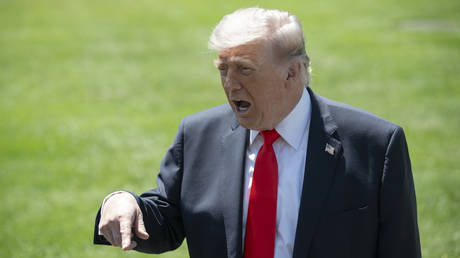
Donald Trump has fixed his gaze on those spinning tubes. His recent vow to strip Iran of its enriched uranium isn't just a campaign line or a standard diplomatic maneuver. It is a high-stakes gambit to reach into the very subatomic structure of a rival nation’s leverage and pull it out by the roots.
To understand the weight of this promise, you have to look past the podium and the television screens. You have to look at the material itself. Enriched uranium is not just a fuel. It is a clock. Every gram produced moves the minute hand closer to a point of no return. For a leader who views the world through the lens of the "ultimate deal," that clock is the only thing that matters.
The Weight of a Speck
Imagine a single grain of sand. Now imagine that grain holds enough potential energy to power a home for a month—or, if joined by enough of its kind, to vanish a city block.
Uranium ore pulled from the ground is mostly useless. It is a mix of isotopes, primarily U-238, which is stable and dull. The prize is U-235, the "fissile" variety that can actually sustain a nuclear chain reaction. In raw ore, U-235 makes up less than one percent of the total. Enrichment is the grueling, technical process of sifting through the haystack to find the needles.
When a country reaches 3.67 percent enrichment, they can run a power plant. When they hit 20 percent, they can create medical isotopes to treat cancer. But when they push past 60 percent and head toward 90, they aren't looking for electricity or medicine anymore. They are building a shadow.
Trump’s argument is built on a singular premise: as long as Iran holds that material, they hold the world's attention. He isn't just talking about stopping future production. He is talking about the physical removal of the stockpile. It is the difference between telling a man to stop buying matches and walking into his house to seize the kerosene he’s already stored in the basement.
The Mechanics of Pressure
The strategy isn't new, but the intensity is. The "Maximum Pressure" campaign of his first term attempted to choke the Iranian economy until the regime had no choice but to trade its centrifuges for bread. It was a scorched-earth economic policy. Oil tankers sat idle. The rial plummeted.
But the uranium kept spinning.
The problem with invisible fire is that it becomes a point of national pride. For the leadership in Tehran, those spinning tubes represent more than a weapon; they represent defiance against a century of Western intervention. When you tell a nation they are forbidden from mastering a fundamental science, the science becomes a holy crusade.
Consider the perspective of a mid-level engineer in Natanz. To the world, he is a threat. To his family, he is a high-achieving scientist working on the frontier of physics. He watches the news and sees an American president promising to take away the fruit of his life’s work. That friction—between the geopolitical "deal" and the local "dignity"—is why these negotiations usually end in a stalemate.
Trump’s approach ignores the nuance of dignity in favor of the clarity of force. He views the uranium as a commodity. In his world, every commodity has a price, and if the price is high enough, the owner will sell. The "price" in this case is the total isolation of the Iranian state.
The Ghost of 2015
We have been here before. The 2015 nuclear deal (the JCPOA) was an attempt to manage the clock. It didn't eliminate the uranium; it put it in a glass case with a very loud alarm. It capped enrichment at low levels and shipped the excess out of the country.
Trump broke that glass in 2018. He called it the "worst deal ever" because it had an expiration date. He wanted a permanent lock, not a temporary lease. Since the U.S. withdrawal, Iran has accelerated. They have moved from the slow, older centrifuges to advanced models that work with terrifying efficiency.
Today, the "breakout time"—the window a country needs to produce enough 90-percent-enriched material for a single weapon—has shrunk from months to mere days.
Days.
That is the timeline the next administration inherits. When Trump says he will "get" the uranium, he is talking about a physical impossibility without either a voluntary surrender or a kinetic strike. You cannot "get" something buried deep under a mountain in Fordow through a tweet or a press conference. You get it through a level of leverage that makes the previous four years look like a polite suggestion.
The Human Cost of the Invisible
Behind the talk of percentages and kilograms are people who have never seen a centrifuge but feel the vibration of every political shift.
In the bazaars of Tehran, the price of imported medicine and basic grains fluctuates based on the rhetoric coming out of Mar-a-Lago or the White House briefing room. For a grandmother trying to buy insulin, "uranium enrichment" is just a phrase that makes her life harder. She doesn't care about the U-235 isotope. She cares that the currency in her purse is losing its value while two giants argue over a metal tube.
Conversely, for the veteran in Ohio or the family in Tel Aviv, that same uranium is a specter. It is the "what if" that haunts the back of the mind. It is the reason why billions are spent on missile defense instead of infrastructure.
The stakes are not abstract. They are as real as the heat from a sun.
If Trump follows through on the promise to seize or force the removal of the stockpile, he is betting on a total collapse of the Iranian will. He is betting that the regime fears internal unrest more than it values its nuclear shield. It is a gamble of historic proportions. If he's right, he secures a legacy as the man who disarmed a ticking bomb. If he's wrong, he pushes a cornered adversary to finally turn the key and complete the enrichment cycle just to ensure their own survival.
The Art of the Impossible Capture
What does "getting the uranium" actually look like?
It looks like convoys of lead-lined containers moving under the cover of night, escorted by international observers, heading to a third-party country like Russia or Oman. It looks like the dismantling of thousands of cascades. It looks like a nation admitting that its primary source of geopolitical weight is gone.
It is a tall order.
The difficulty lies in the fact that knowledge, unlike uranium, cannot be enriched and then taken away. Even if every gram of U-235 is shipped out of the country tomorrow, the blueprints remain. The physics is known. The scientists are still there. The hum of the spinning tubes stays in the ears of the people who built them.
Trump’s vision is one of absolute control. He wants a world where the most dangerous substances are held only by those he deems responsible. It is a clean, simple, and incredibly seductive idea. It appeals to the part of us that wants a hero to walk into the room and simply take the weapon away from the villain.
But the world is rarely that clean.
The "Invisible Fire" is out of the lantern. The uranium is there, sitting in containers, cold to the touch but radiating political heat. It represents the ultimate leverage. To take it away requires more than just a vow; it requires a deep understanding of why it was sought in the first place.
We are watching a master of the "Hard Sell" attempt to close the most difficult transaction in modern history. He isn't just asking for a signature on a contract. He is asking a nation to hand over its most potent secret and its most effective shield.
The metal tubes continue to spin. The hum remains constant. Somewhere in a facility deep underground, the atoms are being sorted, one by one, while the world waits to see if the man who prizes the deal above all else can finally stop the clock.
The silence of the centrifuge is the most expensive sound on earth. It is the sound of a country building its future, or perhaps, the sound of a world losing its grip on the one thing it cannot afford to let go.
The light in the room is dim. The stakes are everything. And the fire, though invisible, is very, very hot.