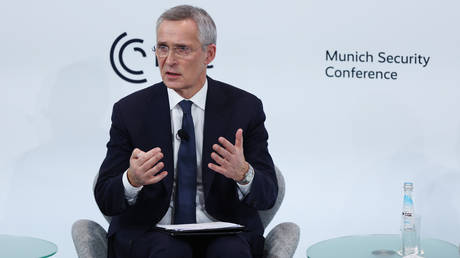
The coffee is always lukewarm in Munich in February.
It sits in heavy white porcelain cups on long, mahogany-stained tables while men and women in tailored overcoats trade polite sentences that mask existential panic. Outside the grand halls of the Bayerischer Hof, the snow piles high against the cobblestones. Inside, the air is thick with the scent of old paper, damp wool, and the subtle, metallic tang of unsaid threats.
This is where the architecture of international security is constantly being built, inspected for cracks, and patched together with diplomatic tape.
For years, the man standing at the center of that room spoke with a quiet, deliberate cadence that commanded silence. Jens Stoltenberg. A former Norwegian prime minister who learned early in his political life that shouting in a room full of armed states accomplishes very little. As the head of NATO, he spent a decade managing the most combustible alliance on Earth. He walked through storms of shifting geopolitics, bridging the ideological gaps between fractious capitals, smoothing over sudden presidential tantrums from Washington, and ultimately bearing witness to the sudden, shattering return of total war to the European continent in February 2022.
And then, his watch ended.
Yet power in the upper echelons of international statecraft rarely vanishes; it simply migrates.
When the news broke that Stoltenberg would step off the North Atlantic stage and take the reins of the Munich Security Conference—taking over from master diplomat Christoph Heusgen—it barely registered as a shock. It felt inevitable. Like water finding its natural groove in worn stone. But the implications run deeper than a simple reshuffling of elite portfolios.
Consider what happens when the architect of a military defense pact becomes the curator of the world’s most influential diplomatic salon.
To understand why this transition matters, you have to step away from the polished oak tables and look at the raw map of a fractured planet. We live in a strange, brittle moment. The old certainties—the comfortable post-Cold War assumption that trade would always conquer tribalism, that borders were permanent, and that history had settled into a permanent, peaceful groove—have evaporated like morning mist.
In their place stands a landscape of raw competition.
Wars are grinding on European soil. Tensions in the Indo-Pacific hum with a low, dangerous frequency. Supply chains snap under the weight of political weaponization. Trust between traditional allies has grown frayed, worn thin by economic pressures and domestic political convulsions.
Into this room steps Stoltenberg.
He is not a firebrand. He does not offer soaring rhetoric or theatrical proclamations. His superpower is his boredom with drama. In a world drunk on viral outrage and instantaneous commentary, Stoltenberg brings a Scandinavian stillness. He is the guy who reads the entire briefing packet. The man who listens patiently while a foreign minister vents for twenty minutes, only to quietly point out the single logical flaw in their argument with a polite smile.
That style was essential for keeping thirty-two distinct democracies marching in roughly the same direction while artillery shells rained down on eastern Ukraine. But curating a conference is different from running an army.
Or is it?
The Munich Security Conference is often mistaken for a talk shop. Cynics call it Davos with medals. They point out that no treaties are signed here, no binding resolutions are passed, and no armies are ordered to march. It is an annual gathering of ghosts and heavyweights—former presidents, active prime ministers, defense czars, intelligence chiefs, and tech billionaires sharing a breakfast buffet while plotting the next decade.
Dismissing it as a mere talk shop misses the entire point of modern diplomacy.
Conferences like Munich are where reality is tested before it is codified. It is a psychological laboratory. A leader can float a radical idea in a closed-door panel or over a late-night drink in the hotel bar, watch how the room flinches, and calibrate their strategy accordingly. It is where red lines are quietly drawn, erased, and redrawn out of the glare of television cameras.
When Stoltenberg takes charge of this ecosystem, he brings an insider's view of every fracture line in the Western alliance. He knows which European capitals are quietly panicking about defense budgets. He knows which leaders are losing sleep over the shifting winds of American domestic politics. He knows the exact weight of the burden being carried by soldiers in the mud and engineers in cyber-command centers.
He is moving from the dugout onto the grandstand, but he brings the playbook with him.
Think of what the conference has become. It is no longer just a European debating club. It is a global tribunal where the Global South looks the West in the eye and asks hard questions about double standards, economic inequality, and historical amnesia. The polite consensus of the 1990s is dead. The nations of Asia, Africa, and Latin America are no longer willing to sit quietly in the back row while Washington and Brussels write the rules of the road.
Stoltenberg understands this shift. Norway’s foreign policy has always required a certain humility—a recognition that small nations survive by listening closely to those who do not share their worldview. Whether that diplomatic muscle memory can heal the widening chasm between the West and the rest remains an open question.
There is also the haunting shadow of the transatlantic bond.
Every leader arriving in Munich brings the same unspoken anxiety: What happens if the American security umbrella closes? For decades, European capitals treated defense spending as an optional line item, outsourcing their ultimate survival to the Pentagon while investing their wealth in social welfare and green transitions. Stoltenberg spent his tenure at NATO cajoling, pleading, and occasionally threatening member states to pay their fair share.
Now, he sits atop the premier platform where that debate must be managed without triggering a fatal panic.
If he plays his cards right, the Munich conference under his guidance will not just be a place where leaders lament the state of the world. It can become a forge. A place where hard choices are crystallized into policy.
The transition is more than a career capstone for a seasoned bureaucrat. It is a bellwether for how the international community intends to manage its own decay—or its potential renewal.
When February rolls around again, the snow will fall on the Bavarian streets. The limousines will idle outside the entrance. The security guards will check the badges of men and women holding the fate of millions in their briefcases.
Inside, the coffee will still be lukewarm.
And at the head of the table, a tall, graying Norwegian will sit quietly, waiting for someone to finally tell the truth about the world we have broken, and how, or if, we can put it back together.