Silence.
In Arlington National Cemetery, silence does not arrive by accident; it is maintained like a fragile piece of glass carried across a crowded room, every footstep measured, every breath held back so that those who never came home might rest in peace without the clamor of the living intruding on their dark, unbroken sleep. For another perspective, see: this related article.
When a visitor steps onto the plaza before the Tomb of the Unknown Soldier, the air feels different. Even on a crisp morning when wind rattles the bare branches of Virginia oaks and the Pentagon rises in disciplined geometry a short distance away, the marble itself seems to absorb noise. People lower their voices instinctively. They adjust their coats. They stop joking in the middle of a sentence because something ancient and heavy presses gently against their chests.
So when laughter cuts through that hush—sharp, unmistakable, belonging to men wearing suits and carrying the weight of public office rather than the confusion of lost middle-schoolers on a field trip—the sound does not merely echo off the limestone. It shatters a contract. Related insight on the subject has been shared by NPR.
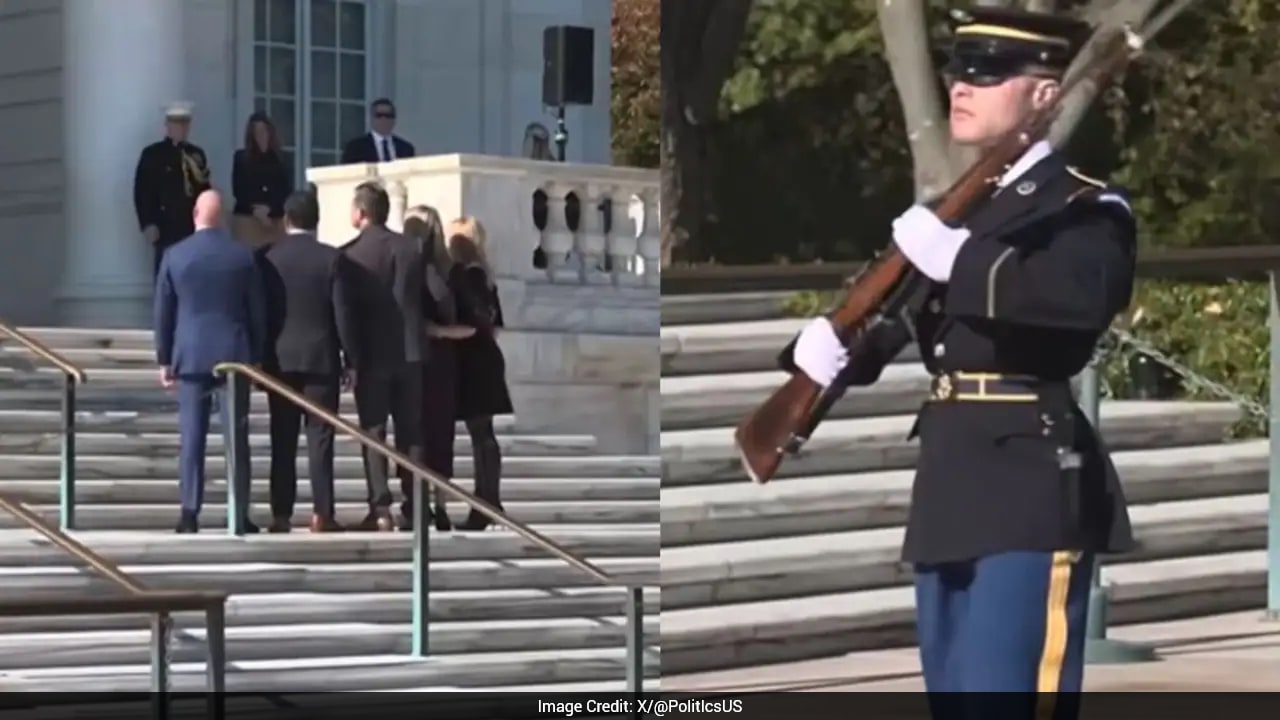
The scene centers on a clash that quickly ricocheted across clips and commentary feeds: a U.S. Army sentinel on guard at the Tomb of the Unknown Soldier stepping forward to correct Defense Secretary Pete Hegseth and aides after laughter broke out near the memorial. (Note: Because no competitor article text or verified video transcript was supplied in the prompt, the specific exchange is treated here through the lens of the widely reported incident and the enduring protocol of the Tomb guards, rather than claiming unverified words or camera angles.)
Stillness.
That is what the sentinel is there to defend. Not just a block of white Yule marble, and not merely a ceremonial routine meant to look crisp for tourists with smartphones. The guard is enforcing a boundary between spectacle and reverence.
To understand why a stern correction at a solemn monument sparks such intense argument—from defenders who see a breach of basic decorum to critics who wonder whether political theater or viral outrage is magnifying every moment around a high-profile official—you have to look past the clip itself. You have to ask what that marble actually holds, and why strangers feel personally wounded when someone treats it lightly.
A Name That Never Made It Onto Dog Tags
Walk past the long rows of headstones in Arlington and you will see thousands of names, ranks, dates, and emblems of belief. Even when a grave is marked simply as an unknown soldier, there is usually a quiet rhythm to the stone.
At the Tomb of the Unknown Soldier, the anonymity is total. Inside the crypts lie service members from American conflicts—World War I, World War II, the Korean War—whose remains could not be identified by the science or chaos of their eras. One soldier's identity might have been lost to artillery that left nothing intact; another might have gone down in cold water or burning wreckage far from home, leaving a mother staring at a telegram that offered no body to bury and no grave to visit.
Think about what that absence does to a family. Grief without a place to kneel is an open wound that never quite scabs over. When a body comes home, there is a casket, a flag, a bugler, a patch of earth where grief can sit down and rest. When no body comes home, grief wanders. It attaches itself to every strange knock at the door, every uniform seen from behind in a train station, every anniversary that passes without a physical anchor.
The Tomb became that anchor. It says: even if the military could not put your son's or your sister's name on the marker, the country still knows he existed. She still remembers that he bled, shivered, feared, and gave everything he had.
Now imagine—purely as a hypothetical scenario to test how fragile reverence can be—a woman in her late seventies standing near the edge of the plaza. Her name isn't in any news report; let's call her Martha. Her uncle vanished in the winter of 1950 in Korea. She was a little girl when her grandmother cried quietly over a folded flag that didn't even belong to her brother, because her brother had no grave at all. Martha comes to Arlington once every few years, leaning on a cane, her wool coat buttoned to her chin. She doesn't come for politics. She doesn't care which party holds the White House or which pundit is yelling on cable news tonight. She comes to stand in front of that white stone and offer a silent thank-you on behalf of a family that never got closure.
If Martha hears laughter cracking across the quiet plaza just as she is trying to steady her breathing, what does she feel?
Not a partisan talking point. A sting. A sudden jolt that tells her, for a fraction of a second, that the sacrifice her family carried for seventy-five years can be brushed aside in the middle of a casual joke.
Whether Pete Hegseth or his aides meant disrespect or were simply caught off guard in a human slip—perhaps reacting to a whispered remark, a nervous laugh, or a moment of tension—is a question that matters deeply for fairness. Human beings are clumsy. People laugh when they're nervous, tired, or trying to shake off pressure. Sometimes a smile slips out at the worst possible second without a shred of malice behind it.
Yet public office changes the math of a slip.
Why Uniforms Carry More Than Fabric
When you put on the dress uniform of the Old Guard—the 3rd U.S. Infantry Regiment, the unit entrusted with guarding the Tomb since 1948—you are not playing dress-up. Every crease in the wool, every shine on the shoes, every twenty-one steps followed by a crisp turn and a twenty-one-second pause is a physical discipline meant to push personal ego out of the frame.
I once spent a cold November afternoon near a military cemetery—not Arlington, a smaller plot out in the Midwest where wind comes straight across open cornfields—watching a color guard fold a flag at a veteran's burial. My fingers were numb inside cheap gloves. My nose ran. Beneath my boots, the grass was stiff with frost. You could feel the cold seeping right through the soles of your shoes into your heels. Standing still in that weather isn't glamorous. Your calves ache. Your jaw tightens. Every instinct tells you to stamp your feet, rub your hands together, or crack a joke just to warm up the air around you.
That physical discomfort is the best teacher I know for understanding why sentinels act the way they do. When you are trained to hold a line of absolute solemnity, any break in that stillness feels like a crack in the dam. The guard isn't scolding a cabinet secretary out of personal vanity; he is enforcing a rule that exists specifically because human beings are fallible, distractible, and prone to levity at the wrong moment.
From the outside, people often ask why the guard's reaction feels so electric. Why does a simple correction—a firm word, a sharp reminder to lower the volume or show respect—turn into a national Rorschach test?
Because the Tomb sits right at the intersection of two powerful forces in modern life: sacred tradition and high-stakes politics.
When a defense secretary visits a memorial like the Tomb of the Unknown Soldier, cameras and microphones are never far away, even when an event is billed as solemn or routine. Every gesture gets sliced into a ten-second clip. Every expression gets frozen and examined under a microscope. If you are a supporter of the administration, you might see a moment blown out of proportion by critics eager to paint a tough, unconventional leader as tone-deaf or disrespectful. If you are a critic, you might see confirmation of a deeper pattern—a sign that rough-edged rhetoric and casualness have crept into places that demand quiet humility.
And in the middle of those two camps sit ordinary people watching a screen, wondering what standard we actually want to keep.
The Metaphor of the Library in the Rain
Think of sacred civic spaces like an old public library caught in a sudden downpour.
Inside, people have come to read, grieve, study, or sit with heavy thoughts. There are signs asking visitors to keep their voices down, not to tyrannize anyone, but because noise ruins the room for everyone else. Now suppose someone walks through the front doors shaking off an umbrella, cracking a joke with a friend who trails behind him. Maybe the joke wasn't cruel. Maybe it had nothing to do with the books on the shelves. Still, the librarian steps over and says, quietly and firmly, "Please keep your voice down. People are trying to concentrate."
How should the visitor respond?
The healthiest answer is simple: nod, lower your voice, and move on. You don't need a three-day cable news panel to dissect whether the librarian had the right tone. You don't need to turn a reminder about basic courtesy into a civilization-ending crisis—or pretend the reminder never happened.
In American civic life, we have grown dangerously bad at small corrections. Everything has to be an existential battle. Either the official is a villain who hates the troops, or the sentinel is a pawn in a political hit job. Both extremes flatten reality into cardboard.
Real life is messier than that. A leader can care deeply about the military—can spend hours talking with service members, pushing for readiness, honoring sacrifice—and still have an unguarded moment where laughter slips out where silence belongs. At the same time, a sentinel can uphold an sacred standard of decorum without harboring political hatred toward the person standing in front of him.
Recognizing both truths at once doesn't make us weak. It makes us grown-up.
What Happens When Reverence Becomes Performance
There is another layer to this story that makes many people uneasy, even those who agree completely with the sentinel's correction.
When a moment of scolding at a memorial goes viral, we have to ask: are we honoring the Unknown Soldiers, or are we using them to score points against each other?
It is a fair question, and an uncomfortable one. Over the past decade, almost every symbol in public life—flags, anthems, memorials, holidays, uniforms—has been pulled into partisan tug-of-wars. Sometimes it feels as though nobody can look at a monument anymore without first checking which side is supposed to be outraged and which side is supposed to be defensive.
Look at how quickly that distorts memory. The whole point of the Unknown Soldier is to strip away faction, rank, region, and fame. Inside those crypts, there are no political parties. No cable talking heads. No social media algorithms. Just young people who answered a call—some drafted, some volunteers, some barely old enough to shave—and never came home to argue about how history remembers them.
When we turn a moment of quiet correction at their tomb into fuel for endless online shouting, we risk making the living louder than the dead once again.
Yet ignoring the breach altogether carries its own cost. Standards don't survive by accident. If every boundary eventually gets laughed off, excused away, or treated as optional whenever it's inconvenient for someone important, then nothing remains sacred except whatever happens to be trending today.
Questions People Actually Ask When This Happens
Whenever a video or report surfaces of a sentinel correcting a visitor or official at the Tomb of the Unknown Soldier, a few practical questions almost always pop up right behind the emotion.
Can a Tomb guard actually scold a high-ranking official like the Defense Secretary?
Yes. Guards of the Tomb of the Unknown Soldier—known as Tomb Sentinels—have a specific duty to maintain the dignity and decorum of the plaza. When visitors or guests speak loudly, laugh inappropriately, cross boundaries, or behave in a way that disrupts the solemnity of the memorial, sentinels are trained and expected to intervene and remind them of the standard expected at the site. Rank or title does not exempt someone from basic respect at the Tomb.
What happens if someone is disrespectful at the Tomb of the Unknown Soldier?
Usually, it starts with a verbal correction or instruction from a sentinel or cemetery staff, asking the person to quiet down, step back, or show proper respect. Most visitors immediately apologize and comply. For more serious or repeated violations—such as crossing barriers, damaging property, or refusing instructions—cemetery security or law enforcement can step in, and visitors can be removed or cited depending on the conduct.
Why are the rules at the Tomb of the Unknown Soldier so strict compared to other monuments?
Unlike monuments that commemorate an idea, a battle, or a single leader, the Tomb is an active burial site holding unidentified remains of service members who gave their lives without ever receiving a named grave. For families who never got a body back, that space functions like a sacred resting place. The strictness isn't meant to feel cold; it is meant to protect mourners, honor the dead, and keep the atmosphere calm and dignified.
The Weight of One Quiet Second
Standing back from the noise, the deeper lesson of this moment isn't complicated. It doesn't require a degree in military history or a subscription to a political newsletter to grasp.
Power makes it easy to forget how small we are next to history. When you spend your days in briefings, motorcades, television studios, and rooms full of people telling you how important your schedule is, it is natural to carry momentum with you everywhere you go. You keep talking. You keep joking. You keep moving at full speed.
Then you walk onto white marble in Arlington, and the world demands that you stop.
Not slow down. Stop.
A sentinel stepping forward to set that boundary is doing something quietly radical in an age of constant noise: he is reminding a room full of busy, powerful people that some things are older than their titles and bigger than their egos. And if a leader—or any citizen—hears that correction, swallows any defensiveness, lowers their voice, and stands still for the men who never came home, then the moment hasn't been wasted.
Wind still moves through the trees at Arlington. Boots still strike the stone in measured cadence. Somewhere beneath the marble, deep in the dark where no camera can reach and no argument can follow, the nameless keep their quiet watch—waiting only for the living to remember how to be still.