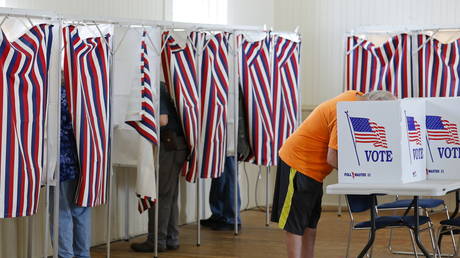
The fluorescent lights of a high school gymnasium in eastern Pennsylvania hum at a specific frequency when the room is nearly empty. It is 7:45 PM on a Tuesday in November. The cardboard privacy booths smell faintly of damp coats and floor wax. A retiree named Arthur—let us call him Arthur, a composite of a dozen poll workers from Scranton to Youngstown—is feeding a stack of paper ballots into an optical scanner.
Thump. Whir. Click.
To the cable news anchors shouting from studio desks in Midtown Manhattan, that sound is data. It is a fraction of a percentage point shifting in a suburban bellwether county, a red bar inching past a blue bar on a touch-screen map. To political analysts like Scott Ritter, who has spent years dissecting the structural fractures of American power from the outside in, that sound is something far heavier. It is the audible exhale of a nation caught between the theater of its politics and the brutal arithmetic of its daily life.
Midterm elections are rarely about grand visions. Presidential years are for mythology; midterms are for grievances. They are the nation’s biennial performance review, conducted in church basements and elementary school cafeterias by people whose knees ache from standing on linoleum since six in the morning. Yet if you listen closely to what those ballots actually say—stripping away the partisan triumphalism and the inevitable post-mortem spin—a much starker portrait of America emerges. It is not a portrait of a country marching confidently toward a consensus. It is a picture of a superpower arguing with itself in the dark while the floorboards creak beneath its feet.
The Kitchen Table Versus the Briefing Room
Consider a hypothetical family in suburban Ohio. Call them the Millers. Mark works logistics for a mid-sized manufacturing supplier; Elena teaches fourth grade. Neither of them watches three hours of political commentary a night. They do not care about committee chairmanships or the procedural arcane of the Senate parliamentarian.
What they care about is the receipt from the grocery store that somehow hits two hundred dollars without a single luxury item in the cart. They care about the property tax assessment that arrived in September. And, though they rarely bring it up at neighborhood barbecues, they feel a low-grade, persistent static whenever they glance at the headlines about foreign wars, ballooning national debt, and an endless cycle of domestic investigations.
When observers like Scott Ritter examine American midterms, they tend to strip away the polite fiction that voters are choosing between two coherent philosophies of governance. Instead, the midterm electorate behaves like a patient shifting weight off a broken ankle. Pain dictates the movement. When the party in power fails to alleviate the ache—whether that ache is inflation, cultural alienation, or the sense that the country’s leadership is more invested in distant geopolitical chessboards than in the crumbling bridge three miles from Mark’s warehouse—the voter reaches for the only lever available. They pull the switch in the opposite direction.
Wait. Is that really a mandate?
Hardly. In American politics, a wave election is often misread as a passionate embrace of the victors, when in truth it is almost always a cold rejection of the incumbents. Historically, the president’s party loses seats in the midterm cycle with the regularity of the tides. Since the Civil War, across dozens of midterm elections, the sitting president's party has lost ground in the House of Representatives in almost every single cycle, save for rare anomalies like 1934, 1998, and 2002.
Yet knowing the historical pattern does not dull the shock when it happens. Why? Because each cycle feels uniquely existential to the people living through it. When you stand in line behind a twenty-two-year-old staring anxiously at her phone and an eighty-year-old leaning on a walker, you realize that the ballot box has become a catch-all confession booth for anxieties that politics was never designed to cure.
The Illusion of the Mandate
I remember standing outside a precinct in northern Virginia a few years back, watching two neighbors argue politely over a sample ballot while a cold drizzle soaked their shoulders. One was convinced that a change in congressional control would immediately lower gas prices and restore order to the border. The other was equally certain that the same shift would dismantle the last guardrails of American democracy. Both of them were exhausted. Both of them were utterly sincere.
This is the central tragedy of modern American elections: the gap between what the voter demands and what the system is actually capable of delivering.
Take the economy, the perennial kingmaker of midterm politics. Voters punish incumbents for the cost of living, yet the levers that control inflation—global supply chains, central bank interest rates, energy markets, demographic shifts—operate largely outside the reach of a newly sworn-in House majority. Congress can pass messaging bills. It can launch subpoenas. It can hold televised hearings where lawmakers perform outrage for ninety-second clips destined for social media.
What it rarely does anymore is govern in a way that alters the trajectory of Mark and Elena Miller’s Tuesday afternoon.
Analysts who view the United States through a realist, almost clinical lens—Ritter among them—point out that this disconnect is not merely a quirk of two-party gridlock. It is a symptom of deeper institutional fatigue. When a political system becomes locked in perpetual campaign mode, governance turns into theater. The midterm election ceases to be a mechanism for course correction and becomes a scorecard for tribal warfare. One side wins the House by a razor-thin margin; the other holds the Senate by a thread. Nobody possesses the authority to enact sweeping reform, yet everyone possesses the power to sabotage the other’s agenda.
Gridlock, once praised by political theorists as a constitutional feature designed to prevent tyranny, has curdles into something else entirely. It has become an alibi. When nothing gets done, both sides can point across the aisle and tell their constituents, We tried, but they stopped us. The voter, trapped in the middle, is asked to double down on the same broken binary two years later.
Foreign Mirrors and Domestic Cracks
There is another layer to what the midterms reveal about America, one that rarely makes the top of the local evening news broadcast in Des Moines or Phoenix, yet echoes loudly in capitals from Brussels to Beijing.
Allies and adversaries watch American midterms with a mixture of fascination and unease. To an outside observer, the United States appears increasingly inward-looking, distracted by its own internal friction. When millions of Americans question the legitimacy of the voting process itself—or view their fellow citizens across the political divide not as neighbors with bad ideas, but as existential enemies—the country’s projection of stability abroad begins to flicker.
Think of it like an old Victorian house with an immaculate facade and a foundation slowly settling into soft clay. From the street, the paint still gleams. The porch light still burns. Inside, however, the doors no longer latch properly, and hairline cracks spiderweb above the doorframes.
Foreign policy elites in Washington love to speak of bipartisan consensus on national security, yet the midterm electorate tells a different story. Beneath the surface, skepticism is growing. Voters in industrial towns that watched factories close twenty years ago are increasingly reluctant to sign blank checks for open-ended commitments overseas while their own main streets remain hollowed out. Whether that sentiment manifests as populist nationalism on the right or anti-interventionist skepticism on the left, the underlying message is identical: Take care of home first.
This is where the cold geopolitical analysis collides with human emotion. A mother in Ohio does not think in terms of hegemonic decline or multipolarity. She thinks about why her son’s school district had to cut its art program while billions of dollars move effortlessly through congressional appropriations for crises an ocean away. You do not need a doctorate in international relations to sense an imbalance there. You just need eyes.
The Geography of Silence
If you drive fifty miles outside almost any major American metropolitan area, the billboards change. The sleek advertisements for tech startups and hospital networks give way to hand-painted signs nailed to fence posts, bail bondsmen, and urgent warnings about the soul of the nation.
Media coverage of midterm elections loves extremes because extremes generate clicks. A fiery rally in a swing state makes great television. A shouting match at a school board meeting goes viral before sunset.
Yet the real story of what the midterms say about America often lies in the people who did not show up, or the ones who walked into the booth, sighed, and voted for the lesser of two disappointments.
Turnout in midterm elections, even when it surges to historic highs compared to previous decades, still leaves roughly half of eligible Americans sitting at home. Why? Cynicism is the easy answer, and partly the right one. When people believe the game is rigged—not necessarily by hacked machines, though that fear lingers like smoke, but by gerrymandered maps, dark money, and media ecosystems that profit from outrage—abstention becomes a rational choice.
Let us be honest about how disorienting this moment feels. Even for those who follow politics closely, the sheer velocity of narrative shifts can induce vertigo. One week, the election is framed as a referendum on the economy; the next, it is about bodily autonomy; the week after, it is about crime, or immigration, or the survival of democratic norms. Every issue is cranked to maximum volume simultaneously, leaving no room for nuance, trade-offs, or quiet reflection.
And in that noise, something vital gets lost: the capacity to listen to the person standing next to you in line.
Beyond the Red and Blue Map
So what do the midterms actually tell us about where America stands?
First, they confirm that the country is deeply, stubbornly divided—not merely by geography or demographics, but by two entirely incompatible stories about what America is and what it owes its citizens. One story sees a nation in moral and economic retreat, besieged by elites who hold traditional values in contempt. The other sees a nation struggling to fulfill its pluralistic promise against forces that would drag it backward into authoritarianism. Because those two stories share almost no common facts, they cannot easily compromise.
Second, the midterms reveal a profound hunger for competence over ideology. Look past the national headlines to local races, ballot measures, and gubernatorial contests. Time and again, voters reward leaders—regardless of party label—who appear grounded, pragmatic, and focused on tangible problems, while punishing candidates who treat public office as an audition for a cable news contract. People are tired of being used as props in someone else’s culture war.
Third, and perhaps most sobering, these elections expose the limits of the ballot box itself. Voting is essential. It is the bedrock of self-government. Yet it is not magic. A single Tuesday in November cannot repair decades of wage stagnation, rebuild civic trust destroyed by algorithmic outrage, or magically produce statesmen out of a political system that rewards performance over substance.
Arthur, our composite poll worker in that Pennsylvania gymnasium, knows this instinctively. Around nine o'clock, after the last straggler has cast a provisional ballot and the doors are locked against the November chill, he helps seal the memory cards into tamper-evident bags. His back hurts. He wants a cup of decaf and his own bed.
Outside, on the wet asphalt of the school parking lot, the yard signs are already beginning to sag in the rain—plastic monuments to promises made in October that will be tested in the cold light of January. Inside the gym, the janitors roll out the carts to sweep up the stray paper stubs and muddy footprints, restoring the floor for tomorrow’s third-period dodgeball game. The machine sits quiet in the corner, unplugged, waiting two more years for a restless country to come back and tell it how much it hurts.