Walk down the Rambla in Montevideo on a Tuesday afternoon, and you will notice two things immediately. The Atlantic wind tastes of salt and cold iron, and the strollers are missing.
You see dogs. You see joggers in neon windbreakers. You see retirees sitting on concrete benches with thermoses of yerba mate tucked neatly under their left arms, their silver bombillas glinting in the low southern sun. What you rarely see is a crowd of toddlers tumbling over the grass.
Uruguay has always been the quiet outlier of South America. It is a nation of roughly three and a half million people wedged between giants, famous for progressive laws, stable democracy, and a secularism so deeply baked into its civic bones that Christmas is officially known on the national calendar as Family Day. For decades, outsiders looked at Uruguay and saw a laboratory of modernity.
Today, demographers look at Uruguay and see a warning flare.
Birth rates in the country have plunged to historic lows, hovering around 1.2 children per woman—well below the 2.1 replacement threshold needed to keep a population from shrinking. At the same time, church pews that began emptying a century ago when the state formally separated from the Catholic Church have grown even quieter. In Latin America's most secular nation, more than half the population claims no religious affiliation at all.
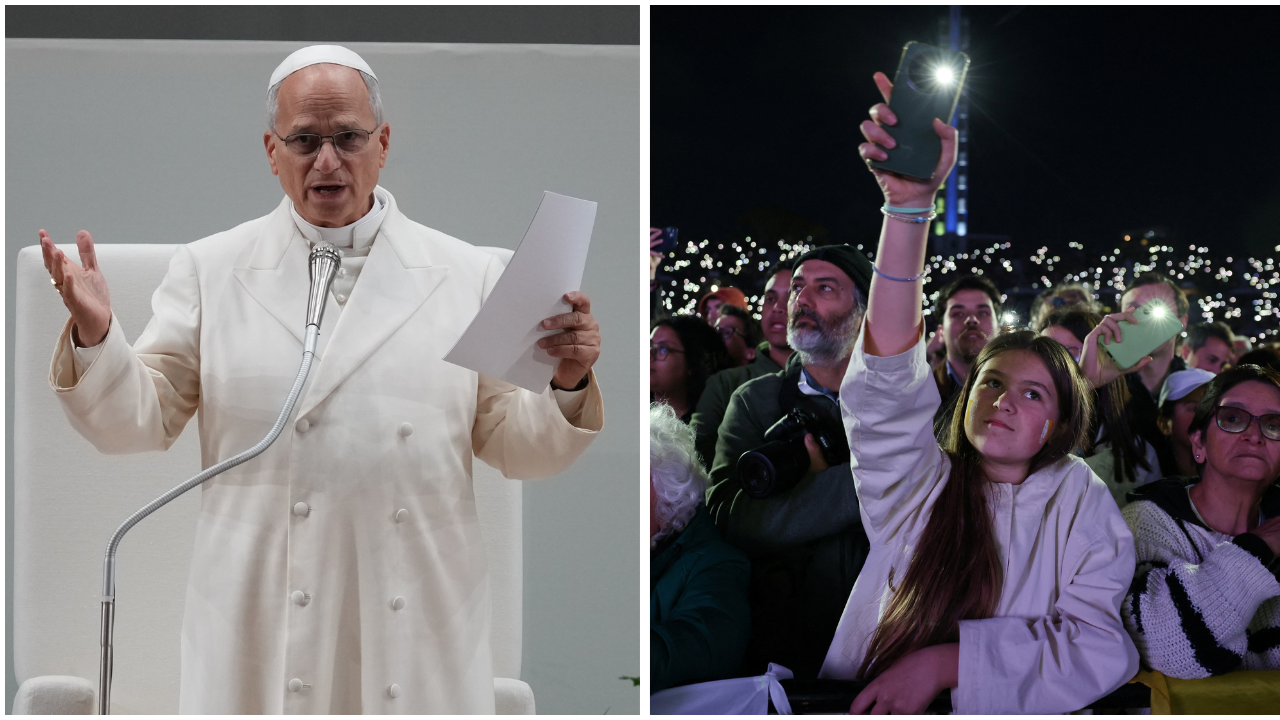
When Pope Leo XIV addressed Uruguay's youth, the headlines wrote themselves in dry, predictable ink. Falling birth rates. Fading faith. A pontiff confronting demographic winter in a secular stronghold.
Those headlines miss the beating heart of the story.
The Weight of an Unwritten Future
To understand why a Pope speaking to twenty-somethings in Montevideo matters, you have to step out of the statistical tables and sit at a kitchen table in the Pocitos neighborhood.
Picture a hypothetical young couple—let's call them Mateo and Sofía. Both are twenty-nine. Both hold university degrees. Both work forty-five hours a week in jobs that pay enough for a rented two-bedroom apartment, occasional dinners out, and a yearly trip to Rocha, provided nothing breaks down.
Ask Mateo and Sofía if they want children, and you will not hear ideological hostility. You will hear a long, tired exhale.
"With what certainty?" Sofía might say, tracing the rim of her coffee mug. "If one of us loses a contract, the math collapses. If we have a child, who watches them while we work? And even if we solve the money, look at the news. Look at the climate. Look at how alone everyone feels."
This is not selfishness. That easy accusation—thrown carelessly at young adults across the Western world—is both cruel and inaccurate. The hesitation gripping young Uruguayans is a quiet, pervasive exhaustion. Psychologists call it future-discounting, a behavioral defense mechanism that kicks in when the horizon feels too foggy to plan for. When you cannot picture ten years ahead with confidence, committing to a new human life feels less like a joy and more like an act of recklessness.
And faith? For Mateo and Sofía, religion isn't something they actively rejected in a moment of youthful rebellion. It simply wasn't in the room when they grew up. Uruguay secularized early, stripping religious instruction from public schools in the early twentieth century and turning faith into a strictly private, almost invisible affair. You don't miss a language you never learned to speak.
Yet late at night, scrolling through glowing phone screens in a quiet apartment, a different kind of hunger surfaces. Demographers track the drop in births. Sociologists track the drop in church attendance. Nobody has a clean metric for the quiet ache of feeling entirely unmoored from anything larger than your own survival.
What the Pontiff Actually Said
When Pope Leo XIV stepped forward to speak to Uruguay's young people, a cynical observer might have expected a scolding. The institutional script is familiar enough: warn against materialism, lament the decline of traditional family structures, demand a return to the pews.
Instead, the Pope bypassed the culture-war playbook entirely.
He looked directly at a generation raised in radical secularism and economic precarity, and he refused to treat them as a demographic problem to be solved. You do not convince someone to love life by handing them a replacement-rate chart. Nobody ever had a baby to rescue a national pension fund.
Leo XIV framed both crises—the empty cradles and the empty churches—as symptoms of a single, deeper fracture: a crisis of hope.
Think of hope not as naive optimism, the glossy delusion that everything will automatically work out, but as an anchor dropped into deep water. Without an anchor, a boat drifts with whatever current hits it—an economic downturn, a wave of digital anxiety, a lonely winter. A society can build immaculate public institutions, pass landmark social legislation, and maintain impeccable civic order, yet still find itself drifting if its youngest citizens secretly believe the best days are behind them.
In his message to Uruguayan youth, the Pope acknowledged the real weight pressing down on their shoulders. Precarious work. The high cost of housing. The subtle cultural pressure that treats vulnerability as a weakness and permanent commitment as a trap. He spoke to young people who had been told their entire lives that freedom meant keeping every option open forever—only to discover that keeping every option open leaves you standing alone in an empty hallway.
"Fear," he suggested in essence, "is a terrible architect."
The Architecture of Fear
If you have ever lived through a season where every major life decision felt paralyzing, you know how subtle fear can be. It rarely announces itself as panic. Usually, it wears the mask of practicality.
Wait until the promotion comes through.
Wait until the savings account hits a round number.
Wait until the world feels a little less chaotic.
The trap is that the conditions never arrive in neat, pre-approved perfection. Life has always been a gamble against uncertainty. Our grandparents did not raise families because the twentieth century was stable; they raised families in the middle of political upheaval, economic shocks, and raw uncertainty because they possessed a stubborn conviction that life itself was worth passing on.
Here is where the conversation around Uruguay turns deeply personal, even for readers who have never set foot in South America and never intend to enter a church.
Uruguay is simply ahead of the curve. What is happening in Montevideo today is unfolding in Seoul, in Tokyo, in Milan, in Madrid, and across major cities in North America. Falling birth rates and fading institutional faith are twin currents reshaping the modern world.
Consider what happens next when a society stops believing in tomorrow.
First, the physical landscape shifts. Schools merge, then close. Pediatric wards shrink while geriatric clinics expand. The background noise of neighborhoods changes—fewer bicycles clattering down sidewalks, more silence behind closed blinds.
Second, the social fabric thins. Extended families—aunts, uncles, cousins—begin to vanish from the family tree. Within two generations, a child can grow up without siblings, cousins, or nieces, inheriting a family structure shaped like an inverted pyramid: one young worker supporting two parents and four grandparents.
Third, something quieter happens inside the human spirit. Without intergenerational continuity, the present moment becomes unbearably heavy. If there is no transcendent horizon above you and no next generation walking behind you, then your brief span of decades has to carry the entire meaning of existence. No wonder anxiety rates are skyrocketing. No wonder young adults feel crushed under the pressure to optimize every hour.
A Different Kind of Rebellion
Pope Leo XIV's challenge to Uruguay's youth landed with unexpected force precisely because it flipped the script on what constitutes rebellion.
In a hyper-secular, hyper-cautious culture, cynicism is the default setting. Irony is armor. Keeping your distance—from institutions, from marriage, from parenthood, from God—is marketed as sophistication.
To bet on the future anyway is the real counterculture.
During his address, the Pope urged young Uruguayans not to let their lives shrink to the size of their screens or their anxieties. He spoke of faith not as a rigid set of rules handed down from an ancient bureaucracy, but as an encounter that gives a person the courage to risk love. And he spoke of welcoming new life not as a duty owed to the state or the church, but as the ultimate act of trust in reality itself.
You do not have to be a devout Catholic to feel the sting of truth in that diagnosis.
Even from a purely human standpoint, every civilization runs on borrowed courage. Someone before us had to look at an uncertain world, accept that they could not control every outcome, and say yes anyway. They built bridges they would never cross, planted trees whose shade they would never sit under, and raised children who would outlive them.
When a generation loses that nerve, the loss is invisible at first. GDP numbers can still look tidy for a decade or two. The cafés in Montevideo still hum with conversation at dusk. The sun still drops like a copper coin into the Río de la Plata.
Underneath the surface, though, the future is quietly being canceled one postponed dream at a time.
The Bridge Across the Empty Square
Let's return to Mateo and Sofía in their Pocitos apartment.
Nobody expects a single papal speech to reverse fifty years of demographic drift overnight. Uruguay will not wake up tomorrow with booming maternity wards and packed cathedrals. History moves slowly, especially in a country proud of its measured, unhurried temperament.
Yet ideas have a way of working like seeds dropped into cracks in concrete.
What Leo XIV offered Uruguay's young people was permission to question the quiet fatalism of their era. He reminded them that their reluctance to build families and their distance from faith are not isolated personal quirks—they are part of a shared cultural winter that can only be thawed by community, solidarity, and stubborn hope.
For a young person staring at a bleak economic forecast, hope is not a magic wand that pays the rent. It is, however, the difference between surrendering to isolation and reaching across the table to build a life with others. Churches, neighborhoods, civic groups, extended families—whatever form community takes, human beings were never designed to carry the weight of existence solo.
Watch what happens when even a small minority refuses to live defensively. One couple decides that love is worth the financial squeeze. A group of twenty-somethings starts gathering weekly, trading digital isolation for real bread, real conversation, and shared faith. A neighborhood comes alive again around a renovated playground.
Hope is contagious in the exact same way despair is contagious.
Late in the evening in Montevideo, long after the commuter buses have thinned out, the streetlights along the Rambla cast long golden ribbons across the wet pavement. Somewhere near the water, a young father walks slowly, bouncing a sleepy toddler against his shoulder, humming a tune older than the city itself. Across the street, the heavy wooden doors of a neighborhood parish stand slightly ajar, spilling a warm triangle of candlelight onto the stone steps.
Neither scene makes the front page. Neither shifts a national statistic by morning.
Both are quiet acts of defiance against the dark—proof that even in the coldest demographic winter, human beings still know how to light a fire and wait for the dawn.