The fluorescent lights of a hardware prototyping lab in Shenzhen buzz at a frequency that eventually disappears into the hum of cooling fans and soldering irons. At 2:00 AM, the distinction between mainland China and Hong Kong feels less like a geopolitical fault line and more like an inconvenient ferry schedule.
Consider a hypothetical hardware engineer named Lin. Let us call him Lin to give a human pulse to a macroeconomic thesis that usually arrives wrapped in gray bureaucratic prose. Lin designs miniaturized medical sensors. His components are stamped out in Dongguan, assembled in Shenzhen, and tested in a cleanroom twenty minutes from the Lok Ma Chau border crossing. Yet when Lin needs to raise thirty million dollars from an international venture fund, draft an intellectual property agreement that will hold up in a London court, or clear customs for a specialized German optical lens without drowning in paperwork, he gets on the high-speed rail. Fourteen minutes later, he steps out at West Kowloon Station.
Fourteen minutes.
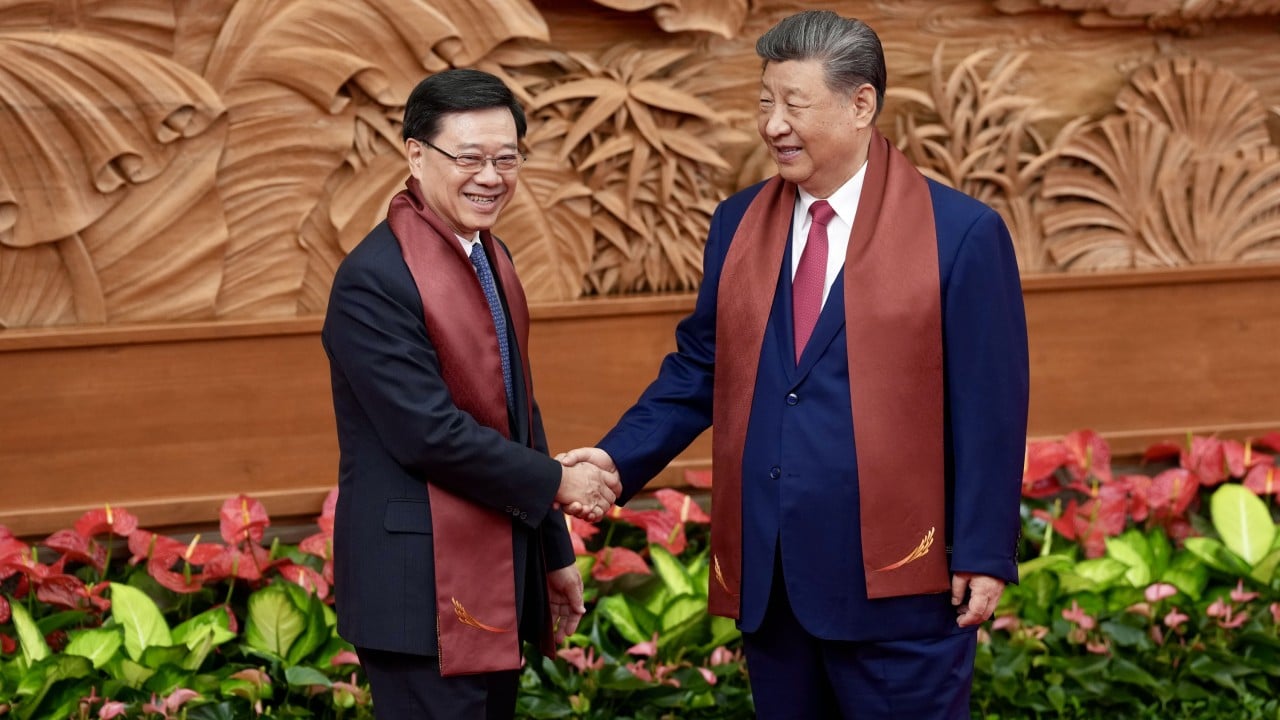
That commute is the physical manifestation of a diplomatic exchange that happened half a world away, beneath the tailored suits and camera flashes of the Asia-Pacific Economic Cooperation summit. When Hong Kong Chief Executive John Lee leaned across a polished table to tell Chinese President Xi Jinping that the Guangdong-Hong Kong-Macao Greater Bay Area possesses "enormous" potential, the press corps recorded the quote, filed it under routine diplomatic affirmation, and moved on to the next bilateral handshake.
They missed the blood and bone beneath the adjective.
To understand why a single word like enormous carries the weight of eighty-six million lives, you have to stop looking at maps drawn by diplomats and start looking at supply chains drawn by engineers, bankers, and desperate founders. You have to look at the Pearl River Delta not as a collection of eleven rival cities, but as a single, sprawling organism trying to teach its left hand how to speak the same legal and financial language as its right.
The Friction of Two Worlds
For decades, the border between Hong Kong and Guangdong province operated like a pressure valve. Capital, global legal standards, and international logistics stayed on the southern side of the Shenzhen River. Manufacturing muscle, cheap land, and seemingly endless labor pools stayed on the north. It was a profitable arrangement, an economic marriage of convenience that turned southern China into the factory floor of the planet.
Then the world changed.
Supply chains fractured under the weight of tariffs, pandemic lockdowns, and shifting geopolitical allegiances. Low-margin manufacturing began migrating to Vietnam, India, and Mexico. Suddenly, being the world’s assembly line was no longer enough to guarantee survival, let alone dominance. Beijing realized that the Pearl River Delta needed to evolve from a workshop into an innovation engine capable of rivaling Silicon Valley and the Tokyo Bay Area.
There was just one glaring problem. The two halves of this engine ran on completely different operating systems.
Imagine trying to build a supercomputer where the processor runs on British common law, free-flowing capital, and a pegged currency, while the memory drives run on mainland civil law, strict capital controls, and a state-directed regulatory apparatus. Every time data tries to move between them, it hits a firewall. Every time a scientist in Guangzhou wants to share biological samples with a research hospital in Hong Kong, customs agents pull out clipboards. Every time a Hong Kong resident wants to buy property, open a bank account, or use health insurance across the border, invisible walls slam shut.
I remember standing on the observation deck of the Ping An Finance Centre in Shenzhen a few years ago, looking south toward the green hills of Hong Kong’s New Territories. Physically, there was no barrier—just a winding ribbon of muddy water and a few stretches of chain-link fence. Yet economically, the distance between those hills and the glass towers beneath my feet was wider than the Pacific Ocean.
The Mathematics of Scale
When John Lee spoke to Xi Jinping at APEC about unlocking the Greater Bay Area’s potential, he was pitching Hong Kong as the ultimate translator between these two systems.
Look at the raw numbers, because numbers stripped of spin tell a stark story. The Greater Bay Area encompasses nine cities in Guangdong province—including Guangzhou, Shenzhen, Dongguan, and Foshan—alongside the two Special Administrative Regions of Hong Kong and Macao. Together, they occupy less than one percent of China’s landmass. Yet this tiny coastal pocket generates roughly eleven percent of the entire country’s gross domestic product.
Its combined economic output hovers around two trillion US dollars, putting it in the same weight class as Canada, Italy, or South Korea. Eighty-six million people live within a radius that can be crossed by high-speed train in under an hour.
Scale.
In economics, scale is gravity. When you put Shenzhen’s hardware ecosystem—where a founder can source ten thousand custom-milled aluminum casings before lunch—next to Hong Kong’s financial depth, where the stock exchange raises tens of billions of dollars and four of the world's top one hundred universities churn out basic research, the gravitational pull becomes immense. Add Guangzhou’s heavy industrial base and Macao’s tourism and Portuguese-speaking trade networks, and the theoretical blueprint looks unstoppable.
Theory, however, does not clear customs.
The Invisible Borders
If you talk to business owners operating across the delta, their eyes rarely light up when you mention macroeconomic blueprints. Instead, they talk about friction. They talk about the exhausting, expensive reality of navigating "One Country, Two Systems, Three Customs Territories."
Let us return to our hypothetical founder, Lin, in his Shenzhen lab. Suppose Lin develops a breakthrough diagnostic chip. To get it approved for global markets, he needs clinical trial data from Hong Kong’s internationally recognized hospitals, paired with massive patient pools from hospitals in Guangzhou. For years, moving human genetic material or medical data across that fourteen-minute rail corridor required months of regulatory approvals. By the time the paperwork cleared, a competitor in Boston or Munich had already patented the next iteration.
Or consider the talent dilemma. A software architect from Singapore or London might happily accept a job offer in Hong Kong, lured by low taxes, familiar legal protections, and an international lifestyle. Ask that same architect to relocate permanently to Dongguan, and you will likely get a polite decline. Conversely, a brilliant robotics engineer educated in mainland China faces labyrinthine visa hurdles just to spend six months collaborating at a Hong Kong university lab.
For years, the Greater Bay Area existed mostly on paper—a collection of glossy brochures, ministerial summits, and overlapping infrastructure projects like the fifty-five-kilometer Hong Kong-Zhuhai-Macao Bridge, an engineering marvel that initially sat half-empty because drivers needed three different license plates and separate insurance policies just to cross it.
Critics outside the region looked at those empty lanes and scoffed. They saw a top-down political project struggling to force organic economic chemistry. Honestly, watching the early rollouts, it was hard not to share their skepticism. Building concrete bridges is easy when you have state-backed construction giants. Building regulatory trust between bureaucracies that have spent decades guarding their turf is another matter entirely.
Rewiring the Circuitry
Something fundamental has shifted over the past twenty-four months, and it explains the urgency behind Lee’s message to Xi at APEC. Necessity has forced the bureaucracies to finally start dismantling the invisible walls.
Look closely at the policy shifts happening beneath the surface headlines. The Cross-Boundary Wealth Management Connect scheme was expanded, allowing residents in the mainland cities to invest directly in financial products sold by Hong Kong banks, and vice versa, effectively punching a controlled pinhole through China’s capital wall. In the Lok Ma Chau Loop—a patch of reclaimed marshland sitting directly on the border—workers are constructing the Hetao Shenzhen-Hong Kong Science and Technology Innovation Co-operation Zone.
The Hetao zone is a radical experiment. It is an attempt to create a legal and logistical hybrid: a place where mainland researchers and international scientists can work side by side, where data and biological samples can flow under specialized customs protocols, and where Hong Kong’s common law system can govern commercial contracts just steps away from mainland manufacturing lines.
Meanwhile, Hong Kong has aggressively rewritten its immigration rules. Through the Top Talent Pass Scheme, tens of thousands of graduates from the world’s premier universities—and high-earning professionals—have flooded into the city, reversing years of pandemic-induced brain drain. Many of them are using Hong Kong not as an isolated island, but as a springboard into the broader delta.
Even the bridge is filling up. Under the "Northbound Travel for Hong Kong Vehicles" scheme, ordinary Hong Kong families can now drive their personal cars straight into Guangdong without the absurd requirement of acquiring dual commercial plates. On weekends, the border checkpoints clog with SUVs heading north for cheaper groceries, sprawling shopping malls, and family dinners in Zhuhai and Shenzhen.
Consumer integration always precedes corporate integration. When people start treating two cities as one neighborhood, capital inevitably follows.
The Geopolitical Tightrope
Yet we cannot pretend this integration is happening in a vacuum. To understand the stakes of the APEC meeting, you have to acknowledge the elephant sitting in every boardroom from Central to Nanshan: decoupling.
Western governments, led by Washington, have spent the last several years erecting tariffs, restricting semiconductor exports, and scrutinizing outbound venture capital into China. Hong Kong, once treated by global markets as an autonomous financial enclave insulated from mainland politics, has been caught directly in the crossfire. Global banks have grown cautious. Western institutional investors have pulled back from Chinese equities, leaving Hong Kong’s benchmark Hang Seng Index battered and bruised compared to its historical peaks.
This is the vulnerability that makes John Lee’s pitch both a bold vision and a high-stakes survival strategy.
Hong Kong can no longer rely on its old playbook of simply acting as a passive tollbooth for Western capital entering China. If Western capital is hesitant, Hong Kong must prove it can generate its own technological gravity—and that means tying its fate inextricably to the industrial powerhouse right across the river. At the same time, Beijing desperately needs Hong Kong to retain its international DNA. If Hong Kong loses its common law credibility, its free flow of information, and its convertible currency, it ceases to be useful to Shenzhen or Guangzhou. It simply becomes another coastal Chinese city, redundant and outgunned.
President Xi’s endorsement of Hong Kong’s role at APEC wasn't just polite encouragement; it was a strategic directive. Beijing is betting that by fusing Hong Kong’s international financial and legal architecture with Guangdong’s relentless manufacturing and technological scale, the region can insulate itself from external shocks and build an ecosystem too large, too fast, and too integrated for global markets to ignore.
The Human Variable
Stand at the West Kowloon high-speed rail station on a Tuesday morning, and you can watch this geopolitical theory play out in real time.
It is a sea of lanyards, Rimowa suitcases, and smartphones. There are young venture capitalists in Patagonia vests heading to Shenzhen to inspect battery factories. There are mainland pharmaceutical executives in tailored suits riding south to meet with investment bankers overlooking Victoria Harbour. There are university professors carrying stacks of grant proposals between campuses in Kowloon and Guangzhou.
They are not thinking about APEC communiqués or gross domestic product projections. They are thinking about burn rates, patent filings, supply chain bottlenecks, and whether they can make it back in time for dinner.
If our hypothetical founder, Lin, succeeds in bringing his medical sensor to market, it will not be because a politician declared the region’s potential to be enormous. It will be because a logistics manager in Dongguan figured out how to shave three days off customs clearance, a lawyer in Hong Kong drafted a cross-border licensing agreement that satisfied both regulators, and an engineer in Shenzhen stayed awake until 2:00 AM refining the circuit board.
Grand economic visions always sound grandiose from a podium. Down at street level, they are built out of mundane compromises, rewritten customs forms, and fourteen-minute train rides.
Late at night, when the last high-speed train pulls out of West Kowloon and plunges into the dark tunnel beneath the hills toward Shenzhen, the carriage goes quiet. Passengers lean their heads against the glass, watching the blurred lights of the New Territories give way to the neon skyline of Guangdong. Outside the window, the border passes beneath the tracks without a sound, invisible in the dark, marked only by the sudden shift in cell phone signals vibrating inside eighty-six million pockets.


