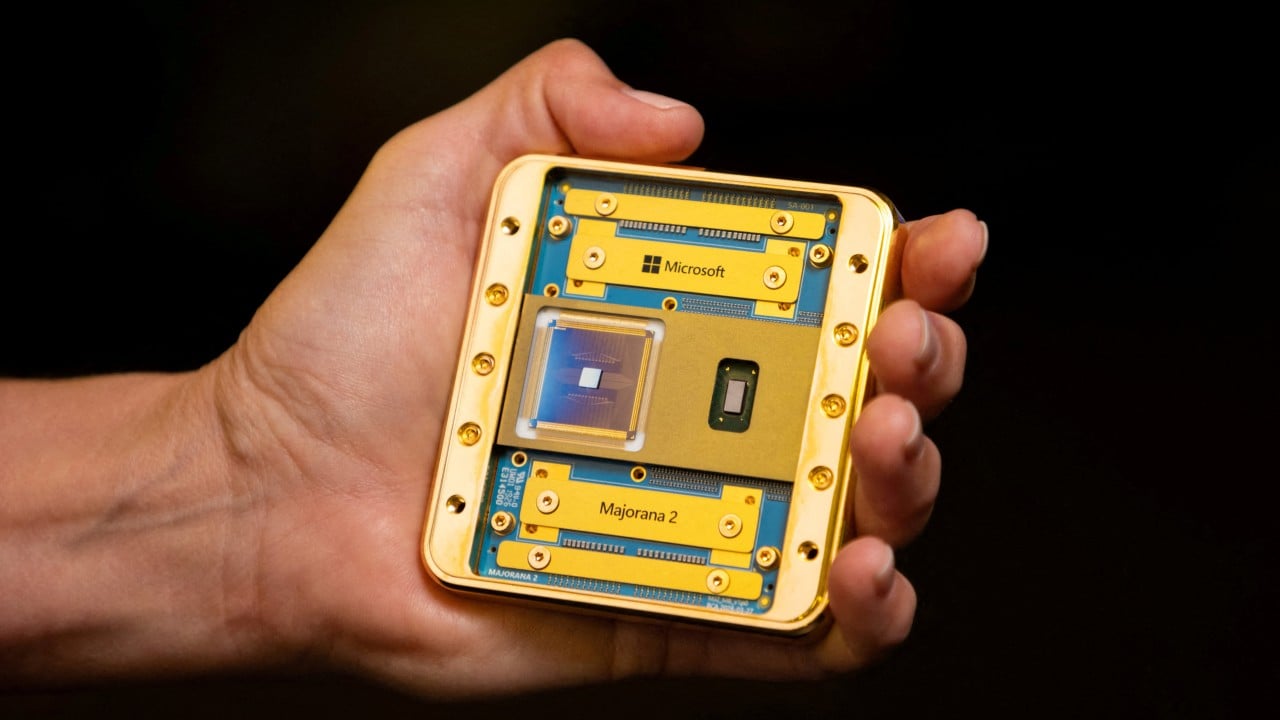
The United States Department of Defense funding injection of 350 million dollars into quantum computing signals a structural transition from academic exploration to national security asset protection. Capital allocation in state-sponsored technology programs does not follow commercial venture capital logic. Instead, it operates on a calculus of existential risk, asymmetric advantage, and supply chain sovereignty.
Understanding this initiative requires moving past surface-level reporting of the dollar amount and examining the underlying mechanics of how defense capital reshapes high-technology markets. The strategy rests on three distinct operational vectors: cryptographic obsolescence, sensing precision, and error-correction scalability. Don't miss our recent coverage on this related article.
The Cryptographic Threat Model
Public-key cryptography currently secures global financial transactions, classified diplomatic communications, and critical infrastructure networks. Standard protocols like RSA and Elliptic Curve Cryptography rely on mathematical problems that are intractable for classical computers, such as factoring large prime numbers or solving discrete logarithms.
Shor algorithm execution on a fault-tolerant quantum computer fundamentally alters this equation. A sufficiently scaled quantum processor reduces the time required to break these cryptographic standards from millennia to hours or minutes. If you want more about the context of this, Ars Technica provides an in-depth summary.
The defense rationale for a 350 million dollar capital push is defensive as much as it is offensive. State actors operate under a "harvest now, decrypt later" paradigm. Intercepted encrypted traffic is stored today to be decrypted once scalable quantum hardware matures. State-level funding accelerates the timeline for post-quantum cryptography migration by forcing commercial vendors and defense primes to adopt lattice-based or hash-based cryptographic standards before legacy systems become completely exposed.
Scaling Bottlenecks in Quantum Architectures
Throwing capital at quantum computing does not yield linear returns because the underlying physics presents severe engineering hurdles. The current state of the art is constrained by three interdependent variables: qubit fidelity, coherence time, and gate error rates.
Qubits are notoriously fragile. Thermal fluctuations, electromagnetic interference, and material defects cause quantum states to decohere, destroying information before a computation completes. While noisy intermediate-scale quantum systems have demonstrated utility in specific simulation niches, national security applications require fault-tolerant logical qubits. Building a single logical qubit demands thousands of physical qubits dedicated entirely to quantum error correction.
The Department of Defense allocation functions as targeted research and development capital designed to solve specific materials science and control-engineering bottlenecks. Rather than funding broad commercial utility, this capital targets cryogenic packaging, microwave control electronics, and semiconductor manufacturing tolerances required to scale qubit counts without proportional increases in noise.
Dual-Use Divergence and Strategic Sovereignty
Technology development in quantum information science diverges significantly from classical software development due to the hardware-software co-design requirement. You cannot iterate rapidly in a cloud environment when the underlying asset requires a dilution refrigerator operating near absolute zero.
This physical reality creates a chokepoint in the global technology supply chain. Rare isotopes like helium-3, specialized dilution refrigerators, ultra-pure silicon substrates, and precision optical components form a restricted manufacturing ecosystem. By injecting capital directly into domestic quantum technology developers, the state attempts to secure an indigenous industrial base.
China's parallel state-directed investments in quantum communication networks, such as quantum key distribution, and quantum computing infrastructure create a geopolitical race where speed dictates standard-setting power. The nation that establishes operational dominance in quantum sensing and processing dictates the protocols for secure global data transmission for the next century.
Strategic Allocation of Defense Capital
The 350 million dollar figure must be evaluated through the lens of federal procurement efficiency. In defense technology acquisition, capital is deployed across a tiered ecosystem:
- Basic research grants to university laboratories focusing on foundational physics and material science.
- Small Business Innovation Research contracts designed to bridge the valley of death between academic proof-of-concept and scalable engineering prototypes.
- Prime contractor integration contracts aimed at hardening quantum sensors for field deployment in GPS-denied environments and secure communication backbones.
Quantum sensors represent a near-term strategic win that often gets overshadowed by the long-term focus on cryptanalysis. Cold-atom interferometers and magnetometers allow for precise navigation and timing without reliance on satellite constellations. In contested military environments where satellite signals are jammed or spoofed, inertial navigation systems backed by quantum sensors provide absolute positioning accuracy.
Capital allocation toward these systems bypasses the commercial market's demand for immediate monetization. Defense funding absorbs high initial failure rates in pursuit of technological asymmetry.
To evaluate the true efficacy of this push, analysts must monitor three operational milestones: reductions in physical-to-logical qubit overhead ratios, the deployment timeline for hardware-agnostic post-quantum cryptography standards across defense networks, and the successful miniaturization of quantum sensing packages for field deployment. The value of the initiative lies not in the headline number, but in its precision targeting of foundational system failure points.


