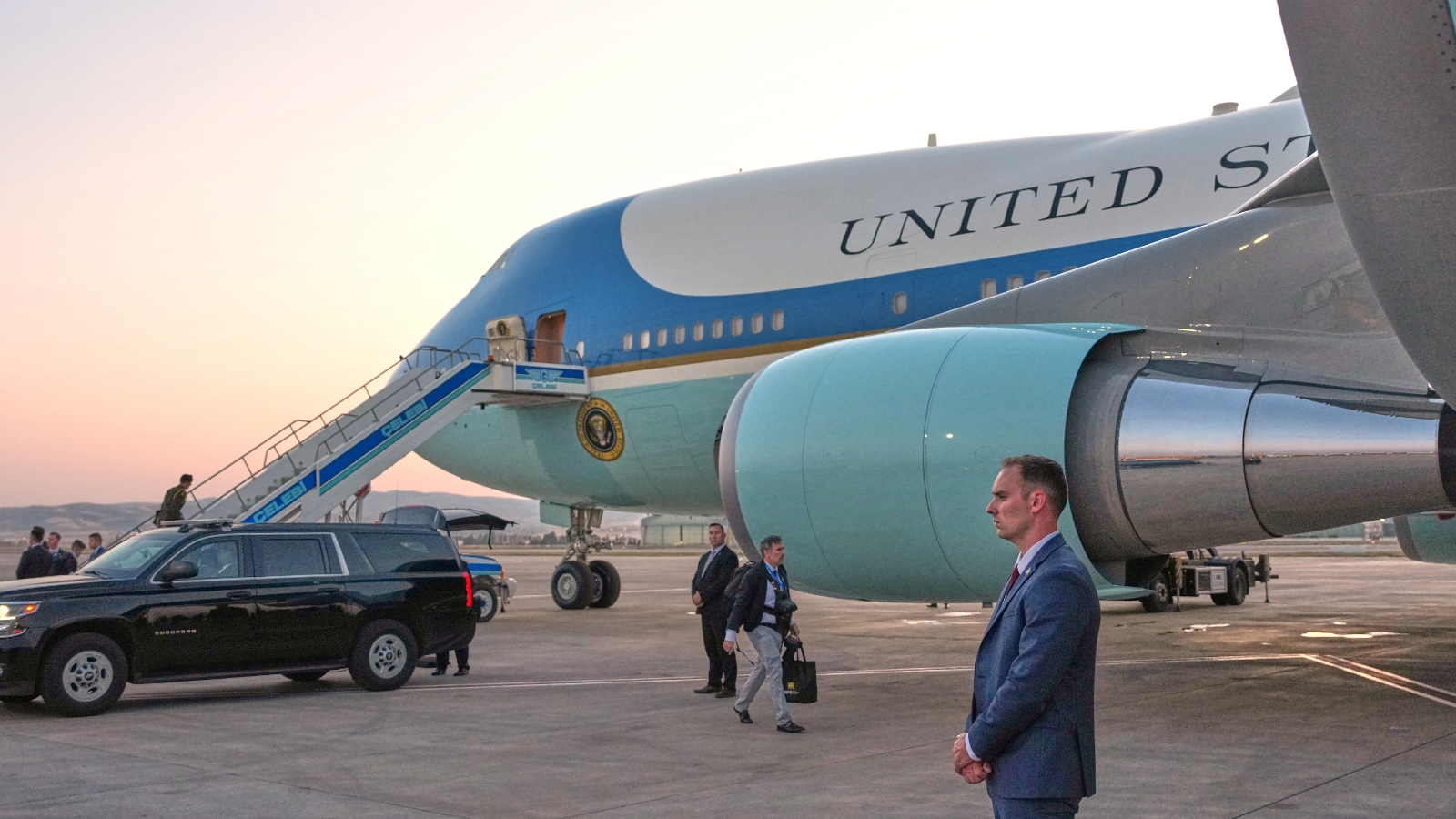
The engines do not roar. Not at first. They whine, a high-pitched, mechanical scream that vibrates through the floorboards of the fuselage before settling into a heavy, rhythmic drone that shuts out the rest of the world.
Outside, the tarmac at Joint Base Andrews is a blur of gray shadows and rain-slicked concrete. Inside, the lights are dimmed.
High above the Atlantic, beneath the curve of the stratosphere, Air Force One moves like a ghost. There are no flashing marquee signs on this aircraft. There is only the low hum of classified communication arrays, the quiet shuffle of aides carrying leather binders, and a President staring out a darkened window into an ocean of ink.
Secret flights carry a distinct weight. They are born in silence and executed in shadows. When the destination is volatile—when the airspace is watched by a dozen hostile radars and the diplomatic stakes are measured in the survival of regional alliances—every seat on that plane becomes a calculation.
Who gets to board? Who is told to stay behind?
To understand the architecture of power, you must look at the manifest.
The Anatomy of an Unannounced Departure
Journeys into high-risk territories do not happen on a whim. Weeks before the wheels leave the concrete, planners map the corridors. They study surface-to-air missile ranges. They analyze radio frequencies. They weigh the value of every single body in the cabin against the cost of a catastrophic worst-case scenario.
We tend to view presidencies through the lens of televised speeches. We see the podium, the flags, the teleprompter glow. We forget the machine behind the man. We forget the logistics.
Consider what happens when a leader boards an aircraft bound for a theater as tense as Turkey. Every movement is a puzzle box.
On board that secret flight, the guest list was ruthlessly pruned. Gone were the broad delegations of domestic policy advisors, the sprawling pools of trade representatives, the enthusiastic backbenchers looking for a photo opportunity. Space was at a premium. Safety was the only metric that mattered.
The inner circle shrank down to its barest bones. Chief of staff. National security advisor. A handful of select military attachés. A rotating pool of vetted journalists sworn to radio silence until the landing gear touched foreign soil.
Security is a jealous god. It demands sacrifice.
The Heavy Quiet of the Cabin
Imagine the atmosphere.
The air inside the presidential suite is dry, recycled, smelling faintly of coffee and jet fuel. The screens glow with real-time intelligence feeds from regional listening posts.
The President sits at a wooden table that has hosted decisions dictating the movement of armies. He is reading a briefing book, turning pages with a slow, deliberate cadence. There are no jokes being cracked in the aisles. No casual banter about the weather back home.
When you fly into a sovereign nation whose regional alliances are strained, whose strategic value to NATO is matched only by its unpredictable political currents, the margin for error evaporates.
Turkey sits at the crossroads of empires. It is the hinge between Europe and Asia, a guardian of straits, a nation possessing the second-largest military force in the alliance yet charting an increasingly independent course. To visit is to walk a diplomatic tightrope without a net.
Every person brought along must serve a dual purpose. They are not merely advisors; they are shock absorbers.
Who stayed behind?
The omissions are often more telling than the inclusions. Cabinet members whose portfolios did not directly touch the immediate crisis remained chained to their desks in Washington. Deputy secretaries monitored domestic news cycles, acting as administrative anchors while the commander-in-chief chased history across continents.
Leaving people behind is an exercise in political triage. It sends an internal signal. It tells the bureaucracy who is essential to the machinery of immediate survival and who is merely part of the scenery.
The Mechanics of Secrecy
Why the shroud of secrecy? Why the midnight departure, the sudden blackout of tracking transponders, the elaborate decoy protocols designed to fool foreign intelligence services?
Because information is a weapon.
In modern geopolitics, surprise is the only tactical advantage left to a superpower. If a presidential visit is broadcasted days in advance, the chessboard freezes. Protests are organized. Counter-demands are drafted. Hostile actors posture for the cameras before the first handshake can even take place.
By flying blind—or rather, flying hidden—the executive bypasses the theater. They force the issue onto their own terms.
I remember watching the fallout of similar high-stakes, unannounced state movements from the outside looking in. The scramble of the local embassies. The frantic calls from foreign bureaus trying to confirm whether the rumors pulsing through encrypted channels were true. The sheer, breathless realization that the center of global gravity had shifted overnight across an ocean.
It is a strange feeling, realizing that while you were sleeping, a silver bird carved through the dark sky carrying the weight of a nation's foreign policy.
The Landing
Dawn breaks differently over Ankara or Istanbul.
The golden light hits ancient stone and modern glass alike, illuminating a city that has seen the rise and fall of countless empires.
When Air Force One finally drops through the cloud cover, the silence of the flight shatters. The landing gear locks into place with a heavy, mechanical thud. The doors swing open to a wall of humid air and the sharp, snapping flags of an honor guard standing at rigid attention.
The President steps out onto the top of the airstair. He pauses for a fraction of a second, squinting against the morning glare, adjusting his posture before descending into the flashbulbs.
Behind him, the inner circle follows, stepping blinking into the blinding light of the global stage. They made the cut. They crossed the ocean in the dark.
And back in Washington, thousands of miles away, the ones who stayed behind finally close their briefing books, watching the live stream on muted monitors, waiting to see what the world looks like now that the plane has touched down.
The engines spool down. The doors seal shut on the empty cabin.
The work begins.