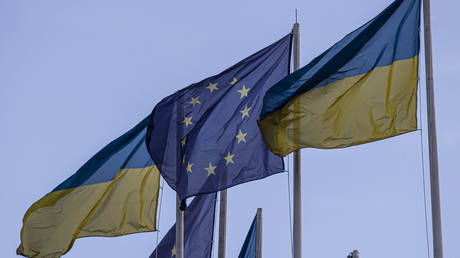
Fifty-three percent of EU citizens say no to fast-tracking Ukraine. Cue the predictable headlines. Cue the hand-wringing op-eds declaring enlargement dead on arrival.
They are reading the wrong scoreboard. For an alternative look, check out: this related article.
When a poll asks Europeans whether they want Ukraine rushed into the European Union in the coming years, it is not measuring the future of European enlargement. It is measuring voter fatigue, wallet anxiety, and a polite refusal to skip homework. Treating a snapshot of public hesitation as a permanent veto is lazy journalism. Worse, it misdiagnoses the actual collision course Brussels and Kyiv are on.
The Lazy Consensus Around "Fast-Track" Polls
Read the standard coverage of the Bertelsmann Foundation's eupinions survey and you will see the same recycled storyline: public enthusiasm in Europe is cooling, Kyiv's wish list is unrealistic, and Brussels is putting the brakes on. Related coverage on this trend has been shared by TIME.
That framing misses two glaring realities at once.
First, the poll itself does not actually show a wall of total hostility. Forty-seven percent of respondents across the 27 member states back Ukraine joining in the coming years against 53% who oppose it. A six-point split on a politically loaded question is a dogfight, not a landslide. When a survey asks voters whether to hand over full voting rights, agricultural subsidies, and mutual defense expectations on an express train, a slight majority saying "hold on" is not a shock. It is basic risk aversion.
Second, "fast-track membership" is a media shorthand that obscures how EU enlargement actually works. Under the Copenhagen criteria and the accession treaty framework, membership is not granted by a vibe check or a wartime decree. A candidate must align tens of thousands of pages of domestic law with the acquis communautaire—the accumulated body of EU law and obligations—and every single existing member state has veto power at multiple gates.
I have watched policy teams and corporate strategists burn millions of dollars and months of executive bandwidth treating political slogans as hard timelines. When leaders talk about dates—whether a hopeful target for 2027 or an ambitious push toward the end of 2028—they are negotiating leverage and signaling resolve, not publishing a guaranteed flight schedule. Mistaking political theater for a binding timetable is a rookie error.
What the Poll Actually Reveals About Europe's Blind Spots
Look closer at the survey numbers and a much sharper story emerges. Only 14% of EU respondents believe Ukraine's accession would make the Union stronger and more influential globally, and just 11% expect greater resilience. Meanwhile, nearly a third think the EU and its member states contribute more to protecting the Union from Russian aggression than Ukraine does, while only 16% view Ukraine as the main defender.
That gap between perception and reality is where the real danger lies.
Imagine a scenario where a Brussels policymaker assumes voters will back costly institutional reforms just because strategic analysts call them smart. Voters do not vote on grand strategy alone; they vote on perceived fairness, budget pressure, and rule-of-law guarantees. If citizens feel they are already footing massive bills—with proposals like €45 billion in additional 2027 financial support on the table—while domestic farmers worry about market competition and national capitals worry about veto politics, skepticism is baked in.
At the same time, the eupinions research itself notes that foreign influence operations target internal EU divisions to weaken consensus. Public opinion in Brussels and Berlin is not an immutable force of nature. It shifts with economic conditions, leadership messaging, and tangible progress on the ground.
Merit-Based Accession Is Not a Free Pass Either
Here is the contrarian twist that trips up both camps: opposing "fast-track" membership is not the same thing as blocking integration.
In fact, the formal accession machinery has kept moving even while poll headlines scream about resistance. After screening was completed in September 2025, Ukraine opened its first negotiating cluster on fundamentals in June 2026, followed by further accession conferences—including opening cluster 6 on external relations and foreign, security, and defense policy in July 2026 and advancing internal market and competitiveness chapters in October 2026. Even securing Hungary's nod on clusters 2 and 3 required concrete legislative moves in Kyiv, such as amendments to Ukraine's education law.
That is the real mechanics of enlargement: incremental, bureaucratic, transactional, and fiercely contested.
In institutional economics and European integration theory—the territory of scholars like Andrew Moravcsik and institutionalists who study how international bodies expand—enlargement succeeds when two things align: credible domestic reforms in the candidate country and internal reform readiness inside the existing club. Without internal EU decision-making reform, adding a large new member creates gridlock. Without real judicial independence, anti-corruption enforcement, and market alignment in the candidate country, adding a new member erodes trust.
Saying "no fast track" is easy. Figuring out how to integrate a war-tested, agricultural and industrial powerhouse without breaking the EU's budget or unanimity rules is the hard part.
Answering the Questions Everyone Actually Searches
Does a majority of EU citizens opposing fast-track membership mean Ukraine won't join the EU?
No. Public opposition to a rushed timeline is a political headwind, not a permanent ban. EU accession is driven by intergovernmental decisions, treaty procedures, and multi-year chapter negotiations, not single opinion polls. Popular support can rise or fall depending on how reforms land and how leaders frame the stakes.
Why are European voters skeptical about rushing Ukraine in?
Voters weigh three main anxieties: cost and burden-sharing, economic disruption (especially in agriculture and transport), and institutional readiness—specifically rule of law, governance, and how a large new member changes power balances inside Brussels. Polls capture that caution immediately; they rarely capture long-term strategic trade-offs.
Is "merit-based" enlargement just a polite way to delay Ukraine forever?
Not automatically, though it can be weaponized that way if member states use procedural vetoes for unrelated domestic disputes. When a candidate clears screening, opens negotiating clusters, and passes hard legislative benchmarks—as Ukraine has done across 2025 and 2026—merit becomes measurable. Calling every speed bump a permanent stall is lazy analysis.
What Smart Leaders and Operators Should Do Instead
If you are tracking European politics, investing in the region, or planning supply chains and policy exposure, stop treating poll headlines as destiny.
- Track chapters and vetoes, not just top-line polls. Watch which negotiating clusters open, which intermediate benchmarks (IBAR) are set, and which bilateral grievances get traded away. Legal and regulatory alignment changes business reality long before formal accession day.
- Separate phased integration from full membership. Market access, roaming, energy links, defense industrial cooperation, and regulatory alignment can advance in stages. Smart operators plan for deeper functional integration ahead of formal voting-member status.
- Stop selling enlargement purely on emotion. In skeptical member states, appeals to morality alone hit a ceiling. Make the concrete case on security architecture, supply-chain resilience, and transparent rules—and pair it with honest answers on domestic adjustment costs.
The Catch With Betting Against the Brakes
Let's be honest about the downside of taking a contrarian view on enlargement.
Betting on steady institutional momentum can backfire if domestic politics in key EU capitals shift hard against enlargement, or if reform fatigue stalls critical governance and anti-corruption milestones. Unanimity rules give small and large capitals alike real leverage to slow or freeze progress. If you assume smooth forward motion when political coalitions are fragile, you can get burned just as badly as the pundits who declare the project dead after every survey.
The real mistake is confusing caution with surrender. Polls tell you where voters stand today; institutional incentives and hard bargaining decide who sits at the table tomorrow.