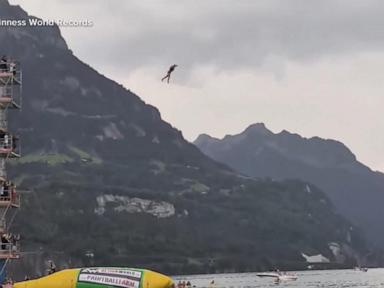
Gravity usually wins. But on a lakeside in Brunnen, Switzerland, a team of extreme athletes bent the rules of momentum so violently that a human body was propelled nearly nine stories into the air.
Robin Steiner did not just break a world record; he survived what looks on paper like a localized ordnance explosion. Launched from the end of a water-filled inflatable airbag known as a blob, Steiner reached an astonishing height of 28.22 meters, translating to 92.58 feet. The feat shattered a standard that had stubbornly stood for fourteen years.
For the uninitiated, water blobbing is equal parts physics experiment and backyard daredevilry. A massive, cylindrical rubber tube rests half-submerged on a body of water. One participant, designated as the flyer, sits at the sealed end, vulnerable and waiting. Three heavy-set jumpers ascend a parallel tower—in this case, standing roughly 14 meters above the water—and hurl themselves downward in synchronized coordination, crashing onto the opposite end of the tube. The compressed air rushes violently down the vinyl tube, weaponizing the internal pressure and converting the airbag into a literal human cannon.
Steiner described the sensation to onlookers as a car crash in reverse. It is an apt metaphor for an event where kinetic energy is transferred through a flexible medium into a singular focal point in milliseconds.
The Anatomy of a Record
To understand how a human being is launched higher than a standard telephone pole, you have to look past the casual summer camp origins of the sport. Blobbing began as a casual diversion on American lakes, but European extreme sports coordinators, specifically Adrian and Eric Baumann of Paintball Farm, turned it into an exact science.
The previous benchmark was set in 2012 on a German television show, reaching 22 meters. For over a decade, that record sat untouched because of a ceiling imposed by raw physics. Airbags have a threshold of elasticity, and human jumpers have a limitation on mass and timing. If the three jumpers do not hit the membrane within milliseconds of one another, the force disperses laterally rather than axially.
Steiner’s team solved this through absolute precision. Alongside Swiss compatriot Luc Siegenthaler, German jumper Lennart Florczak, and American Tristan Kuhn, the collective synchronized their drop weights to maximize compression. When they hit the vinyl, the instantaneous displacement sent Steiner skyward faster than a drag racer leaving the line.
When Nature Intervenes
World record attempts in extreme sports rarely happen in sterile laboratory environments. They happen against a clock dictated by meteorology.
On August 9, the Swiss team faced an escalating weather crisis. A severe Alpine storm system was barreling toward the lake, threatening to turn the stunt into a liability. High winds and lightning make crane towers and open water safety nightmares. Compounding the stress, a team member suffered an injury during the preliminary attempts, forcing the crew to scramble for a last-minute replacement before the window slammed shut.
On their first official try of the day, they cleared 23 meters, cleanly breaking the old mark. Refusing to settle, they reset. Steiner climbed back onto the vinyl tip, staring down a descent that would terrify a seasoned base jumper. The second launch yielded the staggering 92.58-foot apex.
Five minutes after Steiner broke the surface of the lake, the storm hit. Tents collapsed, infrastructure took flight, and the entire crew was forced to evacuate the shoreline. The margin between engineering a historic milestone and fleeing a natural disaster was measured in minutes.
The Cost of the Fall
Falling from nearly 100 feet into open water is an exercise in structural integrity. At that velocity, water ceases to act like a fluid upon impact and behaves much more like solid concrete if entry form breaks.
Steiner had to manage his rotation, tuck his frame, and punch through the surface tension cleanly to avoid catastrophic skeletal damage. The human body accelerates rapidly under gravity, meaning the descent back down from 92 feet took roughly two and a half seconds of pure, unadulterated freefall. For the athletes involved, the glory is fleeting, but the threat of a career-ending injury on impact remains constant. Yet as extreme sports push further into the absurd, records like this prove that human ingenuity will always find new ways to defy the ground.
Greatest height LAUNCHED from an airbag (blobbing)
This short video clip from Guinness World Records provides a visual look at the record-breaking launch and the sheer scale of the 92-foot height achievement.