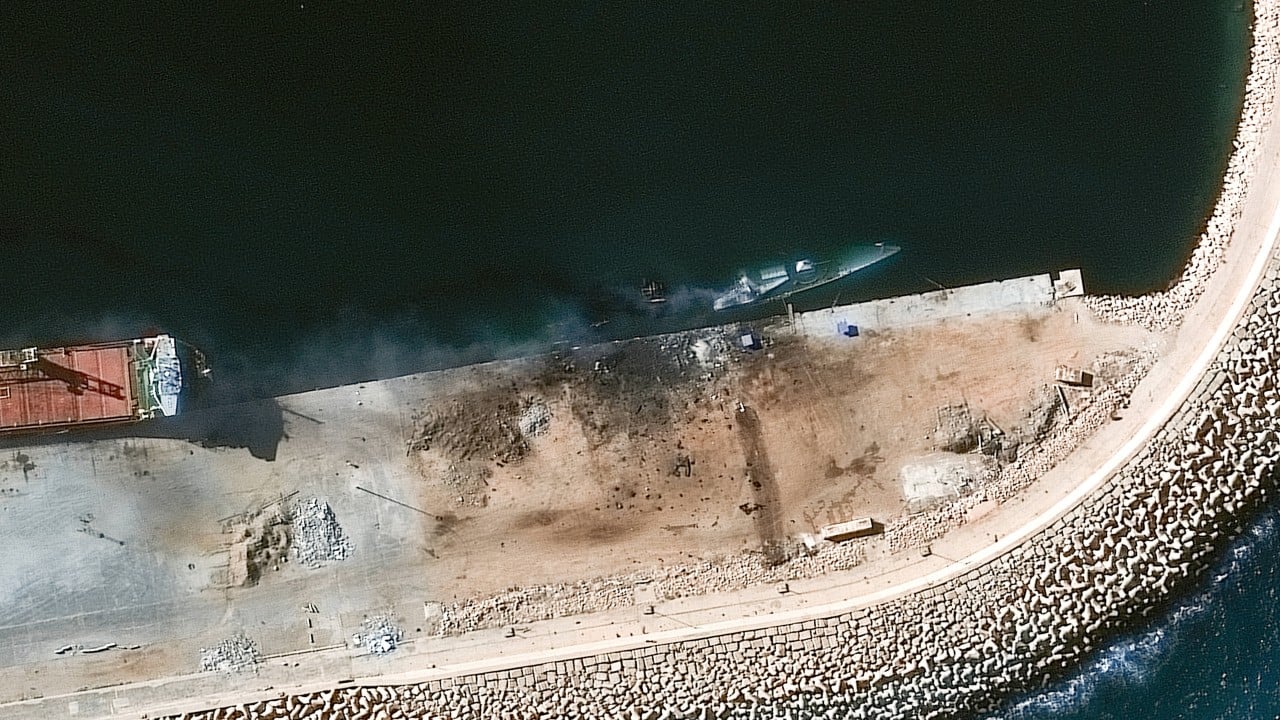
Most people think the war in Ukraine is stuck in the muddy trenches of the Donbas or confined to the choppy waters of the Black Sea. They're wrong. When suspected Ukrainian sea drones hit a Russian warship at a Libyan naval base, the entire map of modern naval warfare shifted overnight.
It wasn't just a random explosion in the Mediterranean. It was a calculated message sent thousands of miles away from Kyiv. If you've been following how unmanned surface vessels operate, you know they aren't simple remote-controlled speedboats anymore. They're long-range, satellite-guided weapons capable of hunting down high-value targets in ports that Moscow thought were completely safe. If you enjoyed this piece, you should read: this related article.
Let's look at what actually happened, why the Libyan coastline matters so much to the Kremlin, and what this strike means for global shipping and naval security.
Why a Russian Warship Was Sitting in a Libyan Port
To understand why suspected Ukrainian sea drones hit a Russian warship at a Libyan naval base, you have to look at Russia's bigger strategic headache. Following the collapse of Bashar al-Assad's regime in Syria and the loss of guaranteed, uncontested access to the Tartus naval facility, Moscow needed a new Mediterranean foothold. Fast. For another angle on this development, refer to the latest coverage from NBC News.
Eastern Libya—specifically ports like Tobruk and Benghazi controlled by Field Marshal Khalifa Haftar's Libyan National Army—became the obvious backup plan. Over the past couple of years, open-source intelligence analysts and maritime trackers have documented Russian landing ships, cargo vessels, and naval escorts making regular runs into Tobruk. They weren't just dropping off humanitarian aid. Satellite imagery analyzed by groups like the Royal United Services Institute has repeatedly shown heavy military hardware, air defense components, and supplies for Russia's Africa Corps offloading on those docks.
Moscow treated Tobruk like a safe rear-area logistics hub. After all, Libya is over 1,500 miles from the nearest Ukrainian-held coastline. Russian naval commanders assumed their vessels could dock, refuel, and transfer cargo without looking over their shoulders.
That assumption blew up right alongside their hull.
How Ukrainian Sea Drones Pulled Off a Mediterranean Strike
The immediate question everyone asks is simple. How do unmanned boats built in Ukraine end up inside a guarded harbor in North Africa?
They didn't drive all the way from Odesa through the Bosphorus Strait. Turkey strictly enforces the Montreux Convention, which blocks warships and military vessels from transiting between the Black Sea and the Mediterranean during wartime. Even if a low-profile drone tried to slip through, getting past Turkish naval patrols and Greek radar networks undetected is practically impossible.
Instead, military analysts point to two much more realistic launch methods:
- Commercial motherships: A civilian cargo vessel or fishing trawler operating in the international waters of the Mediterranean can easily conceal two or three sea drones inside standard shipping containers. Once the ship reaches international waters off the Libyan coast, a crane or stern ramp drops the drones into the water under the cover of darkness.
- Covert coastal launch teams: Intelligence operatives working with local contacts along the fractured Libyan coastline could assemble and launch modular unmanned vessels from isolated beaches miles away from the main naval base.
Ukraine's Main Directorate of Intelligence, known as the HUR, has a well-documented track record of operating far beyond Ukraine's borders. Ukrainian special operators have previously conducted drone and ground operations against Russian mercenary forces in Sudan. Moving maritime drones into the Mediterranean isn't a wild leap for an agency that has spent years perfecting asymmetric warfare.
What Makes Modern Sea Drones So Hard to Stop
If you've ever watched footage from Ukraine's Group 13 or the Security Service of Ukraine's Sea Baby units, you've seen how these attacks unfold. They don't send one drone. They send a wolfpack.
Traditional naval warships are designed to fight other warships, submarines, and supersonic anti-ship missiles. Their radar systems are tuned to scan the horizon for large metal hulls or high-speed aerial threats. A carbon-fiber sea drone sits barely two feet above the waterline. In choppy Mediterranean swells, radar screens often dismiss them as wave clutter until they're less than a kilometer away.
Even inside a harbor, defenses struggle. Ports rely on floating booms, patrol boats, and heavy machine guns mounted on piers. When multiple unmanned vessels attack simultaneously from different angles, defenders get overwhelmed. One drone draws fire and breaches the outer boom, while the second and third slip through the gap carrying hundreds of kilograms of high explosives straight into the warship's waterline.
Once a warhead detonates against the hull of a frigate or corvette in port, the damage is catastrophic. Even if the ship doesn't sink to the harbor floor, warped propeller shafts, flooded engine rooms, and shredded electronics take months or years to repair. And Russia has zero heavy naval drydocks in Libya capable of fixing a crippled warship.
The Bigger Strategic Headache for Moscow
This strike hurts Russia in ways that go far beyond a single damaged vessel. It breaks the illusion of sanctuary.
For months, the Kremlin has been trying to project power across the Sahel and North Africa, using Libya as a springboard to move weapons and fighters into Mali, Burkina Faso, and Niger. That entire supply chain depends on predictable maritime logistics. Ships need to enter port, sit at anchor for days while cranes unload heavy equipment, and steam back out without getting hit.
Now, every Russian captain entering the Mediterranean has to treat the open sea and friendly ports as active combat zones.
Think about what that forces the Russian Navy to do:
- Burn fuel and manpower on constant patrols: Warships can't just sit tied to a pier with skeleton crews anymore. They have to keep engines warm, maintain constant electronic warfare jamming, and post armed watchstanders around the clock.
- Reroute supply lines: Moving heavy armor by air via Ilyushin Il-76 transport planes is massively expensive and carries a fraction of what a single landing ship holds. Without safe sea lanes into Tobruk, Russia's Africa Corps faces severe supply bottlenecks.
- Lose diplomatic leverage: Local Libyan power brokers tolerated Russian ships because Moscow promised security and stability. Watching a Russian warship burn inside a Libyan harbor makes the Kremlin look vulnerable, not invincible.
Common Misconceptions About Naval Drone Warfare
Whenever news breaks about a strike like this, bad takes flood social media within minutes. Let's clear up a few things people consistently get wrong.
First, this doesn't mean traditional navies are obsolete. Warships still control sea lanes, project air defense umbrellas, and carry heavy firepower that a small unmanned boat can never match. What it does mean is that any navy operating without dedicated counter-drone sensors, acoustic detection nets, and automated close-in weapon systems is asking for trouble.
Second, people assume Western intelligence hands Ukraine a button to press and guides the drones directly onto the target. While intelligence sharing on Russian fleet movements happens regularly, the engineering, satellite communication relays, and terminal guidance software on vessels like the Magura V5 and Sea Baby were developed and refined by Ukrainian engineers under wartime pressure. They've iterated faster in three years than most defense contractors do in two decades.
Third, don't expect Moscow to easily retaliate in kind against Ukrainian ports in the Mediterranean—because Ukraine doesn't have any. Russia has plenty of targets scattered from the Baltic Sea to the Pacific Ocean, while Ukraine's naval footprint is already fighting for survival at home. That asymmetry gives Kyiv a massive advantage when choosing where and when to strike next.
What to Watch Next in the Mediterranean
If you track maritime security, defense policy, or global shipping routes, this incident isn't the end of the story. Watch how commercial insurance rates for vessels operating near eastern Libya react over the coming weeks, as underwriters hate unpredictable war-risk zones. Pay close attention to open-source satellite imagery of Tobruk and Benghazi to see whether Russian vessels start anchoring miles offshore instead of tying up at the main piers.
Most importantly, watch how other militaries adapt. Every naval commander from the Red Sea to the South China Sea just saw proof that an expensive warship isn't safe even when parked inside a foreign ally's harbor thousands of miles from the front line. If you're monitoring this conflict, start tracking maritime AIS transponder gaps in the central Mediterranean—that's where the next chapter of this war is already taking shape.