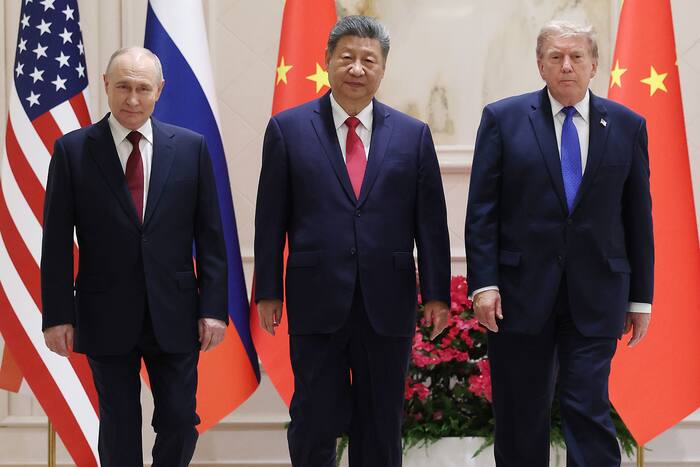
Everyone wants a clean cinematic ending when three superpowers sit down at the same table. You've seen the headlines treating the historic summit between Donald Trump, Xi Jinping, and Vladimir Putin like a Yalta-style carving up of the globe. That's a lazy read of what actually happened behind closed doors.
I've spent years tracking diplomatic communiqués and watching how leaders spin multilateral meetings for domestic cameras. When you strip away the staged handshakes and the breathless cable news commentary, a much messier reality emerges. None of these men walked away with a blank check, and none of them abandoned their core national interests just to pose for a photo op.
The real story isn't a sudden rebirth of global harmony. It's a cold, transactional recalibration among three leaders who deeply distrust each other yet desperately need breathing room on their own home fronts.
Why the Historic Summit Between Trump Xi and Putin Happened Now
Great powers rarely get into the same room out of goodwill. They do it when the cost of not talking gets too expensive.
By the time these three leaders agreed to sit together, each faced acute pressure that couldn't be solved through bilateral backchannels alone. Washington wanted off-ramps from simultaneous flashpoints in Eastern Europe and the Indo-Pacific without looking weak ahead of domestic economic pressures. Beijing needed relief from punishing tariff regimes and tech export controls that were squeezing its manufacturing sector. Moscow needed sanctions relief and a way to normalize its diplomatic standing after years of grinding conflict and economic isolation.
You can't solve a three-body problem two people at a time. Whenever the U.S. pushed Russia on European security, Moscow leaned harder on Beijing's economic lifeline. Whenever Washington squeezed China on trade or Taiwan, Beijing quietly coordinated with the Kremlin to complicate American logistics elsewhere. Putting Trump, Xi, and Putin in one room forced every side to stop playing one bilateral track against the other.
It was a pragmatic gamble. And honestly, it was long overdue.
Three Leaders Three Completely Different Playbooks
If you watch how each leader operated during the summit, you can see they weren't even playing the same game.
Trump Treated It Like a High-Stakes Boardroom Merger
Donald Trump has always preferred personalist diplomacy over slow-moving institutional bureaucracy. His team bypassed weeks of traditional State Department pre-negotiation drama to focus on direct leader-to-leader leverage.
His angle was blunt. Put tariffs, energy exports, and security guarantees on the table all at once, then dare the other two men to blink. Trump believes personal rapport can break through decades of diplomatic scar tissue. Critics call that reckless because it sidelines traditional European and Asian allies who weren't in the room. Supporters argue that traditional diplomacy had stalled for years anyway, so shaking the table was the only way to move the pieces.
Xi Played the Long Institutional Game
Xi Jinping doesn't do spontaneous deals. While Trump thrives on unpredictability, Xi spent months preparing talking points anchored in sovereignty, multipolarity, and supply chain stability.
Beijing's main goal wasn't to rescue Moscow or flatter Washington. It was to ensure China remains the indispensable economic hub that neither the U.S. nor Russia can afford to alienate completely. Xi used the summit to position himself as the steady adult in the room—the leader pushing for global trade predictability while Washington and Moscow argued over security architecture.
Putin Focused on Legitimacy and Leverage
For Vladimir Putin, simply being seated as an equal alongside the American and Chinese presidents was half the victory. Years of Western isolation strategies were designed to turn Russia into a permanent diplomatic pariah. Sitting at a trilateral summit shattered that narrative overnight.
Beyond optics, Putin's playbook was narrow and concrete. He wanted recognition of Russia's security perimeter in Eastern Europe, an easing of financial restrictions on Russian energy and banking sectors, and assurances that NATO expansion wouldn't resume under a different name.
The Biggest Myths About What Was Actually Agreed
Social media exploded with rumors of secret treaties and sweeping territorial swaps within hours of the closing press conference. Almost none of that holds up under scrutiny.
First, there was no grand bargain dividing the world into formal spheres of influence. Neither the U.S. Congress nor China's Politburo would ratify a treaty that surrenders core strategic flexibility. What actually emerged were parallel frameworks—essentially working groups tasked with de-escalating military incidents at sea, stabilizing critical mineral trade, and keeping communication lines open during regional crises.
Second, Russia and China didn't break up. Western pundits love predicting a Sino-Russian split every time Putin smiles at an American president. That's wishful thinking. China still relies on discounted Russian oil, gas, and raw materials, and Russia still depends on Chinese industrial goods and diplomatic cover at the United Nations. The summit created a pressure valve for Moscow, not an exit ramp from Beijing.
Third, America's allies haven't been abandoned, though they're definitely rattled. European capitals and leaders in Tokyo and Seoul watched nervously from the sidelines because trilateral great-power talks naturally make smaller nations feel like menu items rather than diners. Yet behind the scenes, American diplomats spent days briefing allied counterparts to clarify that no bilateral defense treaties were altered.
What the Communiqué Left Out Tells the Real Story
When analyzing high-level diplomatic readouts, the omissions matter way more than the adjectives.
Look closely at what wasn't resolved during the summit:
- Semiconductor and AI export controls: Washington kept its core restrictions on advanced computing chips aimed at Beijing, signaling that tech competition isn't going away anytime soon.
- Nuclear arms control: While all three leaders acknowledged the danger of strategic miscalculation, there was no binding replacement for lapsed bilateral nuclear treaties, nor did Beijing agree to cap its expanding arsenal.
- Cyber operations and election interference: The final statements used vague boilerplate language about digital stability without establishing verification mechanisms or penalties for state-backed hacking.
- Maritime disputes in the South China Sea: Both Washington and Beijing restated their standard positions without altering patrol schedules or territorial claims.
Basically, the three powers agreed to stop stepping on each other's toes in ways that could trigger an accidental war, while leaving every structural rivalry intact.
How This Shifts Markets and Geopolitics Right Now
You don't need a foreign policy degree to see how this affects everyday economics and global stability.
Energy and commodity markets react immediately whenever Washington and Moscow hint at lower friction. Even modest steps toward easing sanctions enforcement or clarifying shipping insurance rules can cool oil price volatility and shift global liquefied natural gas routes. Meanwhile, any pause in escalating U.S.-China tariff threats gives multinational manufacturers breathing room to untangle supply chains across Southeast Asia and North America.
For businesses and investors, the takeaway is straightforward. Stop pricing in an imminent superpower collision, and start pricing in managed competition. Volatility won't vanish because the underlying disputes over Taiwan, Ukraine, currency dominance, and artificial intelligence haven't been solved. They've just been moved from a boiling pot to a controlled simmer.
How to Read the Next Phase Without Falling for Spin
If you want to track whether this historic summit between Trump, Xi, and Putin actually holds up over the coming months, ignore the speeches and watch three concrete indicators instead.
Watch military hotline usage and naval encounters in the Black Sea, Baltic Sea, and Taiwan Strait. Real de-escalation shows up when fighter jets stop buzzing reconnaissance planes at unsafe distances, not when leaders praise each other at banquets.
Track customs data and tariff exemptions published by the U.S. Trade Representative and China's Ministry of Commerce. Diplomatic warmth means nothing if import duties and entity-list blacklists keep expanding every quarter.
Pay attention to allied defense spending and diplomatic visits across Europe and East Asia. If Warsaw, Berlin, Tokyo, and Canberra keep accelerating independent weapons production and regional defense pacts, it proves they don't trust the trilateral truce to last.
Great-power summits never fix the world in a single weekend. At best, they buy time. Use that time to look past the political theater, follow the hard economic and military data, and judge these leaders by what they sign into law rather than what they promise at a podium.