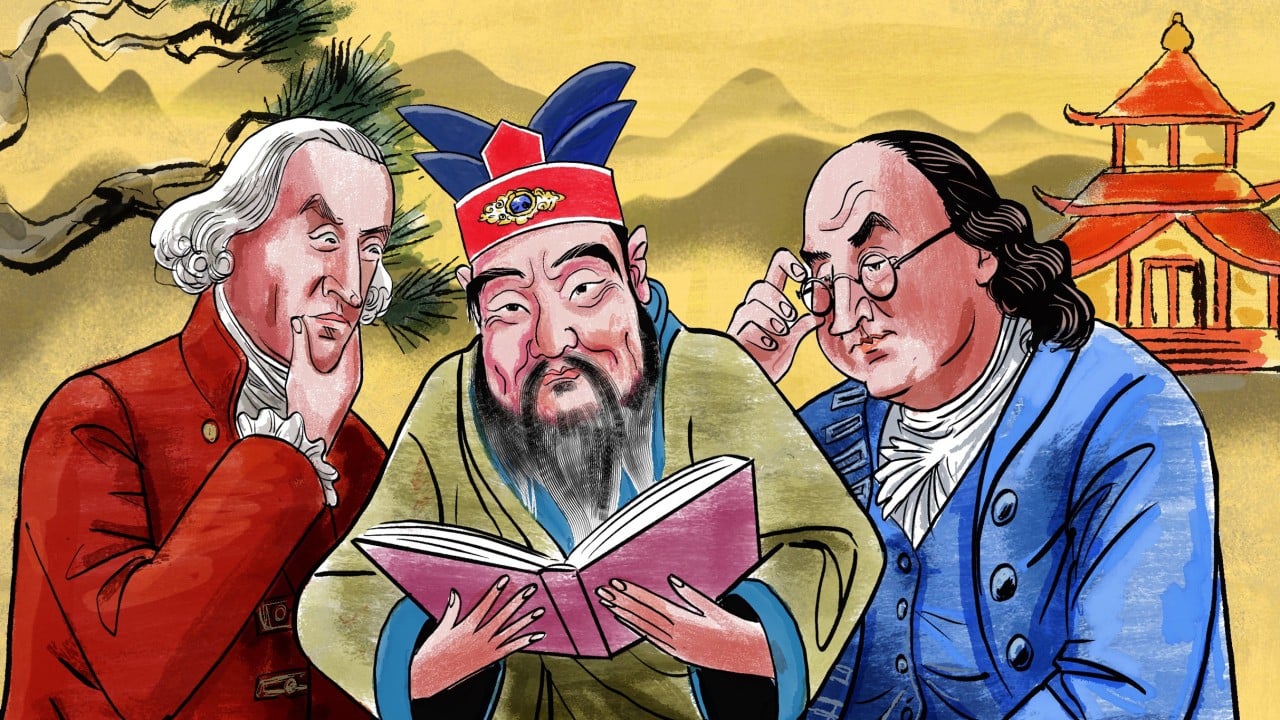
You probably think the ideas behind the American Revolution came entirely from European minds like John Locke, Montesquieu, and Voltaire. That's the version taught in every high school history class. But it's an incomplete story. When men like Benjamin Franklin, Thomas Jefferson, and James Madison sat down to construct an entirely new civilization from scratch, they looked far beyond the Atlantic. They looked directly to ancient China.
During the eighteenth century, a massive wave of global intellectual trade brought translated texts of the Chinese philosopher Confucius right into the hands of colonial America's elite. The American founding fathers didn't just read these books out of curiosity. They used Confucian moral philosophy, statecraft ideas, and structural concepts to help build a brand-new republic.
The real question behind this historical reality isn't just whether they read it, but why they needed it. The founders desperately wanted to break free from the hereditary, corrupt monarchies of Europe. They found a blueprint for a society based on merit, civic virtue, and secular morality in a civilization that had already been operating that way for two thousand years.
Benjamin Franklin and the Pursuit of Moral Perfection
Benjamin Franklin was colonial America’s ultimate Sinophile. His obsession with Chinese civilization started early. During his stay in London between 1724 and 1726, an eighteen-year-old Franklin got his hands on The Morals of Confucius, a 1691 English translation of Latin works compiled by Jesuit missionaries. It fundamentally altered how he viewed personal development.
When Franklin returned to Philadelphia, he used his own media machine to spread these ideas. In March 1737, he published extensive excerpts from The Morals of Confucius in his newspaper, The Pennsylvania Gazette. He told his readers that this philosophy was the direct path to "the sublimest wisdom."
If you read Franklin’s famous Autobiography, you'll find his famous system for achieving "moral perfection" through thirteen specific virtues like temperance, silence, order, and frugality. Historians who compare Franklin’s personal journals with early translations of The Analects have discovered that eleven out of Franklin's thirteen virtues line up almost exactly with Confucian tenets.
Virtue Comparison: Franklin vs. Confucius
------------------------------------------
Franklin's Temperance: "Eat not to dullness; drink not to elevation."
Confucian Direct Source: "Eat to increase thy strength... preserve the life received from heaven."

Franklin's Sincerity: "Use no hurtful deceit; think innocently and justly."
Confucian Direct Source: "Be serious, and not precipitate in our answers... moderate and reserved."
Franklin explicitly wanted a moral framework separate from Christian dogma. He saw Confucianism as a way to cultivate good citizens without relying on religious threats of hellfire. In a July 1749 letter to the famous colonial clergyman George Whitefield, Franklin argued that using the Confucian style of teaching virtues had a massive impact because people often "fear less the being in Hell, than out of the fashion."
Destroying the European Class System with Meritocracy
The most radical part of the American experiment was rejecting the idea that kingly or noble blood gave you the right to rule. European tradition said authority descended from God down to a hereditary king, then to the nobles, and finally to the people.
Franklin utterly despised this. To fight back against the Society of the Cincinnati—a post-Revolutionary organization that tried to establish a hereditary aristocracy for military officers—Franklin looked directly to Chinese history. He explicitly argued against hereditary honors by citing the Chinese system, writing:
"Among the Chinese, the most ancient, and, from long Experience, the wisest of Nations, Honour does not descend but ascends. If a Man from his Learning, his Wisdom or his Valour, is promoted by the Emperor to the Office of mandarin, he becomes illustrious of course: but his Parents also are made illustrious."
This concept of upward social mobility based entirely on merit, learning, and character rather than who your father was came straight out of imperial China's civil service system. It gave the founders intellectual ammunition to build a nation where a poor kid from Philadelphia could become one of the most powerful diplomats on earth.
Jefferson, Madison, and the Pursuit of Happiness
Thomas Jefferson was another heavy consumer of Enlightenment translations of Chinese philosophy. He famously included "the pursuit of happiness" as an unalienable right in the Declaration of Independence. While many track this back to European writers, the specific phrasing and political framing heavily mirror the Confucian link between a ruler’s personal virtue, the benevolence of the state, and the literal happiness of the citizens.
Jefferson’s personal library catalogs show he owned multiple volumes on Chinese history and philosophy. His contemporaries frequently noted the structural similarities in his worldview. He was even compared directly to Confucius by his peers for his efforts to establish secular educational systems designed to produce a "natural aristocracy" of talent and virtue rather than wealth.
James Madison, the primary architect of the US Constitution, took his admiration a step further into his daily environment. Visitors to his Virginia estate, Montpelier, noted that he kept a portrait of Confucius hanging proudly on his wall. For Madison, the Chinese sage wasn't a distant curiosity; he was a fixture of the intellectual universe that shaped the American political framework.
Beyond Philosophy: Practical Chinese Technology in Early America
The founders weren't just ivory-tower intellectuals talking about ethics over tea. They were practical builders facing extreme material shortages in a wild, undeveloped continent. Franklin, in particular, looked to China for immediate solutions to economic and environmental problems.
By the 1740s, wood shortages were hitting colonial cities hard because people were cutting down massive swaths of forest just to stay warm in the winter. Franklin studied the northern Chinese method of heating homes using underfloor brick channels. This research directly influenced his invention of the Pennsylvania Fireplace, famously known as the Franklin Stove, which revolutionized home heating efficiency in early America.
When the colonies wanted to declare economic independence from Great Britain, they needed to stop relying on British imports. Franklin and his botanist friend John Bartram worked together to transplant valuable Chinese agricultural products to American soil. In 1772, Franklin successfully obtained Chinese rhubarb seeds and sent them to Bartram to kickstart local production. He also sent Chinese prints detailing silk production methods to Ezra Stiles, the president of Yale University, hoping to establish a domestic silk industry in Connecticut.
Even the way American ships were built changed because of Chinese influence. Franklin carefully analyzed reports of Chinese maritime technology and published articles advocating for the adoption of water-tight compartment construction. He recognized that dividing a ship’s hull into separate sealed sections would keep a vessel afloat even if it struck a rock—a standard Chinese practice that Western shipbuilders had ignored for centuries.
The Physical Legacy in Washington
This historical crossover isn't just preserved in dusty old letters. You can see it carved directly into the literal stone foundations of American democracy.
If you walk up to the East Pediment of the U.S. Supreme Court building in Washington, D.C., you won't just see Western figures. The central sculpture features three monumental lawgivers who shaped human civilization: Moses, Solon, and Confucius. Designed by sculptor Hermon Atkins MacNeil in 1935, this structural choice permanently honors the reality that the foundational architecture of American law and societal order drew deep inspiration from the Far East.
U.S. Supreme Court East Pediment Lawgivers
1. Moses (Representing religious and moral law)
2. Solon (Representing Greek civic and constitutional law)
3. Confucius (Representing Eastern moral philosophy and civic virtue)
The next time you read the founding documents or look at the architecture of the American republic, remember that the intellectual universe of 1776 was global. The founding fathers were looking for anything that worked to break the chains of European monarchy. They found exactly what they needed by looking westward across the Pacific to an ancient Chinese tradition of merit, virtue, and practical science.
To truly understand the roots of American political thought, stop limiting your reading to European history. Dig into the early English translations of The Morals of Confucius from the 1700s to see the exact text that Franklin read. Look into the agricultural notes of John Bartram to see how Chinese plants shaped early American farming. Broadening your historical perspective changes how you see the entire foundation of the United States.