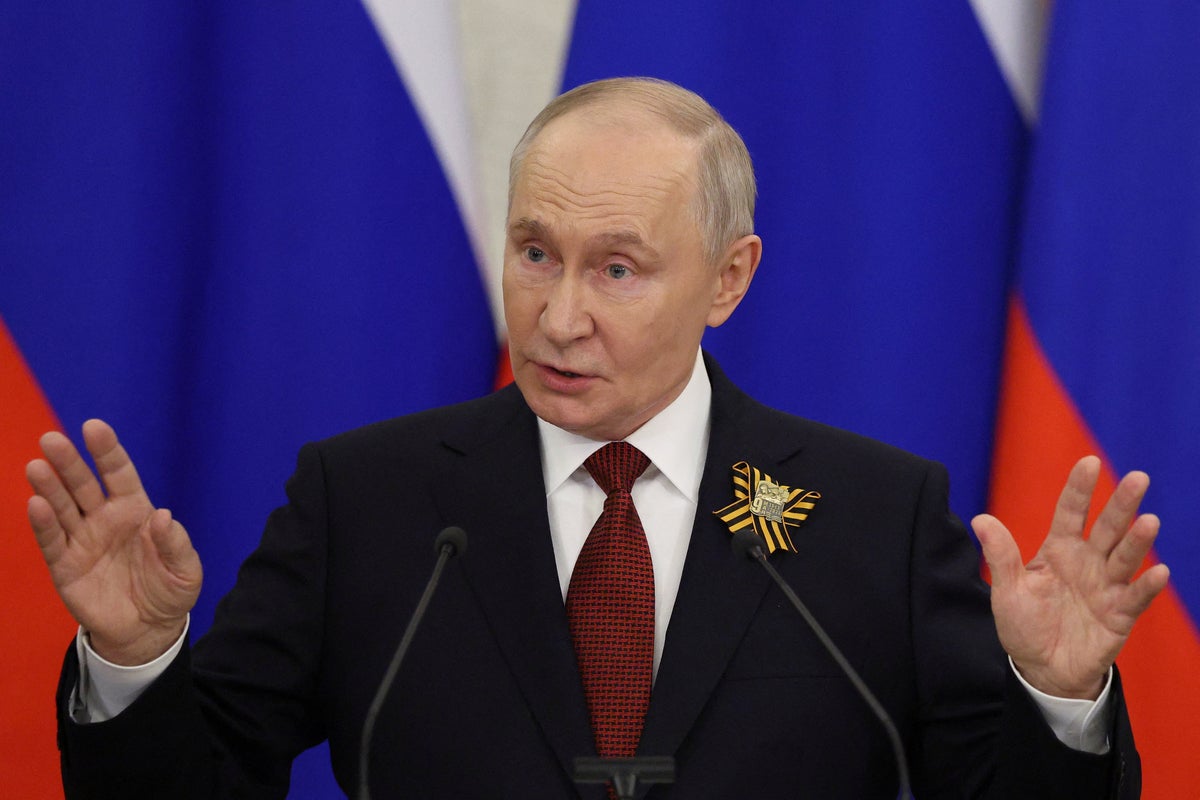
Western analysts are addicted to the "desperation" narrative. Every time Vladimir Putin mentions negotiations or hints at a ceasefire, the media cycle churns out a predictable slurry of headlines claiming the Kremlin is buckling under the weight of sanctions and battlefield losses. They call it a sign of weakness. They label it a cry for help.
They are dangerously wrong. Recently making waves lately: The Beijing Compliance Check.
This isn't desperation. It's a calculated psychological operation designed to exploit the West’s shortest-lived resource: political will. By dangling the carrot of a "war ending," Putin isn't signaling a white flag; he is sharpening his blade for a long-term siege that the NATO coalition is structurally unequipped to handle.
The Consensus Is Lazy and Lethal
The mainstream argument suggests that Russia’s economy is a hollowed-out shell and its military is a disorganized mess. The "desperation" theory relies on the assumption that Putin needs an exit ramp because he is "losing." Additional information regarding the matter are detailed by BBC News.
If you look at the raw mechanics of a war of attrition, Russia isn't losing; it’s recalibrating. Russia has successfully pivoted to a total-war economy. While Western capitals bicker over budget cycles and election-year optics, Moscow has streamlined its military-industrial complex to outproduce the entire European Union in artillery shells.
When Putin talks about peace, he isn't looking for a way out. He is looking for a pause that allows him to consolidate gains, replenish stocks, and wait for the inevitable fracture in Western support. It is a classic Soviet "maskirovka" tactic—deception aimed at making the enemy believe you are weaker than you are.
Sanctions Are a Blunt Instrument in a Scalpel Fight
We were told sanctions would collapse the Ruble and spark a popular uprising. I’ve watched analysts in D.C. and London bet their careers on the idea that cutting Russia off from SWIFT would be the "financial nuclear option."
It wasn't.
Russia spent a decade "fortress-proofing" its economy. They shifted trade to the Global South, built alternative payment rails with China, and turned the energy market into a weapon of high-frequency manipulation. The "desperation" the West sees is actually a hardened, autarkic system that has learned to thrive in the shadows.
If Putin were truly desperate, we wouldn't see him hosting high-level diplomatic summits in Kazan or deepening ties with Tehran and Beijing. We would see him making genuine, painful concessions. Instead, his "peace offers" always include the same non-negotiable demands: total recognition of annexed territories and a neutral Ukraine. That’s not a plea for mercy. That’s a demand for surrender wrapped in the language of diplomacy.
The Democracy Trap
The Kremlin understands something Western leaders refuse to admit: democracies have a shelf life for conflict. Putin is playing for 2025, 2026, and beyond. He knows that in every Western nation, there is a growing faction of voters who are tired of funding a "forever war" while their own inflation rates climb and infrastructure crumbles.
By appearing "ready to talk," Putin provides ammunition to these populist movements. He allows them to argue that the only thing standing between the world and peace is the "warmongering" stance of their own governments. It’s a brilliant play on the internal contradictions of the West.
The Attrition Reality Check
Let’s look at the numbers—the real ones, not the sanitized versions.
- Manpower: Russia has a mobilization pool that dwarfs Ukraine’s. They can absorb losses that would trigger a revolution in any Western country.
- Material: Despite the "junk tanks" narrative, Russia’s ability to refurbish Soviet-era armor and deploy cheap, effective loitering munitions (like the Geran-2) has created a cost-asymmetry that favors the defender.
- Energy: Europe is still, through various backdoors and LNG loopholes, funding the very machine it claims to be dismantling.
The Flawed Premise of "Victory"
The biggest mistake the "desperation" crowd makes is misdefining what victory looks like for the Kremlin. Putin doesn't need to take Kyiv tomorrow. He doesn't even need to take it next year. He only needs to ensure that Ukraine never becomes a viable, Western-aligned state.
A "frozen conflict" is a win for Russia.
A "negotiated settlement" that leaves him in control of the Donbas is a win for Russia.
A "ceasefire" that breaks the momentum of Western aid is a win for Russia.
When he claims the war is ending, he is setting the stage for a victory on his terms, not ours. He is daring the West to stop the flow of billions, betting that we will take the bait because we are desperate for a return to "normalcy."
Stop Looking for a Collapse That Isn't Coming
I’ve seen this play out in corporate restructuring and geopolitical shifts alike: the incumbent player acts wounded to lure the aggressive newcomer into an overextended position. The West is currently overextended—politically, militarily, and emotionally.
Putin’s rhetoric is a tool for managing Western escalation. Every time he mentions peace, it delays the delivery of more advanced weaponry. It creates hesitation in Berlin. It fuels debate in the U.S. Congress.
If you want to understand the truth, stop reading the lips of the man in the Kremlin and start looking at the factories in the Ural Mountains. They aren't slowing down. They are accelerating.
Russia is not looking for an exit; it is looking for an era. It is building a world where it can dictate terms to its neighbors regardless of what the "international community" thinks. If we keep interpreting his strategic maneuvers as signs of failure, we are going to find ourselves at a peace table where we have no cards left to play.
The "desperation" isn't in Moscow. The desperation is in our own refusal to acknowledge that the old world order is gone, and the new one is being forged in fire, not in the empty promises of a man who uses "peace" as a tactical reload.
Stop waiting for the Russian collapse. Start preparing for a reality where they don't go away. The war isn't ending because Putin is tired; it’s changing shape because he thinks he’s winning.
Stop being the easy mark.