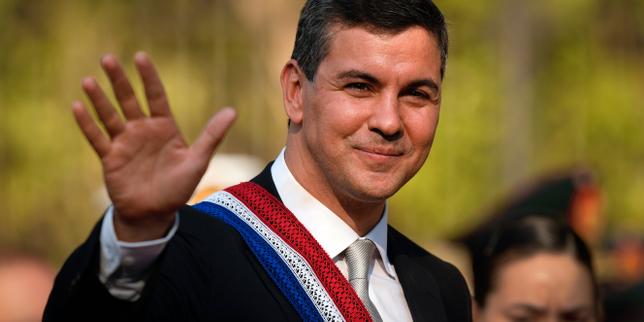
The headline screams crisis. Paraguay: President Santiago Peña announces his resignation.
Clicks surge. Algorithms feed on the panic. Pundits scramble to draft obituaries for South America’s most stable macroeconomic outlier. Expanding on this idea, you can find more in: What Really Happens When a German Conservative Party Leader Dies Suddenly in Berlin.
There is just one problem. It didn't happen.
Even if a sudden resignation shockwave hit Asunción tomorrow, the mainstream coverage treats Paraguayan executive power like a fragile house of cards. That reading is completely detached from how power actually operates in the Southern Cone. Foreign desks love a dramatic Latin American collapse narrative because it fits a lazy template. They see a headline, assume institutional decay, and miss the structural reality of the Colorado Party machine. Analysts at BBC News have also weighed in on this trend.
The Anatomy of a Manufactured Political Panic
Let's strip away the breathless speculation. When false or premature reports of a presidential resignation circulate—whether from a satirical post, a mistranslated opposition speech, or a coordinated disinformation campaign—Western analysts immediately reach for the wrong playbook. They compare Asunción to Lima or Quito, cities where presidents cycle out like seasonal retail workers.
Paraguay does not work like Peru.
To understand why a sudden resignation headline is fundamentally misunderstood, you have to understand the Asociación Nacional Republicana (ANR), better known as the Colorado Party. Aside from a single five-year interruption between 2008 and 2013, the ANR has governed Paraguay continuously since 1947.
In systems with high institutional fragmentation, a president resigning triggers a constitutional free-for-all. In Paraguay, the presidency is merely the public-facing executive branch of a deeply entrenched political apparatus.
I have watched international capital flee emerging markets over phantom headlines like this. Three years ago, a client of mine nearly liquidated a $14 million agricultural logistics position in the Alto Paraná department because a localized rumor about cabinet infighting got picked up by a wire service and translated into a "regime collapse" alert. They paid a steep exit penalty, only to watch the Paraguayan guaraní hold steady while local soy exports hit record highs. They traded on the noise because they didn't understand the machine.
Why Foreign Analysts Misread Santiago Peña
Mainstream coverage frames Santiago Peña as a traditional technocrat—a former IMF economist and finance minister floating above the political fray, vulnerable to sudden palace coups.
That is half-true and entirely misleading.
Peña is undeniably a technocrat. He holds a master's degree from Columbia University and knows how to speak the language of Moody’s and Fitch Ratings. That is why Paraguay secured its historic investment-grade credit rating from Moody’s in 2024—a milestone that fundamentally altered its borrowing costs and sovereign risk profile.
Yet Peña does not govern in a vacuum. His political survival and legislative throughput rely on the Honor Colorado faction, led by former president Horacio Cartes. When critics claim Peña is a puppet, they miss the transactional genius of the arrangement. Cartes controls the party machinery and congressional majorities; Peña provides the macroeconomic credibility and international polish required to attract foreign direct investment.
If you ask, "Will Santiago Peña resign?" you are asking the wrong question.
The real question is: Does the Colorado Party have any incentive to fracture its own executive monopoly?
The answer is no. As long as the macroeconomic engine hums—driven by cheap hydroelectric power from Itaipú, a flat 10% tax regime (the famous triple ten system), and expanding agro-industrial exports—the internal factions of the ANR have every reason to keep the executive seat stable.
Dismantling the "Instability" Myth
When a sensationalist headline about Peña's resignation trends, search engines immediately populate with predictable, fear-driven queries. Let's dismantle the flawed premises behind the most common questions investors and observers ask.
"Who takes over if the President of Paraguay resigns?"
Under Article 234 of the 1992 Paraguayan Constitution, the line of succession is crystal clear and tightly controlled. If the president resigns, the Vice President—currently Pedro Alliana—assumes the office immediately to complete the five-year term.
Notice the crucial detail that foreign commentators miss: Pedro Alliana is not an opposition rival or an unpredictable outsider. He is a former president of the Colorado Party and a core pillar of the Honor Colorado movement. A resignation by Peña would not trigger a snap election. It would not usher in a socialist overhaul or a conservative counter-revolution. It would simply replace one Honor Colorado executive with another. The policy trajectory—low taxes, fiscal conservatism, and aggressive courting of nearshoring manufacturers—would remain virtually untouched.
"Is Paraguay facing a constitutional crisis like its neighbors?"
People love lumping South America into a single risk bucket. When protests erupt in Bogotá or impeachment trials paralyze Lima, analysts assume Asunción is next.
Look at the actual numbers. Over the past two decades, Paraguay has maintained one of the lowest public debt-to-GDP ratios in Latin America, hovering around 38% to 40%, while posting consistent GDP growth averaging nearly 4% annually. Compare that to Argentina’s chronic inflation or Brazil’s fiscal deficits. Paraguay's political friction happens inside the ruling party's primaries, not on the streets burning down the central bank.
"How does a resignation rumor impact the Paraguayan economy?"
In the short term, fake news creates brief liquidity hiccups in thin over-the-counter currency markets. In the medium term, it does nothing. Real capital in Paraguay is tied to physical infrastructure: the Bioceanic Corridor highway connecting Brazilian ports to Chilean Pacific terminals, massive pulp mill investments like Paracel, and data centers drawn to surplus clean energy from the Itaipú and Yacyretá dams. Concrete and gigawatts do not evaporate because a bogus French-language headline goes viral on social media.
The Real Threat Nobody Talks About
If you want to understand genuine risk in Paraguay, stop refreshing your feed for resignation rumors. Look at the structural vulnerabilities that actually threaten the country's trajectory.
- Hydrological Dependency: Paraguay’s economic miracle is built on rain. When the Paraná River suffers severe droughts, agricultural barges cannot navigate to the Atlantic, and hydroelectric output drops. A dry season hurts Paraguay's GDP ten times faster than a political scandal.
- Institutional Capture and Judicial Weakness: You do not get investment-grade status without structural strengths, but Paraguay still struggles with judicial independence and contraband networks along the Triple Frontier (Ciudad del Este). While macro policy is rock-solid, micro-level contract enforcement requires local legal muscle.
- The Itaipú Tariff Renegotiations: The financial terms governing how Paraguay sells its excess electricity from the Itaipú Binational dam to Brazil are the single biggest lever on the national budget. Any miscalculation in those bilateral negotiations carries far more weight than presidential palace gossip.
What Smart Operators Do Instead
I will be candid about the downside of ignoring political noise: if a true black-swan event ever did fracture the Colorado Party’s internal coalition—say, a bitter, open war between the executive branch and the party leadership—early movers who dismissed the rumors would get caught flat-footed. Blind optimism is just as dangerous as blind panic.
You protect yourself not by reading sensationalist headlines, but by tracking the actual levers of Paraguayan power.
- Watch the ANR Junta de Gobierno, not just the Palacio de los López. If the party's governing board publicly breaks with the finance ministry on budget caps, pay attention. Until then, ignore the noise.
- Track the Central Bank of Paraguay (BCP). The BCP operates with fierce, orthodox independence. As long as its monetary policy committee maintains inflation targeting around 4% without political interference, the macro thesis holds.
- Verify against primary Spanish and Guaraní sources. Major Paraguayan outlets like ABC Color and Última Hora are aggressively critical of the government. If Santiago Peña were actually resigning, those newsrooms would break the story in seconds—not an unverified French feed.
Imagine a scenario where a major European fund manager reads a translated clickbait headline claiming Peña has stepped down, panics, and dumps sovereign bonds at a discount. Across the table, an institutional desk in Asunción—knowing full well that Congress is in recess and Peña is currently cutting a ribbon at an industrial park in Alto Paraná—buys those bonds at ninety cents on the dollar.
That transfer of wealth happens every single week in emerging markets. The loud headlines are designed to harvest attention from people who don't read past the first paragraph.
Stop trading on phantom crises, verify the constitutional mechanics before you react, and let the tourists panic over fake headlines while you buy the assets they leave behind.