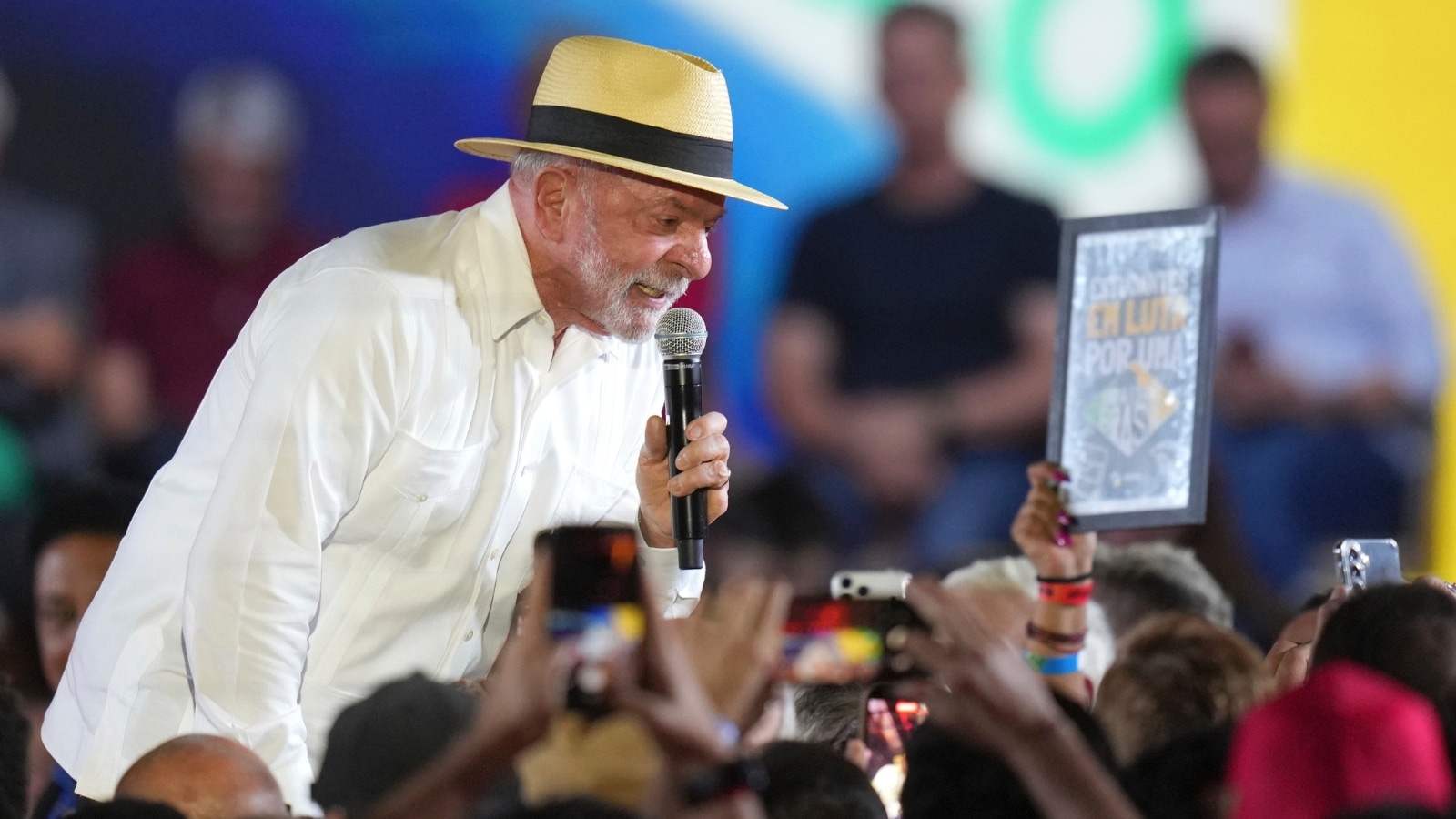
The rain in São Paulo on that late October Sunday did not fall like a storm; it fell like a curtain, heavy and gray, blurring the neon red of the Workers’ Party flags against the bright yellow jerseys of the right.
Wait.
Listen to the sound of a Brazilian electronic voting machine. It is a sharp, electronic pirilililil—a cheerful, almost toy-like chime that signals a citizen’s voice has been locked into the memory of the republic. For hours on October 30, 2022, that sound echoed across twenty-six states and a federal district, from the air-conditioned concrete schools of Rio de Janeiro to the wooden riverboats docking along the muddy banks of the Amazon. Every chime was a micro-event, a tiny drop of ink in a ledger that would decide whether South America’s largest democracy would double down on the nationalist populism of Jair Bolsonaro or return to the scarred, triumphant hands of Luiz Inácio Lula da Silva.
By the time the Superior Electoral Court called the race just before eight o’clock that evening, the numbers looked like a typographical error. Lula had won 50.9 percent of the valid votes. Bolsonaro had taken 49.1 percent. Across a continent-sized nation of more than two hundred million people, the margin between two wildly incompatible visions of human existence came down to just over two million ballots—a razor’s edge so thin you could barely slide a voter registration card between the halves.
Most news reports treated that evening like a box score. They listed the percentages, noted that Lula had become the first Brazilian president to win a third non-consecutive term, and mentioned that Bolsonaro was the first incumbent to lose a bid for reelection since the country returned to democracy in 1985. Those are the bones of the story, cold and brittle. If you stop there, you miss the fever that gripped the streets, the quiet terror at the dinner table, and the way a single election turned neighbors into strangers who spoke different languages while standing on the same sidewalk.
The Kitchen Table in Belo Horizonte
To understand what happened in that runoff vote, leave the marble halls of Brasília and step into a hypothetical kitchen in Belo Horizonte—a composite portrait drawn from thousands of real families torn down the middle during the campaign.
Call the father Mateus. He is fifty-four, owns a small auto-parts shop, and spent the last four years watching his margins shrink while his faith in traditional institutions evaporated. To Mateus, Jair Bolsonaro was not merely a politician; he was a blunt instrument wielded against a corrupt establishment that had taken Mateus for granted. When Mateus looked at the economy, he saw a government that had tried to keep businesses open during a global pandemic, a leader who spoke without a filter, and a defender of the church, the family, and the right to bear arms against the crime creeping into his neighborhood. When Mateus heard Lula’s name, he did not hear "champion of the poor." He heard Operation Car Wash. He remembered the massive corruption scandals that had engulfed the Workers’ Party years earlier, the television images of executives in handcuffs, and the 580 days Lula spent inside a federal police cell in Curitiba before the Supreme Court annulled his convictions on procedural grounds.
Across the table sits Mateus’s daughter, Clara. She is twenty-six, a primary school teacher whose monthly paycheck buys half the groceries it did four years ago. When Clara looked at the same four years, she saw something entirely different. She saw a government that mocked science while nearly seven hundred thousand Brazilians died of COVID-19. She saw satellite data showing deforestation in the Amazon surging to a fifteen-year high, turning the lungs of the planet into smoke that drifted all the way down to darken the afternoon sky over São Paulo. And when Clara thought of Lula, she remembered her grandmother talking about the early 2000s—when a former metalworker who grew up eating dirt to stave off hunger lifted tens of millions of Brazilians out of extreme poverty, expanded public universities to include kids from the favelas, and made the domestic worker’s daughter believe she could become a doctor.
Neither Mateus nor Clara was lying. Both were looking at the exact same country through completely different lenses, and neither could fathom how the other could be so blind.
A History Written in Scars
You cannot grasp the emotional voltage of Lula’s comeback without understanding the sheer improbability of his survival. In politics, second acts are rare; third acts after imprisonment and political exile are practically unheard of.
Born in 1945 in the arid, impoverished backlands of Pernambuco, Lula was the seventh of eight children. He did not learn to read until he was ten. He lost his left pinky finger in a metal press while working on a factory floor in São Bernardo do Campo—a physical mark that would later become a symbol of his bond with the working class. From the union halls of the 1970s, where he led massive strikes against a military dictatorship, to three consecutive failed presidential bids in 1989, 1994, and 1998, his life was a study in stubborn endurance.
When he finally won the presidency in 2002 and governed through two terms ending in 2010, global commodities were booming, and Brazil felt unstoppable. He left office with an approval rating hovering near eighty-seven percent, an almost mythical figure who had hosted the World Cup and the Olympics and turned Brazil into a diplomatic heavyweight.
Then came the fall.
The economic miracle soured under his handpicked successor, Dilma Rousseff, who was impeached in 2016 amid a bruising recession and a sprawling bribery investigation centered on the state-run oil giant Petrobras. By April 2018, Lula was behind bars, barred from running in the election that swept Jair Bolsonaro—a former army captain and longtime fringe congressman—into the Planalto Palace. Many political analysts declared Lula finished, a relic of a bygone era.
Yet here is where human psychology diverges from political science. Adversity does not always destroy a political brand; sometimes it distills it. While Lula sat in his cell, the economic pain of the late 2010s and the trauma of the pandemic reshaped the memory of his presidency. For millions of low-income families struggling to afford cooking gas and chicken bones—a grim viral symbol of inflation in 2021 and 2022—the Lula years became a golden age of full plates and upward mobility. When the Supreme Court threw out his convictions in 2021, ruling that the judge who oversaw his trial had been biased and had colluded with prosecutors, the stage was set for a collision of titans.
The Machinery of Doubt
If the 2022 runoff had simply been a referendum on economic policy, it would have been tense enough. What turned it into an existential crisis for Brazilian democracy was a relentless campaign against the voting system itself.
For months leading up to the October vote, Jair Bolsonaro repeatedly claimed, without providing verifiable evidence, that Brazil’s electronic voting machines were vulnerable to fraud. Introduced in 1996, the machines are air-gapped—never connected to the internet—and have been audited repeatedly by domestic and international observers, including the military, without a single documented case of systemic tampering. Yet repetition has its own gravity. By the time voters walked into the polling booths, millions of Bolsonaro supporters genuinely believed the system was rigged against them, while millions of Lula supporters feared the election would be stolen or overturned by a coup.
Consider what happens when the referee is declared corrupt before the whistle even blows. Every delay in tallying becomes proof of a conspiracy. Every regional swing becomes suspicious.
On the night of the runoff, the early returns favored Bolsonaro, largely because votes from the wealthier, more conservative southern and southeastern states were counted first. Across Bolsonarista group chats on WhatsApp and Telegram, celebration erupted early. Then, as the evening wore on, the results from the Northeast—Brazil’s poorest region and Lula’s unshakable heartland—began pouring into the central servers in Brasília.
The graph shifted. Slowly, inexorably, the red line climbed past the yellow line.
In the streets of São Paulo’s Avenida Paulista, the roar from the crowd gathered outside Lula’s campaign headquarters sounded less like a party and more like an exhale after holding breath for four years. People wept openly, clutching flags, strangers hugging strangers in the rain. Meanwhile, miles away and across the country, highway blockades began forming as furious truckers and Bolsonaro loyalists parked their rigs across major arteries, refusing to accept the math on the screen.
The Invisible Stakes
Why did an election in South America command the breathless attention of Washington, Brussels, Beijing, and environmental scientists around the globe? Because the invisible stakes extended far beyond Brazil’s borders.
First, there was the Amazon. Roughly sixty percent of the world’s largest tropical rainforest lies within Brazilian territory, acting as a massive carbon sink that helps regulate the global climate. Under Bolsonaro, environmental enforcement agencies had been hollowed out, and illegal mining and logging had pushed deep into Indigenous territories. Lula campaigned explicitly on a pledge of zero deforestation by 2030, promising to restore Indigenous land protections and rejoin global climate diplomacy. For climate scientists, the 2.1 million-vote margin was not a partisan victory; it was a reprieve from an ecological tipping point.
Second, there was the test of democratic resilience in the Western Hemisphere. Following the January 6 attack on the United States Capitol in 2021, political observers watched Brazil with acute anxiety, wondering whether a polarized democracy could survive a narrow election contested by an incumbent with deep ties to the security forces. In the end, Brazil’s electoral courts held firm, international leaders—including U.S. President Joe Biden—moved swiftly to recognize Lula’s victory within hours, and the institutional guardrails bent without snapping, even though the deep fractures in society remained wide open, as the world would tragically witness again in January 2023 when rioters stormed government buildings in Brasília.
And finally, there was the question of how a leader governs half a country that did not want him.
The Weight of the Sash
On the night of his victory, speaking to a sea of supporters in São Paulo before heading to Avenida Paulista, Lula’s voice was raspy—worn down by months of rallies and the toll of seventy-seven years. He did not gloat. Instead, he struck a sober, almost weary note that acknowledged the razor-thin reality of his mandate.
"There are not two Brazils," he told the crowd, though every metric in the country suggested otherwise. "We are one single country, one single people, one single great nation."
To prove he meant it, he had already built the broadest, most ideologically awkward coalition of his career. His running mate, Geraldo Alckmin, was a center-right former governor of São Paulo who had run against Lula in 2006 and once called him a threat to democracy. Centrist economists, conservative senators, and environmental activists had swallowed their mutual suspicions to form a fragile alliance aimed at defeating Bolsonaro.
That coalition was both Lula’s greatest strength and his heaviest burden. Winning the election required promising social spending to lift the poor while promising fiscal discipline to calm nervous financial markets—a tightrope walk over a canyon with a hostile Congress waiting below.
The Morning After
I think often about the morning of October 31, 2022, when the rain finally stopped and the sun came up over the concrete neighborhoods of São Paulo and the red-earth roads of the interior.
The flags were still hanging from apartment balconies—red on the third floor, yellow on the fourth. The bakeries opened at six. The buses still groaned up the hills packed with workers staring quietly out the windows. Nothing had magically changed overnight; the groceries still cost too much, the forest was still bruised, and the bitterness between neighbors had not evaporated with the morning mist.
Yet something fundamental had been decided in the quiet privacy of millions of cardboard voting booths. A nation scarred by dictatorship, corruption, pandemic, and fury had stepped up to the edge of the abyss, looked down, and chosen to settle its deepest arguments not with bullets, nor with decrees, but with a sharp electronic chime in the rain.


