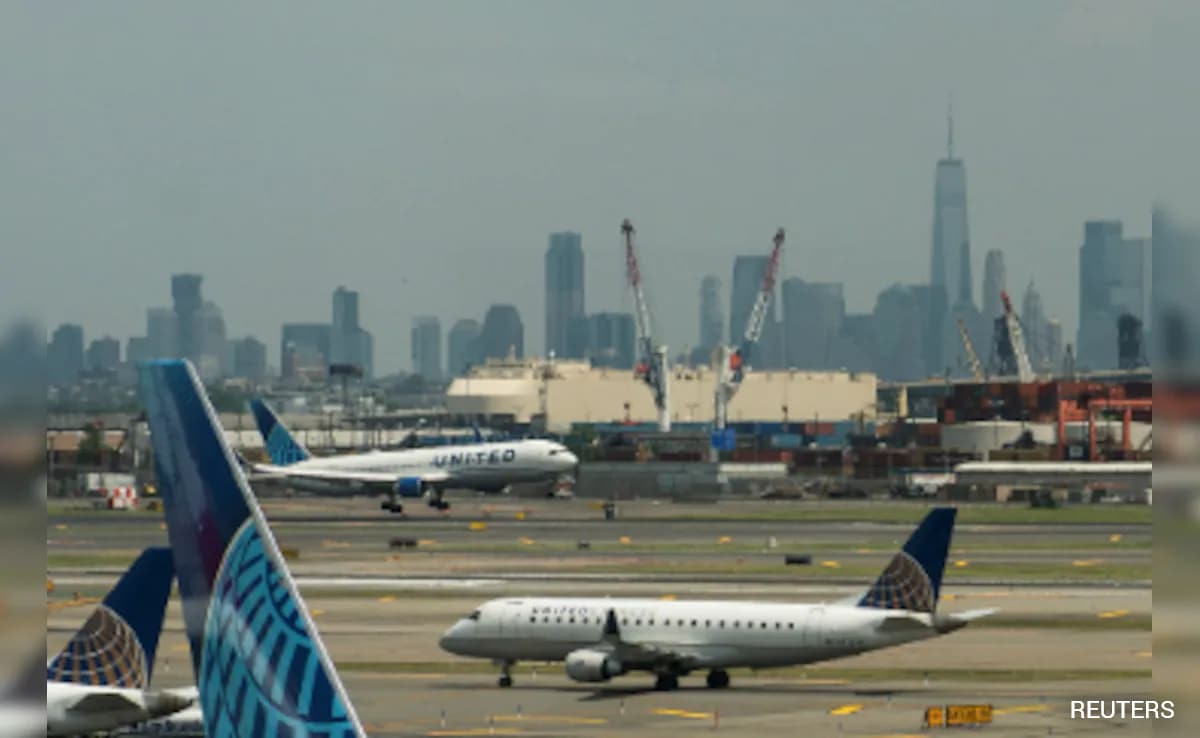
A United Airlines jet clipped a lamppost and a truck near Newark Liberty International Airport. The headlines are predictably hysterical. They paint a picture of chaos, incompetence, and a narrow escape from a fireball.
They are lying to you.
The media loves a "near-miss" narrative because fear sells clicks. But if you actually understand the physics of ground movement and the brutal reality of airport infrastructure, you realize this wasn't a failure. It was a demonstration of why air travel remains the safest way to move a human body across the planet.
Ground incidents are the boring, gritty tax we pay for the miracle of flight. If you’re sweating over a dented wingtip or a knocked-over light pole, you’re looking at the wrong end of the airplane.
The Myth of the Precision Taxi
Most people think pilots steer a 150,000-pound Boeing like they’re driving a Tesla with Autopilot. They imagine a world where every inch of pavement is mapped to a sub-millimeter level of accuracy.
It isn't.
Taxiing a commercial airliner is an exercise in managing massive inertia with visibility that would make a truck driver quit in protest. From the cockpit of a 737 or an A320, you can’t see your wingtips. You are essentially driving a building from the second-story window while trying to navigate a maze of painted lines that are often faded, wet, or obscured by glare.
When a wing clips a stationary object, it isn't "shoddy maintenance" or "declining standards." It is a mathematical inevitability of squeezing increasingly larger aircraft into airports designed in the 1960s. Newark (EWR) is a notorious sardine can. It is a masterpiece of spatial inefficiency. Expecting perfection in that environment is like expecting a professional athlete to never stub their toe. It's going to happen.
Crumple Zones Are For Your Protection
The "outrage" over a damaged wing ignores a fundamental engineering truth: airplanes are designed to break in specific ways to save lives.
Aviation wingtips are often designed with "weak links" or composite structures that fail predictably upon impact. If a wing hits a lamppost, you want the wingtip or the post to give way. You don’t want that energy transferred into the wing spar or the fuel tanks.
The fact that the plane clipped a truck and a pole and everyone walked off to complain on Twitter is proof the system worked. The structural integrity of the fuselage was never in doubt. The fuel system remained sealed. The "disaster" was a fender bender at 10 miles per hour.
Compare this to the highway. If you clip a pole at 10 mph in your SUV, you might trigger an airbag and total the vehicle. In aviation, we swap a part, run a non-destructive inspection (NDI), and the bird is back in the air within days.
The False Premise of Pilot Incompetence
Whenever a ground clip happens, the first instinct is to crucify the flight crew. "How could they not see it?"
I’ve sat in those cockpits. I’ve seen the "battle scars" of taxiways that were never meant to handle the wingspans of modern narrow-bodies. Pilots are managing a three-dimensional puzzle with two-dimensional tools. They are listening to rapid-fire ATC instructions, checking instruments, and trying to keep a massive turbine engine from sucking in debris.
The real culprit isn't a "distracted pilot." It’s Infrastructure Lag.
We are flying 2026 technology into 1950s geography. The FAA and airport authorities are constantly playing catch-up. They widen a taxiway, and then Boeing releases a plane with "scimitar" winglets that add another three feet of width. It’s a literal arms race.
If you want to be mad at someone, don't look at the pilot. Look at the Port Authority. Look at the decades of underinvestment in ground-based guidance systems like SMGCS (Surface Movement Guidance and Control System). We have the tech to prevent every single one of these incidents with automated sensors and ground-stop alarms, but we choose not to install them because it's cheaper to pay the insurance deductible on a clipped wing.
Why "Minor" Incidents Make Flying Safer
Here is the counter-intuitive truth that the "experts" on cable news won't tell you: we need these minor scrapes.
The aviation industry is built on a "No-Blame" culture (or at least it should be). Every time a United jet taps a pole at Newark, a massive data-collection machine kicks into gear.
- Was the taxiway line misaligned?
- Was the lighting at that specific intersection creating an optical illusion?
- Did the ground controller provide a clearance that didn't account for the aircraft's specific wingspan?
We take these "boring" ground incidents and we turn them into safety bulletins that are read by every pilot in the world. This is why you haven't seen a major US carrier hull loss in over a decade. We sweat the small stuff so the big stuff stays impossible.
The competitor article treats this like a sign of a crumbling industry. I see it as a stress test. A truck got hit. A pole fell over. And exactly zero people were injured. That is a victory, not a scandal.
Stop Asking if the Plane is Safe
People also ask: "Is it safe to fly United after this?"
That is the wrong question. It’s a stupid question. A ground collision has zero correlation with the aerodynamic stability of the fleet or the quality of the engine overhauls.
The right question is: "Is the airport infrastructure capable of supporting the volume of traffic we demand?"
The answer is no. But you keep buying the $99 tickets to Newark. You demand high-frequency flights and low-cost fares. That pressure forces airlines to turn planes around in 35 minutes and push them onto crowded taxiways as fast as humanly possible.
You are a participant in the "hurry-up" culture that causes these clips. If you want 100% precision, be prepared to wait three hours on the tarmac for every departure while a ground crew measures every clearance with a laser.
The High Cost of Perfection
Imagine a scenario where we mandated zero ground contact ever. To achieve that, we would have to:
- Increase separation between taxiing aircraft by 500%.
- Redesign every major hub (JFK, EWR, ORD, LAX) at a cost of hundreds of billions.
- Automate all ground movement, removing the "human touch" that actually saves lives in complex, non-linear emergencies.
The result? Your flight from Newark to Chicago would cost $1,200 and take six hours.
We accept a certain level of "ground friction" because it allows for a global economy. A clipped wing is a rounding error in the grand scheme of logistics. It is a minor mechanical hiccup that has been blown out of proportion by a public that demands absolute safety but refuses to pay for the infrastructure required to guarantee it.
The Reality Check
Next time you see a photo of a plane with a crumpled winglet sitting on a taxiway, don't gasp. Don't post a "prayers" emoji.
Realize that you are looking at a system that is so safe, so redundant, and so well-regulated that a 10-mph tap is the biggest news of the day. In any other industry—shipping, trucking, rail—this wouldn't even make the local blotter.
In aviation, we hold ourselves to a standard that is frankly impossible. And then we act shocked when we occasionally graze the ceiling of that standard.
The United clip at Newark wasn't a "scare." It was a reminder that physics is a harsh mistress and that humans are still the ones trying to navigate it. If you can’t handle a scratched wing on the ground, you don't deserve the 500-mph miracle in the air.
Sit down, shut up, and put your seatbelt on. The plane is fine.