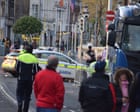
The recent intersection of Irish energy policy and grassroots civil disobedience highlights a critical vulnerability in urban logistics: the fragility of the "last-mile" fuel supply chain when confronted by small-scale, decentralized blockades. While media coverage focused on the surface-level friction between An Garda Síochána and the "People of Ireland Against Fuel Prices" protesters, the deeper reality involves a collision of inflationary pressures, tax structures, and the state’s monopoly on the use of force. This event serves as a case study in how fringe political movements can weaponize the physical layout of a capital city to force a dialogue on national fiscal policy.
The Mechanics of Urban Gridlock
Dublin’s geographic layout creates natural chokes at its port and central bridges. When protesters deployed heavy goods vehicles (HGVs) and private cars at the entrance to the Dublin Port and major arterial routes like the M50, they were not merely occupying space; they were applying a physical brake to the nation's primary economic engine. The effectiveness of a blockade is calculated by the Disruption-to-Resource Ratio.
$D_r = \frac{T_c}{P_n}$
In this model, $T_c$ represents the total economic throughput of the affected corridor, and $P_n$ represents the number of protesters. A small group of approximately 50-100 individuals was able to stall commerce for thousands by targeting high-leverage nodes.
The strategy relied on the Physicality of Resistance. Unlike a pedestrian march, which can be redirected or contained by police cordons, the use of large vehicles creates a significant recovery challenge. Towing a semi-trailer from a blocked junction requires specialized equipment, legal clearances, and significant time—a window protesters used to maximize visibility and media saturation.
The Triple Constraint of Fuel Pricing
To understand the protester's demands, one must analyze the components of Irish fuel costs. The protesters argued for a ceiling on prices, but the pricing mechanism is tied to three non-negotiable variables:
- Global Brent Crude Volatility: As a price-taker on the international market, Ireland has zero influence over the supply-side shocks caused by geopolitical instability.
- The Carbon Tax Escalator: The Irish government’s commitment to the Climate Action Plan involves a pre-determined schedule of tax increases. To retreat on these taxes would signal a failure of long-term environmental strategy.
- VAT and Excise Duties: These are the primary levers of the State. Protesters specifically targeted the "double-taxation" effect, where VAT is applied to the final price, which already includes excise duty.
The friction arises because the government views fuel taxes as a reliable revenue stream ($5.5 billion annually) and a tool for behavior modification, whereas the logistics industry views them as a direct threat to the Operating Margin. For a haulage company, fuel typically represents 30-35% of total operating costs. When pump prices rise by 20% in a quarter, the business model enters a zone of terminal insolvency unless costs are passed immediately to consumers, further fueling the inflationary spiral.
State Response and the Escalation Ladder
The decision by An Garda Síochána to move from containment to enforcement was driven by the Public Order Threshold. Initially, the state practiced strategic patience to avoid the optics of heavy-handedness against "ordinary citizens." However, once the blockade moved from a nuisance to a systemic threat to the supply of essential goods (medical supplies, food logistics, and emergency services access), the police deployed the Public Order Act.
The clearance operation utilized a tiered approach:
- Negotiation Phase: Attempting to achieve voluntary dispersal to avoid the logistical nightmare of impounding dozens of vehicles.
- Formal Direction: Issuing orders under Section 8 of the Criminal Justice (Public Order) Act. This creates the legal basis for arrest.
- Physical Intervention: Using specialized recovery vehicles to clear the roadway.
This sequence reveals the state's priority: maintaining the Free Movement of Capital. The Dublin blockade was less an ideological battle and more a battle over the "Right to the City"—specifically, who controls the flow of transit.
The Illusion of Price Caps
The protesters’ primary demand—a fixed price of €1.10 or €1.20 per liter—fails to account for the Arbitrage Risk. If Ireland were to unilaterally cap prices below the European market average, it would create a "fuel vacuum." Residents from Northern Ireland and even coastal UK regions (via ferry) would drain Irish reserves to take advantage of the price discrepancy. This would lead to fuel shortages, rationing, and a flourishing black market.
The government's refusal to meet these specific demands is not merely an issue of fiscal stubbornness but a realization that price caps are a blunt instrument that often leads to market failure. Instead, the state’s strategy focuses on Targeted Subsidies (such as the €100 million haulage support scheme), which provides relief to critical infrastructure without dismantling the broader tax framework.
Logistical Vulnerability and Infrastructure Resilience
The Dublin Port blockade exposed a critical flaw in Ireland's "Just-in-Time" delivery model. The port handles nearly 50% of the country’s trade. There is no redundancy for this facility. A blockade at the Port Tunnel or the East Wall Road effectively severs the Republic's connection to international supply chains.
From a consultant’s perspective, the state’s failure to prevent the blockade before it formed indicates a breakdown in Predictive Intelligence. Protesters organized via encrypted messaging and closed Facebook groups, allowing them to achieve "First-Mover Advantage." The police were reactive, responding to the blockage after the vehicles were already positioned, which shifted the power dynamic in favor of the protesters.
Fiscal Policy vs. Social Contract
The unrest signifies a breakdown in the social contract regarding the energy transition. The state's "green" objectives assume a level of economic elasticity that does not exist for the working class and the haulage sector. When the cost of compliance (high fuel taxes) exceeds the cost of defiance (fines or arrest), civil disobedience becomes a rational economic choice for the aggrieved parties.
The "Three Pillars of Dissent" in this context are:
- Direct Cost Impact: Immediate reduction in household or business disposable income.
- Perceived Inequality: The belief that the aviation and maritime sectors are exempt from the same tax rigors applied to road users.
- Political Alienation: A sense that the decision-making elite in Dublin are insulated from the rural and logistical realities of the country.
Strategic Recommendation for Infrastructure Protection
To mitigate future disruptions, the Irish government must shift from a reactive policing model to a Proactive Flow Management strategy. This involves:
- Designating Essential Transit Corridors: Implementing permanent "No-Protest Zones" around critical infrastructure like the Dublin Port Tunnel and the M50. This provides a clear legal mandate for immediate removal of obstructions without the need for prolonged negotiation.
- Electronic Geo-Fencing for Commercial Permits: Integrating transport permits with GPS tracking. Vehicles used in illegal blockades could have their commercial licenses suspended automatically through a digital registry, increasing the long-term cost of participation for hauliers.
- Diversification of Supply Entry Points: Investing in the expansion of Rosslare and Shannon-Foynes ports to reduce the "Dublin-Dependency" that makes the nation so vulnerable to a single-point failure.
The Dublin fuel blockade was not an isolated event but a symptom of a global trend where energy costs become the primary catalyst for civil unrest. The state must choose between adjusting its fiscal trajectory to allow for social breathing room or hardening its infrastructure against an increasingly desperate logistical class. The current path of sporadic enforcement and minor subsidies provides only a temporary reprieve from a systemic confrontation that is virtually guaranteed to repeat.