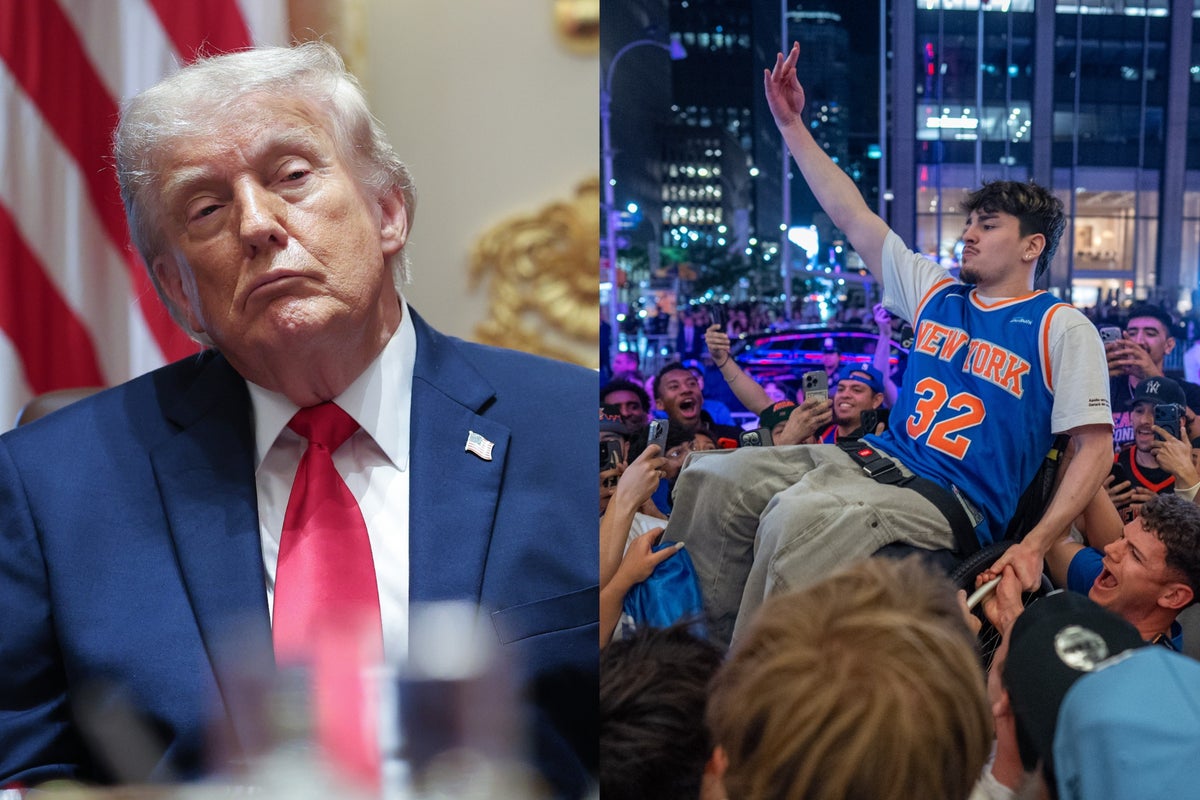
The intersection of elite political figures and high-capacity sporting events generates a measurable operational deficit that standard venue logistics models fail to capture. When Donald Trump attends a high-stakes NBA game—such as Game 3 between the New York Knicks and the San Antonio Spurs—the venue's primary utility shifts from entertainment optimization to threat mitigation. This shift introduces severe systemic inefficiencies, alters player performance environments, and fundamentally degrades the consumer utility function. Examining this phenomenon requires breaking down the exact operational bottlenecks, psychological variables, and economic trade-offs that occur when a hyper-politicized dignitary enters a modern sports arena.
The Tri-Layer Security Bottleneck: Quantifying Fan Ingress Decay
The introduction of "TSA-style" security screening at an arena not designed for airport-volume throughput creates an immediate breakdown in fan ingress. Standard NBA arena security relies on rapid-scan magnetometers and visual bag inspections designed to process approximately 15 to 20 individuals per lane, per minute. The escalation to United States Secret Service (USSS) protocols alters this operational cadence entirely. Building on this theme, you can find more in: Why You Are Completely Wrong About Youri Tielemans And Manchester United.
The disruption manifests across three distinct choke points:
- The Perimeter Expansion Checkpoint: USSS mandates a secondary outer perimeter, forcing ticket holders to queue outside the physical structure of the arena. This subjects the arrival queue to environmental variables and creates physical bottlenecks on public sidewalks, slowing initial foot traffic by an estimated 40%.
- The High-Fidelity Magnetometer Cycle: Standard venue screening allows for continuous movement. USSS protocol requires a complete divestment of all metallic items, deeper physical inspection of bags, and secondary wanding for a higher percentage of entrants. This increases the mean processing time per fan from 4 seconds to upwards of 45 seconds.
- The Concourse Stratification Zone: Internal arena movement is restricted. Specific corridors, elevators, and seating levels adjacent to the VIP suite are entirely cordoned off. This forces standard foot traffic into narrower, non-optimal pathways, compounding concourse density.
[Standard Ingress: 4s per fan] ---> [USSS Ingress: 45s per fan] ---> Queue Backlog Exponential Growth
This delays the physical occupancy of the arena. When a significant portion of the fan base remains trapped in exterior queues during tip-off, the home-court advantage is quantitatively diminished. Arena seats remain empty during the critical opening minutes of the contest, directly neutralizing the psychological pressure a packed home crowd exerts on the visiting team. Experts at FOX Sports have provided expertise on this situation.
The Behavioral Economics of Crowd Distraction and Athletic Performance
The presence of a polarizing political figure alters the baseline psychological state of both the audience and the athletes. In sports analytics, home-court advantage is largely driven by referee bias and crowd energy, both of which rely on a unified, high-amplitude acoustic environment.
Acoustic Fragmentation and Referee Cohesion
A standard playoff or high-stakes regular-season environment features a homogeneous acoustic pattern—fans cheer the home team and boo the visitors or officials uniformly. A polarizing political figure fractures this homogeneity. The crowd splits into competing factions, generating simultaneous cheers, jeers, and chants unrelated to the game action.
This acoustic fragmentation disrupts the subconscious feedback loops that influence officiating. Studies in sports psychology demonstrate that referees are susceptible to crowd noise, often favoring the home team in 50/50 whistle situations to appease the dominant acoustic force. When the crowd's focus is divided and the noise profile becomes discordant, the psychological pressure on officials sanitizes, effectively stripping the home team of its historically proven officiating edge.
Cognitive Load on High-Stakes Athletes
Professional basketball demands intense cognitive focus, particularly when executing complex defensive rotations or adjusting to live tactical changes. The introduction of highly visible, non-sporting elements within the primary field of view—such as heavy security detail surrounding a courtside or suite-level political figure—adds extraneous visual and auditory stimuli.
For a team like the Knicks or the Spurs, operating within tight tactical margins, a 1% deviation in situational awareness due to external arena distractions can lead to missed defensive assignments or delayed transition reactions. The fan sentiment that "we will lose if he comes" is not merely superstitious dread; it is an intuitive recognition of an altered, high-friction operational environment that breaks the rhythm of standard home-court execution.
The Economic Penalty of Compressed Ingress
The financial model of a modern sports franchise relies heavily on the monetization of the pre-game window. Fan spending on food, beverage, and retail merchandise peaks between 60 minutes and 15 minutes prior to tip-off. By forcing fans into extended exterior security queues, the venue directly compresses this monetization window.
- Concession Revenue Attrition: A fan spending 45 minutes in an outdoor security line is a fan not standing at a point-of-sale terminal inside the concourse. The velocity of transaction capability drops to zero for those trapped outside, causing a non-recoverable loss in perishable food and beverage sales.
- Retail Velocity Deceleration: Arena team stores rely on high foot-traffic density and impulse purchasing before the game begins. When ingress is delayed, fans bypass the team store entirely to ensure they do not miss the start of play, flattening the retail revenue curve for that operational date.
- Sponsor Activation Dilution: Corporate sponsors pay premiums for pre-game concourse activations and fan engagement zones. Extended security lines and restricted concourse mobility reduce the total impressions and engagement metrics achieved by these physical assets, leading to post-event make-goods or reduced valuation in future contract renewals.
Operational Limitations of Venue Adaptation
Venues possess limited strategic levers to mitigate these disruptions. While an arena management team can theoretically increase staffing levels to combat the security bottleneck, the physical constraint of the facility acts as a hard ceiling. An arena cannot suddenly add more entry doors or expand the square footage of its lobby to accommodate the footprint of USSS equipment.
Furthermore, scheduling parameters dictated by national television broadcast windows prevent the NBA from delaying tip-off to accommodate delayed fan ingress. The game must begin precisely on schedule, ensuring that the operational friction caused by the dignitary's arrival directly impacts the live sporting product.
The strategic play for franchise ownership and venue operations is a aggressive, transparent communication campaign launched 48 hours prior to the event. This involves shifting the fan arrival distribution curve by offering targeted financial incentives—such as early-arrival concession discounts—to artificially force ingress ahead of the peak bottleneck window. Without these active interventions, the presence of a high-profile political figure functions as a net-negative operational shock, penalizing the venue's bottom line and compromising the home team's competitive environment.