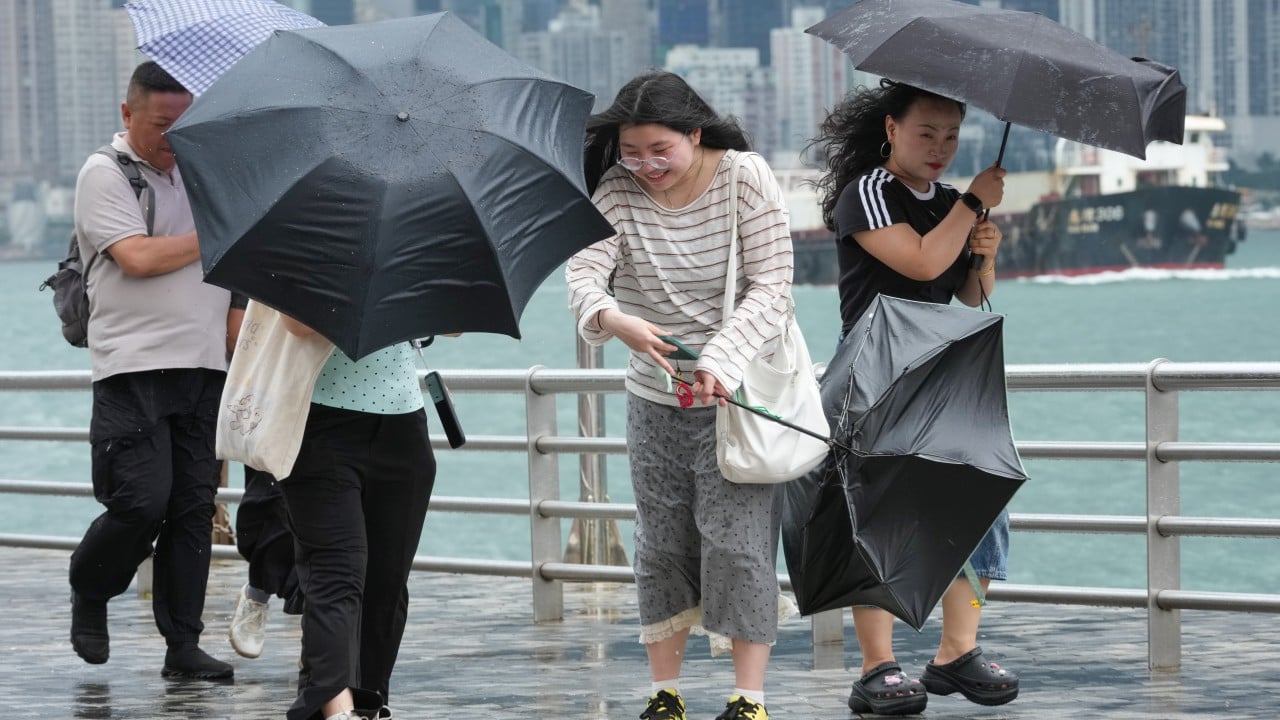
The sky darkens. The first heavy drops hit the pavement. Automatically, millions of eyes dart to their phones, waiting for a government agency to flash a color-coded warning.
The competitor headline tells you exactly what you expect to hear: "Observatory could issue red rainstorm warning, monitoring thundery showers." It is a masterclass in bureaucratic passivity. It treats weather alerts as a benign, helpful service designed to keep you safe. For another view, consider: this related article.
That is a lie.
The entire structure of modern public weather warnings does not protect the public. It paralyzes them. By outsourcing basic situational awareness to an administrative body, we have created a culture of risk-aversion that costs businesses millions, clogs emergency infrastructure, and actively breeds civic helplessness. Related insight on the subject has been shared by The Washington Post.
The False Security of the Color-Coded Grid
Weather bureaus love thresholds. They tell you that a Amber warning means $30\text{mm}$ of rain in an hour, Red means $50\text{mm}$, and Black means $70\text{mm}$. They treat these numbers as if they are precise, objective measures of danger.
They are not. They are arbitrary lines drawn on a map to cover the legal liability of the state.
Rain does not fall uniformly across a territory. A downpour that registers as an Amber event at a hilltop monitoring station can trigger a catastrophic flash flood in a low-lying valley just two miles away. Conversely, a technical "Red" volume of rain falling over a highly modernized, well-drained commercial district might result in nothing more than deep puddles and wet shoes.
When citizens rely entirely on an official declaration to decide whether it is safe to walk outside, two dangerous things happen:
- The Boy Who Cried Red: The observatory issues a severe warning, but nothing happens in the major commercial hubs. People look out the window, see dry streets, and conclude the system is broken. Cynicism grows.
- The Unwarned Catastrophe: A localized, violent cloudburst hits a specific neighborhood before the bureaucracy can process the radar data and update the website. Because there is no official alert, residents assume they are safe, staying in basement apartments until it is too late.
I have spent fifteen years advising logistics firms on climate risk mitigation. I have seen companies freeze entire supply chains, halting delivery trucks and locking down warehouses, costing upwards of $200,000 in afternoon revenue, all because an intern saw a "potential warning" notification on an app. Meanwhile, the actual radar loop showed the storm system moving entirely clear of their transit routes.
We have replaced eyes with apps, and we are paying a premium for it.
The Myth of "Monitoring"
Look closely at the language used by standard media outlets. They note that officials are "monitoring thundery showers."
What does that actually mean? It means they are looking at the exact same real-time Doppler radar feeds that are publicly available to anyone with an internet connection. The only difference is that the government waits for an internal committee to agree before they change a graphic on a screen.
By the time an observatory upgrades a warning from Amber to Red, the severe weather has usually been happening for twenty to thirty minutes. The warning is not predictive; it is historical. It is an autopsy of the weather, packaged as a forecast.
Dismantling the Premise: What People Actually Ask
The standard questions flooding search engines during a storm reveal just how deeply this systemic learned helplessness runs. Let us address them honestly.
"Should I stay home if a Red warning is issued?"
The fact that you are asking an algorithmic system to decide your physical safety is the problem. If water is rising on your street, you stay inside, regardless of whether the government calls it Amber, Red, or neon green. If your path home is clear, elevated, and safe, you move. Stop letting a color wheel dictate your autonomy.
"Why do storm warnings always seem to happen right before rush hour?"
Conspiracy theorists love this one, claiming meteorologists manipulate timing to alter the workday. The reality is thermodynamic. Solar heating peaks in the early to mid-afternoon, destabilizing the atmosphere and triggering convective thundery showers precisely when the workday ends. It is basic physics, not a bureaucratic plot. But by waiting for the formal warning to drop exactly at 4:30 PM, cities create a mass exodus panic instead of a staggered, rational departure.
The Unconventional Solution: Data Democratization over Dictatorship
If the current alert system is broken, how do we fix it?
We do not fix it by making the observatory faster. We fix it by ignoring them.
Businesses and individuals must shift from a model of compliance to a model of localized resilience.
| Traditional Alert Mindset | Decentralized Resilience Mindset |
|---|---|
| Wait for official color-coded notification | Analyze raw Doppler radar trends independently |
| Macro-level decisions based on city-wide alerts | Micro-level actions based on local topography |
| Total shutdown of operations to avoid liability | Dynamic routing based on real-time cell tracking |
| Absolute reliance on government infrastructure | Independent backup power and water diversion |
This approach has a major downside. It requires effort. It requires learning how to read a basic velocity radar map and understanding the elevation profile of your immediate surroundings. It requires accepting the risk of your own decisions rather than pointing a finger at a government spokesperson when a flash flood ruins your carpet.
But the upside is absolute operational continuity. While your competitors are staring at a static app waiting for an update, you are moving goods through the dry corridors of a split storm system.
Stop Waiting for Permission to Survive
The competitor article wants you to sit quietly, monitor the thundery showers, and wait for the authorities to tell you when to be afraid.
This passive consumption of safety metrics is making our cities fragile. The next time the clouds roll in, close the news feed. Open the raw radar. Look out the window. Make a decision based on the reality in front of your face, not the color on your phone screen.
The state cannot protect your basement from flooding, and it cannot recover your lost business revenue. Stop treating meteorologists like prophets and start acting like an agent in your own environment.