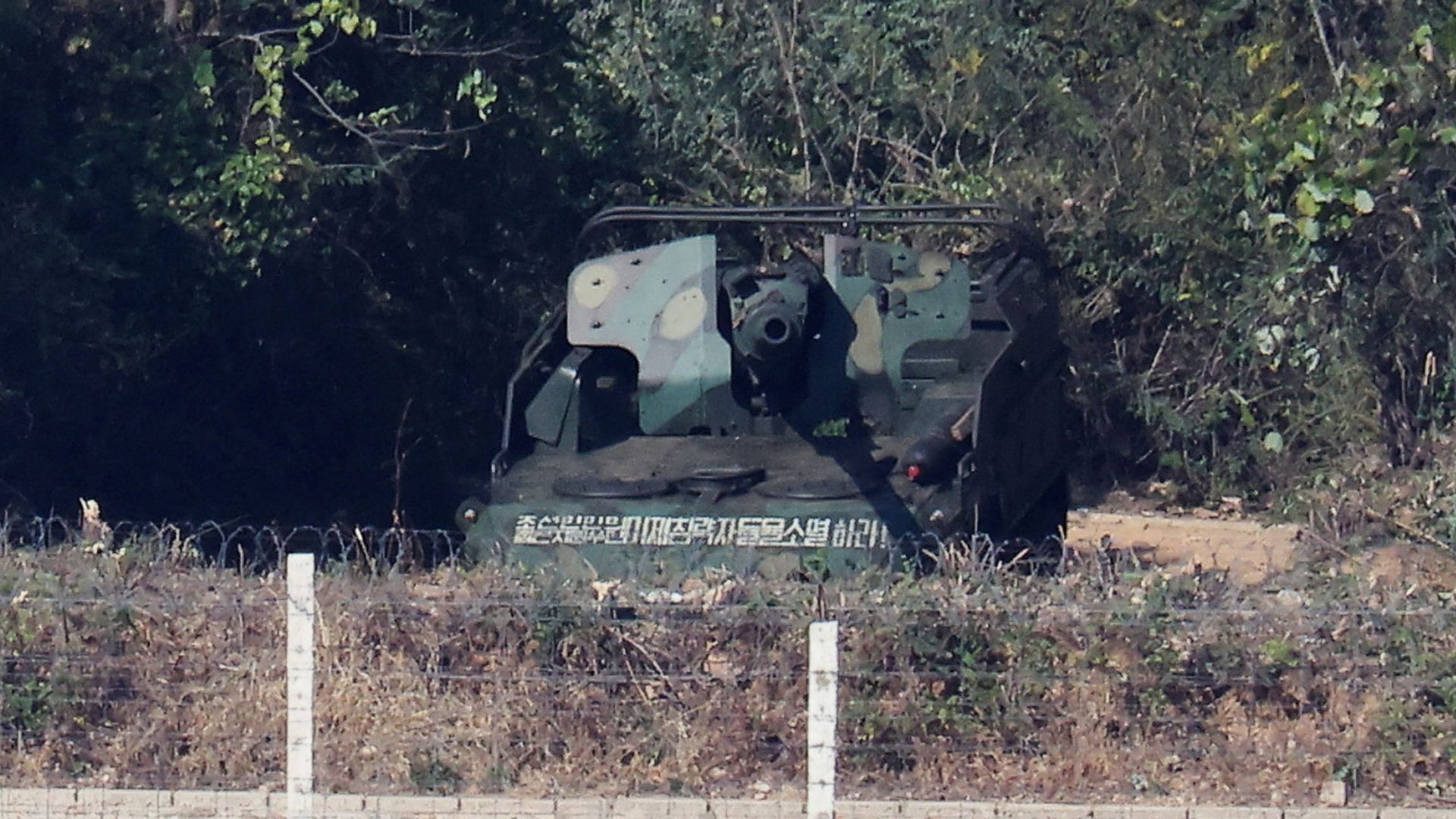
Every few months, commercial satellite imagery captures a fresh cluster of North Korean artillery tubes pointed south toward the Demilitarized Zone, and the defense press goes into predictable, breathless overdrive.
The headlines write themselves. Pundits dust off the Cold War "Sea of Fire" talking points. Analysts count barrels, measure distances to Seoul, and warn that Pyongyang is preparing an imminent, catastrophic bombardment.
This is lazy consensus masquerading as intelligence analysis.
If you are watching towed howitzers roll up to the 38th Parallel and thinking you are witnessing an offensive war plan, you are reading the chessboard backward. Moving static, easily spotted artillery to the forward edge of the battle area is not how you prepare to conquer South Korea. It is how you signal domestic insecurity, drain your own logistics, and hand South Korean counter-battery radars a gift-wrapped target list.
Having spent years dissecting artillery doctrine, counter-battery survivability, and Korean Peninsula force postures, I have watched intelligence consumers panic over the loudest, most visible hardware while ignoring the quiet shifts that actually alter the balance of power. When analysts treat every forward deployment of towed guns as a prelude to invasion, they misallocate surveillance assets and misread Pyongyang's strategic calculus.
To understand what those howitzers are actually doing near the border, you have to strip away the sensationalism and look at the cold physics of modern artillery warfare.
The Physics of Static Artillery in a Counter-Battery Era
Let us define the hardware precisely before buying into the panic. When satellite imagery spots "howitzer guns" near the DMZ, it is typically identifying legacy towed systems like the 122mm D-30, the 130mm M-46, or the 152mm D-20, alongside older self-propelled variants like the M1978 Koksan.
These are area-fire weapons designed for mid-20th-century massed attrition. They rely on unguided, high-explosive shells and require massive logistical tails of trucks, ammunition dumps, and exposed gun crews to sustain fire.
In 1953, lining thousands of these tubes along the border was a terrifying tactical innovation. Today, putting towed howitzers out in the open near the DMZ is military suicide.
Modern counter-battery radar systems—specifically the South Korean Arthur-K and AN/TPQ-36/37 networks—do not need to wait for a shell to land to know where it came from. By tracking the projectile's ballistic arc in mid-air, these radars calculate the exact grid coordinates of the firing tube within seconds. Before the first North Korean round even impacts near the Han River, South Korean K9 Thunder self-propelled howitzers and Chunmoo multiple rocket launchers have already received automated firing solutions.
The K9 Thunder operates on a strict "shoot-and-scoot" doctrine. It can halt, fire three rounds in fifteen seconds, and relocate before return fire arrives. A towed North Korean howitzer cannot do that. Once deployed, its crew must unhook the carriage, dig in the trails, set up aiming stakes, and haul heavy shells by hand. Packing up takes several agonizing minutes under intense counter-fire.
If Pyongyang actually intended to launch a surprise decapitation strike or a sustained artillery campaign against Seoul, moving vulnerable, slow-moving howitzers into observable positions along the border would be the worst possible opening move. It sacrifices the only advantage North Korea possesses in a conventional firefight: concealment inside hardened artillery sites (HARTS) carved into the granite mountains.
Why Pyongyang Moves Iron in Plain Sight
If forward-deploying howitzers makes zero tactical sense for an invasion, why does the Korean People's Army (KPA) keep doing it? Because military hardware on the Korean Peninsula is rarely moved purely for military utility. It is moved for political theater and internal regime maintenance.
Consider the mechanics of strategic signaling. North Korea's leadership understands commercial satellite schedules. Organizations like 38 North, CSIS Beyond Parallel, and major wire services routinely purchase high-resolution imagery from Maxar and Planet Labs to monitor the DMZ. Pyongyang knows that parking artillery batteries in open fields or along newly cleared revetments guarantees global press coverage within 48 hours.
This achieves three distinct objectives without firing a single shot:
- Manufactured Leverage: Whenever diplomatic engagement stalls or domestic economic pressures mount, visible border provocations force Washington and Seoul to pay attention. It is low-cost coercion. Moving existing battalions twenty kilometers south costs diesel and rations, yet it dominates international news cycles and forces South Korean political leaders into defensive postures.
- Domestic Mobilization: Autocratic regimes rely on an external existential threat to justify internal deprivation. Deploying frontline troops and heavy guns to the border allows state media to broadcast images of a resolute military defending the homeland against imminent aggression. It rallies the population and keeps the officer corps occupied with grueling field exercises rather than palace intrigue.
- Sensor Probing: Pushing units forward forces the Republic of Korea (ROK) Armed Forces and U.S. Forces Korea (USFK) to elevate their alert levels. As Seoul shifts reconnaissance drones, signals intelligence aircraft, and radar emitters to track the new artillery positions, North Korean electronic warfare units sit back and map South Korea's intelligence-gathering protocols and response times.
When pundits react to these deployments with breathless alarm, they are acting as unpaid public relations agents for Kim Jong Un's psychological operations.
The "Sea of Fire" Myth vs. Ballistic Reality
To dismantle the lazy consensus completely, we have to address the most persistent myth in East Asian security: the idea that North Korean border howitzers can flatten Seoul in an afternoon.
Imagine a scenario where the KPA opens fire simultaneously with every forward-deployed howitzer along the western sector of the DMZ. What happens next?
First, geography intervenes. The distance from the DMZ to the northern outskirts of Seoul is roughly 40 kilometers (25 miles), and the center of the city sits at around 50 to 60 kilometers. Standard 122mm and 152mm towed howitzers have a maximum effective range of 15 to 24 kilometers using conventional ammunition. They cannot physically reach Seoul. They can barely reach the northern suburbs of Paju and Yeoncheon.
Only a specific subset of North Korean systems—primarily the 170mm Koksan self-propelled gun and the 240mm multiple rocket launcher—possess the range to strike the metropolitan area. Even then, those systems must be positioned right against the southern edge of the DMZ to reach central Seoul, exposing them completely to South Korean direct and indirect fire.
Second, logistical reality sets in. RAND Corporation studies—most notably their comprehensive 2020 assessment on North Korean conventional artillery—demonstrated that while an unprovoked barrage would cause tragic, unacceptable civilian casualties in the tens of thousands within the first hour, it would not destroy the city. Furthermore, the KPA's ammunition stockpile suffers from severe quality control issues. During the 2010 shelling of Yeonpyeong Island, roughly 25 percent of the North Korean shells that hit the island failed to detonate. Dud rates this high drastically degrade sustained lethality.
Third, air supremacy erases static positions. Within hours of an artillery exchange, the combined air forces of South Korea and the United States—operating F-35A stealth fighters, F-15K Slam Eagles, and precision-guided bunker busters—would systematically dismantle North Korea's exposed artillery logistics. You cannot sustain a bombardment when your ammunition trucks are burning on mountain roads.
What Security Analysts Get Wrong About Border Escalations
If you search for information on North Korean border movements, you will run into the same flawed questions dominating public discourse. Let us dismantle them directly.
"Are these howitzers a sign of an imminent invasion?"
No. An actual invasion requires massive, unmistakable logistical pre-positioning that cannot be hidden. You would see tens of thousands of tons of fuel bladders, forward field hospitals, blood supply stockpiles, bridging equipment for crossing the Imjin River, and the mobilization of reserve infantry divisions. Spotting a few dozen artillery pieces without the accompanying logistical tail is a demonstration, not a war plan.
"Can South Korea stop a sudden artillery barrage before shells hit?"
Not entirely, and anyone claiming otherwise is selling snake oil. No air defense network on earth—not Israel's Iron Dome, and not South Korea's developing Low-Altitude Missile Defense (LAMD) system—can intercept 100 percent of thousands of incoming unguided artillery shells fired simultaneously over a short distance. Some rounds will always get through. The goal of South Korean defense posture is not an impenetrable shield; it is immediate, overwhelming counter-fire that destroys the enemy tubes after their first or second volley.
"Does moving artillery closer to the DMZ change the military balance?"
It actually tips the immediate tactical balance in favor of South Korea. By pulling guns out of deep mountain bunkers and placing them in forward, exposed positions, North Korea trades survivability for a marginal increase in range. For South Korean targeteers, an exposed artillery battery in a forward trench is vastly easier to destroy than one hidden behind reinforced blast doors inside a granite ridge.
The Real Threat Hidden Behind the Artillery Smoke
While media outlets zoom in on grainy satellite photos of 152mm howitzers, they routinely miss the genuine modernization happening just behind the front lines. Pyongyang knows its legacy towed artillery is obsolete against modern counter-battery systems. That is precisely why North Korea has spent the last decade aggressively shifting its investment toward platforms that make border howitzers irrelevant.
If you want to understand what keeps commanders in Seoul and Washington awake at night, stop looking at towed guns and start tracking three specific capabilities:
- 600mm Super-Large Multiple Rocket Launchers (KN-25): Technically classified by U.S. intelligence as short-range ballistic missiles, these systems blur the line between artillery and theater ballistic weapons. They are mounted on tracked and wheeled transporters, carry guided warheads, and can strike anywhere in South Korea from deep inside North Korean territory—well out of reach of South Korean counter-battery howitzers.
- Tactical Guided Weapons (KN-23 and KN-24): Modeled after the Russian Iskander and American ATACMS, these solid-fuel missiles fly on depressed, maneuverable trajectories designed specifically to evade Patriot and THAAD missile defense batteries. They do not need to be parked near the DMZ to threaten South Korean airbases and command centers.
- Loitering Munitions and ISR Drones: Drawing direct lessons from the war in Ukraine, North Korea has accelerated the production of cheap, one-way attack drones and reconnaissance UAVs. A $20,000 drone spotting for a guided rocket launcher is infinitely more lethal to modern armored formations than a battery of 1950s-era towed howitzers firing blind at grid squares.
By focusing public outrage on old howitzers near the border, analysts fall for a classic sleight of hand. Pyongyang rattles its rusted saber at the DMZ while quietly fielding precision-guided, mobile strike systems in the rear.
The Caveat: Where Static Artillery Still Matters
Intellectual honesty requires admitting the limits of a contrarian take. Dismissing North Korean howitzers as mere political theater does not mean they are harmless, nor does it mean Seoul can ignore them.
There is one specific scenario where forward-deployed static artillery becomes acutely dangerous: localized, limited-objective skirmishes.
North Korea has a long history of initiating sharp, geographically contained violent provocations—such as the 2010 Yeonpyeong Island shelling or the 2015 DMZ landmine crisis—designed to inflict immediate pain while staying just below the threshold that triggers full-scale war. In a localized border clash lasting thirty minutes, towed howitzers positioned near the DMZ can inflict heavy casualties on South Korean border guard posts, observation towers, and nearby civilian villages before counter-battery fire silences them.
Furthermore, psychological terror does not require strategic victory. Even if legacy howitzers cannot destroy Seoul, the mere threat of shells landing in northern Gyeonggi Province causes severe economic disruption, rattles financial markets, and puts immense political pressure on the South Korean government to either capitulate diplomatically or retaliate disproportionately.
Ignoring the guns completely is reckless. Treating them as an existential game-changer is delusional.
How to Read Korean Peninsula Intelligence Without Getting Played
If you track geopolitical risk, manage supply chains in East Asia, or simply want to consume defense news without falling for sensationalist clickbait, change how you evaluate reports from the DMZ.
- Follow the Logistics, Not the Barrels: Never react to photos of tanks, howitzers, or rocket launchers in isolation. Look for the boring stuff: fuel trucks, ammunition railcars, engineering vehicles, and medical units. Weapons without logistics are just heavy sculptures.
- Check the Range Rings: Whenever a news outlet claims newly spotted artillery "threatens Seoul," pull up a map and verify the weapon system's maximum range. If it is a 122mm or 152mm towed gun sitting north of the DMZ, it is not hitting downtown Seoul. Call out the exaggeration immediately.
- Watch the Rear Echelon: Pay far more attention to test launches of solid-fuel tactical missiles, new Transporter Erector Launcher (TEL) production, and drone factories than to infantry divisions digging trenches near the 38th Parallel.
- Track South Korean Counter-Measures: Look at how Seoul responds. If the ROK military quietly adjusts its intelligence, surveillance, and reconnaissance (ISR) flight paths without issuing panicked press releases, the threat is routine. When Seoul cancels leave for frontline commanders and disperses air assets, the risk is real.
The next time a headline screams that North Korean howitzers have been spotted rolling toward the South Korean border, resist the urge to panic. Look at the calendar, check what diplomatic talks just stalled, and recognize the deployment for what it truly is: loud, heavy, obsolete iron being pushed into the mud to make a weak hand look strong.


