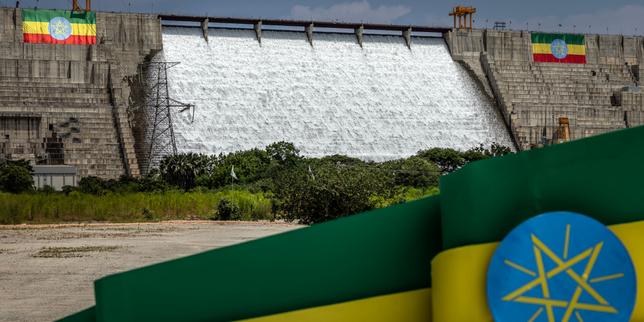
Water has always dictated power in Northeast Africa. When Cairo raises its diplomatic volume over the filling of the Grand Ethiopian Renaissance Dam, it is not merely responding to a modern engineering project. It is defending a hydrologic hegemony that has defined the Nile valley for millennia.
Egypt faces an existential threat. Downstream agriculture depends almost entirely on a single river originating outside its borders. Meanwhile, Addis Ababa views the mega-dam as an absolute necessity for industrialization and rural electrification. A growing population demands energy, and international financing structures have shifted. The resulting standoff exposes the limits of bilateral diplomacy in transboundary river basins.
The Hydrological Reality on the Ground
To understand the current crisis, look past the diplomatic communiques. The Blue Nile provides roughly eighty-five percent of the main river's waters during the rainy season. Egypt sits at the absolute terminus of this vast hydrological system, holding historic rights secured through colonial-era treaties that modern upstream nations refuse to recognize.
Ethiopia completed construction in rugged terrain, turning the Abay Gorge into a massive artificial reservoir. Every cubic meter retained upstream alters the volumetric equation down in the Delta. Cairo relies on Lake Nasser as a multi-year buffer against drought. Yet, during dry cycles, rapid filling schedules imposed by Addis Ababa threaten to drain that buffer far faster than seasonal monsoons can replenish it.
Decades of regional agreements favored downstream extraction. Those arrangements excluded upstream contributors from equitable allocation formulas. Ethiopia argues that international water law principles, including equitable and reasonable utilization, invalidate Cairo's monopoly. Egypt counters with the doctrine of historic rights and existential dependency. Both legal frameworks claim legitimacy, leaving zero room for mutual compromise without external enforcement.
Economic Pressures and Domestic Survival
Domestic political survival drives both capitals. Egyptian leadership cannot afford a visible drop in agricultural output or drinking water availability. Roughly one hundred million citizens depend on the river for food security. Any permanent reduction in flow risks triggering severe economic instability.
Across the border, the Ethiopian state invested billions of dollars in national bonds and diaspora contributions to build the dam. Backing down is politically impossible for Addis Ababa. The project symbolizes national sovereignty, technological capability, and liberation from poverty. Millions of households remain without reliable electricity. Turning turbines at full capacity represents a tangible leap forward for development metrics.
When two governments face zero-sum domestic pressures, compromise becomes a liability. Concessions are framed as treasonous weakness by political opposition factions at home. Consequently, foreign ministries cycle through endless rounds of stalled negotiations, mediation attempts by the African Union, and sharp rhetorical exchanges at the United Nations Security Council.
Regional Security and Environmental Flashpoints
The dispute extends far beyond bilateral water management. It militarizes the Horn of Africa. Egypt has strengthened military ties with regional neighbors, conducting joint air force drills and signing security pacts. These maneuvers send a clear signal regarding strategic depth and operational reach.
Climate change introduces an unpredictable variable into an already volatile equation. Rainfall patterns across the Ethiopian highlands are growing increasingly erratic. Extended droughts alternate with intense, destructive flash floods. If monsoons fail for consecutive seasons, filling the reservoir while maintaining minimum downstream releases becomes a mathematical impossibility.
Downstream nations worry about unilateral control over the flow. An upstream state holding a massive reservoir possesses unprecedented leverage during dry years. Water ceases to be a shared natural asset and transforms into a strategic instrument of statecraft.
The Broader Implications for Transboundary Basins
The Nile crisis serves as a terrifying preview for transboundary water conflicts worldwide. As global temperatures rise and populations expand, hydrologic stress multiplies. International law remains notoriously weak when powerful upstream nations decide to alter natural river flows for national development.
Diplomatic platforms often prioritize procedural talks over substantive concessions. Months pass in procedural debates over data sharing and binding dispute resolution mechanisms while concrete barriers rise across riverbeds.
Cairo continues to press for a legally binding treaty governing filling rates during extended droughts. Addis Ababa insists on non-binding guidelines that preserve sovereign operational freedom. Until this fundamental divide over legal accountability is resolved, the river basin remains a powder keg.
The standoff lingers without a neat diplomatic resolution in sight. Water flows onward toward the Mediterranean, carrying with it the unresolved anxieties of nations bound together by geography and divided by competing survival imperatives.