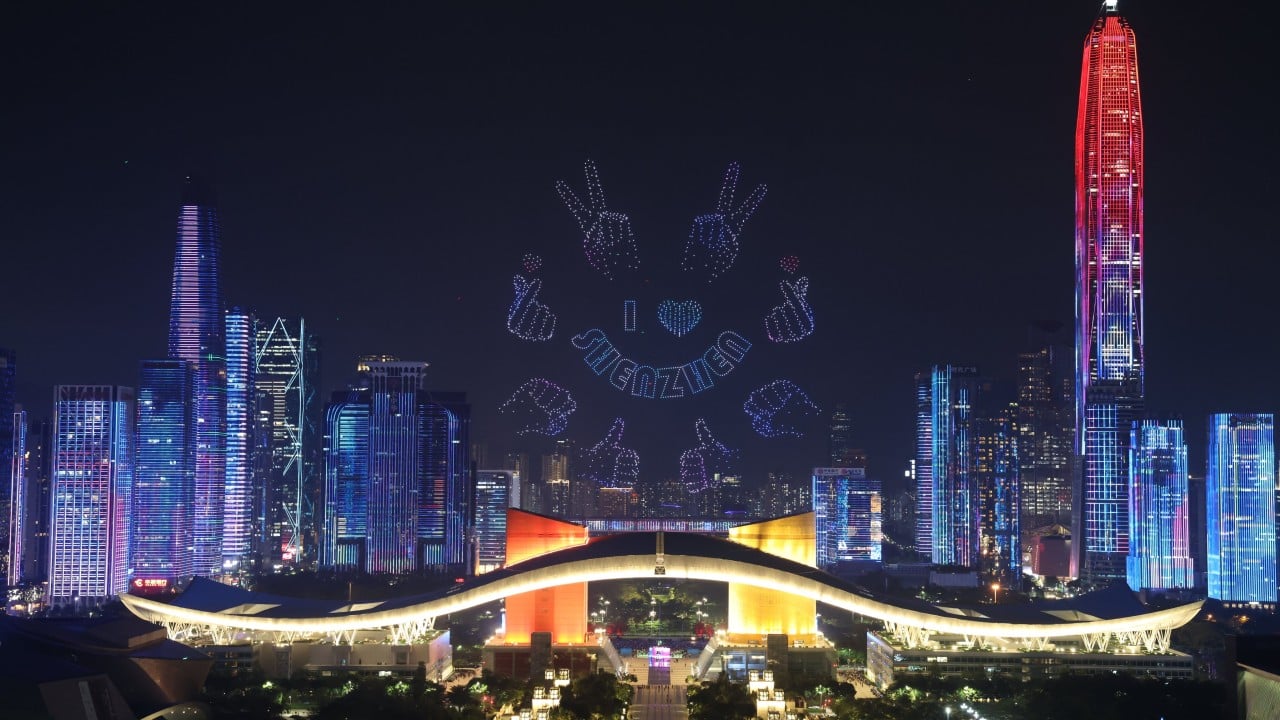
The battery packs always smelled faintly of hot copper and sweet ozone just before liftoff.
If you stood on the perimeter of a Shenzhen industrial park three years ago, the sensation was entirely Pavlovian. First came the low, angry hornet drone of a thousand rotors spinning up in unison. Then, the night split open. Three thousand autonomous nodes would lift off the asphalt like a swarm of glowing bioluminescent jellyfish, climbing two hundred meters into the blackness to paint corporate logos, weeping willows, and rotating terrestrial globes across the smoggy expanse of the Pearl River Delta. It was the modern era's substitute for fireworks. It was clean, programmable, and entirely dependent on a delicate, invisible architecture of radio frequencies, localized GPS arrays, and relaxed municipal oversight. You might also find this connected article useful: North Korea is Not Winning the Cyber War with Artificial Intelligence.
Then came the silence.
Across China, from the humid southern tech hubs to the freezing northern reaches near Beijing, the lights have gone out. State regulators have stepped in, tightening airspace controls with a suddenness that caught operators, municipal tourism boards, and late-night revelers entirely off guard. Thousands of scheduled commercial light displays have been abruptly canceled or grounded indefinitely. The official communiques cite security, airspace management, and public safety. But beneath the bureaucratic language lies a profound shift in how modern states view the sky above our heads. As highlighted in detailed coverage by CNET, the implications are widespread.
To understand why a country that practically invented mass aerial light entertainment would suddenly pull the emergency brake, you have to look at what those drones actually represent. They are not toys. They are networked clusters of programmable flight computers capable of carrying payloads, bypassing ground security, and operating in formations that mimic military swarm intelligence.
Consider a typical evening with Li Wei, a veteran flight controller who spent four years managing corporate synchronized light routines for major electronics brands. Standing behind a folding table with a laptop running custom ground-control software, Li was essentially an orchestral conductor for machines.
"People think you just press play," Li says, recalling the frantic energy of a weekend festival launch. "They see a giant dragon breathing fire across the clouds and they think it is magic. They do not see the math. They do not see the fifty telemetry streams dropping packets because a local television station turned on a high-powered microwave relay five blocks away. When you put a thousand birds in the air, you are gambling with physics every single second."
That gamble became too large for authorities to ignore.
The trouble began with scale. What started as a novelty for tech-giant product launches quickly metastasized into a pervasive cultural phenomenon. Cities across the nation began hiring private fleets to celebrate everything from historic anniversaries to local noodle festivals. Unregulated operators flooded the market. Suddenly, amateur teams with hastily imported hardware were launching formations near commercial flight paths, military installations, and crowded public squares.
The invisible stakes became visible the hard way. There were near-misses with medical evacuation helicopters. There were instances of mass GPS spoofing where entire formations lost their geometric lock and drifted into skyscrapers or startled crowds below.
Airspace is finite. We treat it as an endless, empty ocean, but it is actually a heavily regulated highway system with invisible lanes. When thousands of untracked, low-altitude commercial units began clogging those lanes, the risk profile shifted from a minor nuisance to a national security vulnerability.
The regulatory hammer fell not out of malice, but out of fear. In an era where low-cost aerial robotics are actively reshaping modern warfare halfway across the globe, governments are acutely sensitive to what happens in their domestic skies. If a civilian company can coordinate five thousand drones to form a spinning corporate logo, an adversary can use the exact same frequency hopping protocols, the exact same open-source flight controllers, and the exact same swarm algorithms for something far less benign.
The sudden grounding has left a massive economic crater in its wake. Event production companies that invested millions in custom carbon-frame hardware, proprietary ground stations, and specialized transport trucks are now watching their investments gather dust in warehouses. Technicians who mastered the intricate choreography of spatial coordinates are looking for work in logistics or traditional software development.
Yet, the deeper loss is cultural.
For a brief window in human history, we looked up at the night sky and saw something entirely manufactured by human imagination and machine precision. It was synthetic, yes. It was commercialized, absolutely. But it also offered a communal canvas. Thousands of strangers would stand shoulder-to-shoulder in a public plaza, necks craned upward, watching software translate into art across the dark ceiling of the city.
Now, the plazas are dark again.
The authorities have not banned the technology permanently, but the new licensing requirements are labyrinthine. Operators must now secure military clearance, file flight plans days in advance, and prove redundancy systems that double the cost of an already expensive production. The wild west of aerial entertainment has been fenced in by barbed wire and rubber stamps.
We are left standing on the ground, staring up at an empty sky, forced to confront a sobering reality. Every technology we build to expand our reach eventually demands a mechanism to control it. The drones are waiting in their foam-lined cases, their batteries discharged, their lights extinguished, silent witnesses to the moment the modern state decided that the sky was simply too important to leave to the imagination.


