The modern world does not like to feel small. We build towering structures, illuminate our streets until the night looks like a bruised version of midday, and keep our eyes firmly locked onto screens that measure barely six inches across. We control our environments. We schedule our lives.
Then, the universe reminds us that we are merely passengers on a rock hurtingling through a silent, sprawling void.
On May 31, 2026, a quiet cosmic coincidence will play out above our heads. The news feeds will call it a Blue Moon. They will call it a micromoon. They will talk about Venus and Jupiter flanking the silver disc like celestial bodyguards. But if you only read the headlines, you will miss the point entirely. You will treat it like another piece of digital content to swipe past.
To truly understand what is happening at the end of this month, you have to step away from the artificial glow of the city. You have to remember what it feels like to stand in the dark, cold-backed and wide-eyed, realizing that the sky is not a ceiling, but an ocean.
The Illusion of the Giant Moon
Let us break a common illusion. We are conditioned to love the Supermoon. We love the drama of a massive, swollen lunar disc rising behind a city skyline, painted in shades of deep amber and rust. It feels reachable. It feels monumental.
May 31 offers the exact opposite.
This is a micromoon. It is the smallest full moon of 2026.
To understand why, we have to look at the geometry of the cosmos. The Moon’s orbit around Earth is not a perfect circle. It is an ellipse, an elongated loop. Because of this shape, the Moon constantly dances between two extremes. There is perigee, its closest approach to us, and there is apogee, its furthest retreat.
On this final night of May, the Moon reaches its apogee. It will sit roughly 252,000 miles away from Earth. Because it is at its maximum distance, it will appear about 14 percent smaller and 30 percent dimmer than the dramatic supermoons that dominate social media feeds.
Think of it this way. Imagine holding a quarter at arm's length. That is your typical full moon. Now, swap that quarter for a nickel. That slight, subtle shift in scale is what a micromoon represents. It is the Moon pulling back its hem, retreating into the deeper folds of space. It is a quiet moon. A modest moon.
Yet, there is a strange, understated beauty in this distance. When the Moon shrinks, the sky opens up. The blinding glare that usually drowns out nearby stars is softened. The canvas becomes darker, richer, and far more interesting.
The Secret Lie of the Blue Moon
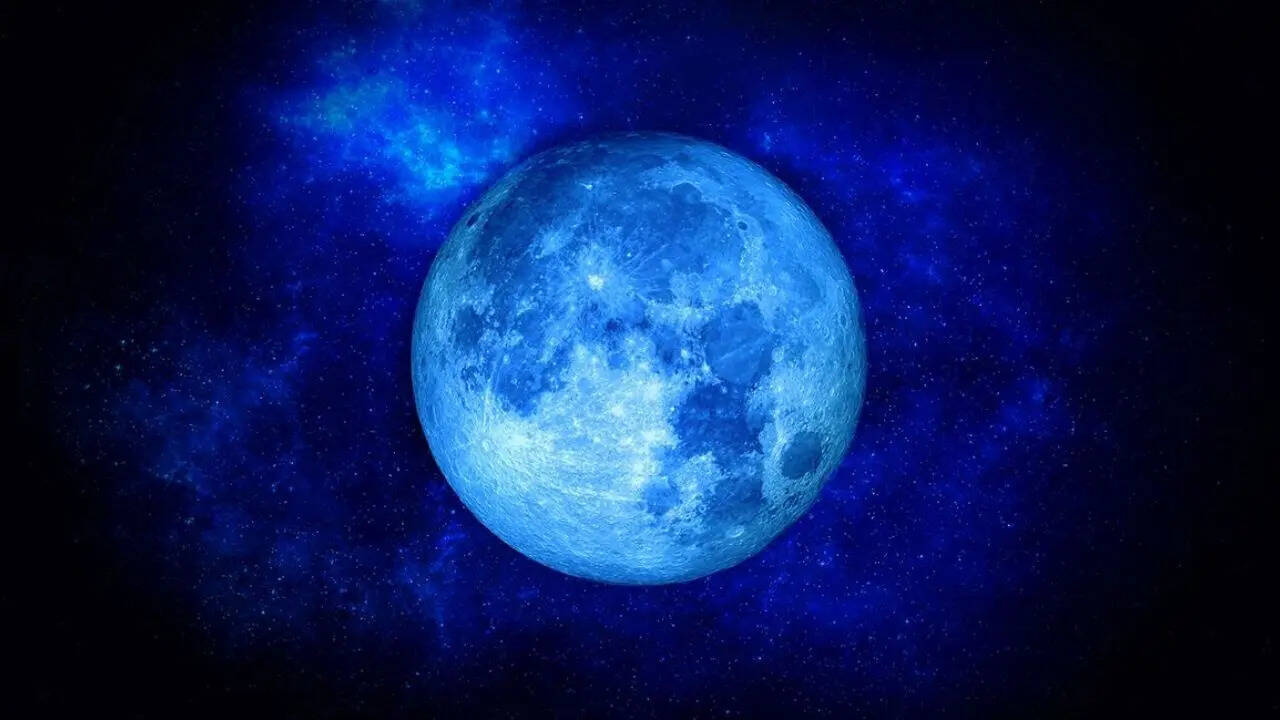
Then comes the name. A Blue Moon.
It conjures images of a cobalt sphere hanging over a misty forest, something straight out of a dark fairy tale. But the sky is an honest performer; it will not change its color for us. The moon will remain the same pearly, cratered gray it has always been.
The term "Blue Moon" is not a description of hue, but a quirk of our calendar. It is a human invention imposed on a cosmic rhythm.
Our calendar months are arbitrary constructs, lasting 30 or 31 days. The lunar cycle, however, takes approximately 29.5 days to complete. Every once in a while, the math aligns perfectly. A full moon peaks at the very beginning of a calendar month, and because the cycle is shorter than the month itself, a second full moon sneaks in just before the final calendar days tick away.
That is what we are witnessing. We had a full moon at the start of May, and now, on May 31, we receive this bonus round. It happens roughly once every two and a half years. It is a mathematical glitch in our attempt to slice up time, a reminder that the universe does not clock in or clock out according to human schedules.
The Celestial Gathering
If a small, distant moon were the only actor on the stage, the night would still be beautiful. But the universe is staging a larger production.
As you look up on the night of May 31, the faint, distant micromoon will not be alone. It will be flanked by two of the brightest jewels in our solar system: Venus and Jupiter.
To the naked eye, they will look like intensely bright, unblinking stars. Stars twinkle because their light is disrupted by the chaotic currents of Earth’s atmosphere. Planets, being much closer and reflecting a wider beam of sunlight, pierce through that atmospheric turbulence with a steady, stubborn glow.
Venus, the evening star, will shine with a fierce, brilliant white light. Jupiter, the giant of our system, will offer a steadier, slightly golden hue. They will frame the small full moon like a cosmic triumvirate.
Imagine standing on a dark ridge. To your left, a planet wrapped in toxic, reflective clouds. To your right, a gas giant so massive it could swallow Earth a thousand times over. And in the center, our quiet, rocky satellite, sitting at the furthest edge of its leash. You are looking at a three-dimensional map of our solar neighborhood, rendered in real-time light.
How to Witness the Quiet Sky
You do not need an expensive telescope to see this. You do not need a degree in astrophysics. You only need a willingness to tolerate a little bit of discomfort.
The greatest enemy of stargazing is not the weather; it is light pollution. Our cities are drowned in an amber fog of LED streetlights, neon signs, and architectural up-lighting. This artificial glow bleaches the night sky, erasing everything but the most aggressive celestial objects.
To see the micromoon and its planetary companions in their true context, you must travel.
Find a patch of darkness. Drive out to a state park, a quiet coastline, or a high ridge away from the suburban sprawl. Let your eyes adjust. It takes about twenty minutes in total darkness for your pupils to fully dilate, unlocking your eyes' natural night vision.
During those twenty minutes, do not look at your phone. The blue light from your screen will instantly reset your night adaptation, plunging you back into visual blindness.
When your eyes finally adjust, look to the east as the sun sets in the west. Watch the shadow of the Earth rise against the horizon—a dark blue band topped by a pinkish glow known as the Belt of Venus. And then, watch the micromoon lift itself above the tree line.
If you happen to have a pair of basic binoculars, bring them. Because the micromoon is smaller and less blindingly bright than a standard full moon, the contrast along the terminator line—the shadow line that separates the dark side of the moon from the light—will be extraordinarily sharp. You will see the jagged rims of craters like Tycho and Copernicus standing out in stark relief, catching the distant sunlight.
The Value of Feeling Minor
We spend our days chasing scale. We want bigger houses, larger followings, weightier achievements. We measure success by how much space we can occupy.
The micromoon is a masterclass in the eloquence of restraint. It shows us that something does not need to be loud, large, or overwhelming to be profoundly beautiful. It sits out there at the 252,000-mile mark, small and pale, yet it still pulls the tides of our oceans. It still commands the attention of anyone wise enough to look up from the pavement.
There is a profound comfort in stepping outside on a cool May night and realizing just how vast the stage really is. The anxieties that feel monumental within the four walls of an office or the confines of a comment section begin to soften when viewed beneath the cold, ancient light of Jupiter and a distant moon.
The sky on May 31 will not wait for you. It will not pause if you are busy, or rewrite its orbit if you forget to look. The clock is ticking toward the final hours of the month. The planets are moving into position. The Moon is reaching the furthest, quietest point of its journey.
The universe is about to put on a show that requires no admission fee, no subscription, and no screen. All it asks is for you to stand in the dark, look up, and allow yourself to feel, if only for a moment, beautifully, wonderfully small.