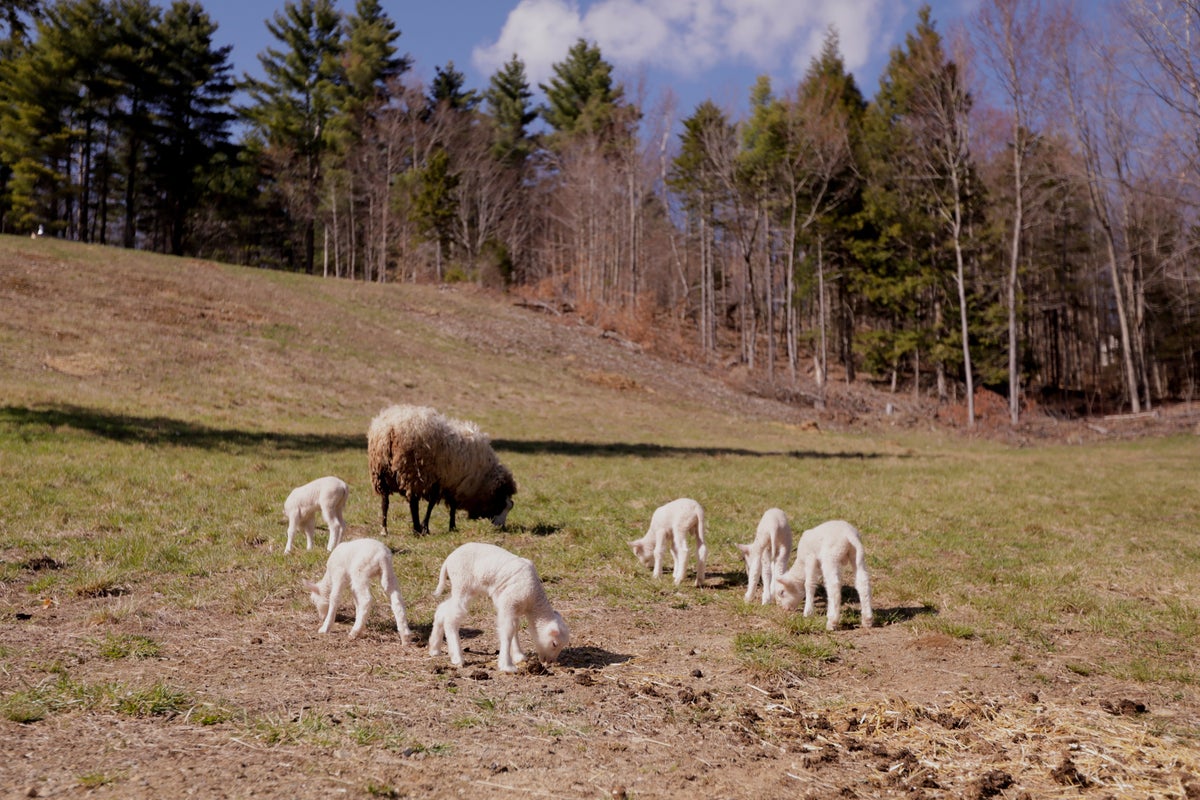
The air inside a lambing shed in the dead of spring doesn't smell like the pastoral poetry of books. It smells of damp wool, amniotic fluid, iodine, and the sharp, metallic tang of exhaustion. For a farmer, this is the season of the long watch. It is a time defined by the rhythmic clicking of a gate, the glow of a flashlight reflected in amber eyes, and the constant, gnawing prayer that the biology of the flock remains predictable.
Predictability is the currency of the land. You bet your mortgage on the fact that a healthy ewe will drop one lamb, or perhaps two. If you are lucky, or if your breeding program is particularly sharp, you might see triplets. Triplets are a headache—a logistical puzzle of extra bottles and orphaned teats—but they are a known quantity.
Then there is the anomaly. The glitch in the genetic code that defies the math of the meadow.
The Weight of Six Hearts
Imagine standing in the straw, the temperature dropping toward freezing, watching a single animal do something that shouldn't be physically possible. On a quiet farm where the hills usually keep their secrets, a Suffolk-cross ewe began a marathon that would leave seasoned vets questioning their textbooks.
The first lamb arrived with the usual wet thud. The second followed quickly, a standard cadence. But as the shepherd moved to clean the mucus from the second newborn’s nose, the ewe didn't settle. She didn't begin the ritual of licking her young to life. She strained again.
And again.
And again.
By the time the fourth lamb hit the straw, the atmosphere in the shed shifted from routine work to something bordering on the supernatural. In sheep farming, the odds of a ewe carrying five lambs are roughly one in a million. Sextuplets? That is a statistic so rare it sits comfortably alongside lightning strikes and winning the lottery while being bit by a shark.
Six lives from one mother. Twenty-four tiny hooves. Six sets of lungs fighting for a first taste of the cold night air. The sheer biological crowding required for such a feat is a marvel of nature; a uterus typically designed for a duo suddenly becomes a packed theater. The "invisible stakes" here aren't just about the novelty of the numbers. They are about the immense physical toll on the animal and the desperate, frantic scramble of the humans responsible for keeping that many fragile heartbeats steady.
The Fragility of the Extraordinary
Nature is rarely kind to the overachiever. When a birth of this magnitude happens, the celebration is usually cut short by the brutal reality of survival. Most sextuplet births end in tragedy—stillborns, crushed runts, or a mother so depleted she cannot recover.
But as the sun began to bleed over the horizon, painting the frost on the fence lines a pale pink, the tally remained impossible. All six were standing.
This isn't just a win for the record books. It’s a testament to the brutal, beautiful labor of the people who live at the mercy of the seasons. To understand this event, you have to understand the math of the teat. A sheep has two. It is an evolutionary hard-stop. When six lambs arrive, the farmer becomes a surrogate parent by necessity, waking every two hours to whisk a rotating cast of newborns toward a bottle. It is a grueling, sleepless cycle of intervention.
The human element of this story isn't found in the headline. It is found in the cracked skin of a farmer’s hands holding a warm milk replacer at 3:00 AM. It’s found in the worry that the smallest of the six—the one the others push aside—won't have the strength to make it through the week.
We often view farming through a distant lens of "food production" or "rural interest." We forget that it is a high-stakes gamble with sentient life. When a "one-in-a-million" event occurs, it isn't just a quirky news snippet. It is a massive, unexpected workload dumped onto a family already stretched thin by the demands of the season.
The Ripple in the Quiet Life
Why does this matter to someone who has never stepped foot in a barn?
It matters because it reminds us that despite our spreadsheets, our reproductive technologies, and our attempts to domesticate the wildness of the world, life still possesses the power to shock us. There is a specific kind of wonder that comes from seeing the "impossible" become literal.
In a world that feels increasingly simulated and controlled, the arrival of six tiny, bleating miracles in a drafty shed serves as a jarring reminder of the raw, unscripted power of biology. It forces a pause. It demands that we acknowledge the sheer tenacity of life.
Consider the ewe. She is the silent protagonist of this saga. Her body performed a feat of endurance that defies standard veterinary logic. She carried nearly a third of her own body weight in offspring, managed to deliver them without fatal complication, and then stepped into the role of mother to a crowd.
There is no "holistic" way to describe it—it was a messy, dangerous, and spectacular defiance of the odds.
The Cost of the Miracle
The aftermath of such a birth is a long road of cautious optimism. The "one-in-a-million" tag sounds like a prize, but for the shepherd, it is a period of intense vulnerability. You become hyper-aware of every cough, every limp, and every drop in temperature.
The bond between the farmer and the flock is often misunderstood as purely transactional. It’s not. There is a deep, unspoken sense of stewardship that keeps a person upright and functional after forty-eight hours without sleep. When you witness a miracle of this scale, you feel a crushing responsibility to see it through to the end. You don't want to be the one who let a million-to-one shot slip through your fingers because you were too tired to check the heat lamp.
The logistics are staggering. The cost of supplemental feed, the constant monitoring for pneumonia, and the sheer spatial requirements of keeping six siblings healthy and thriving represent a significant investment of both capital and soul.
Beyond the Numbers
The facts are simple: one sheep, six lambs, zero deaths.
But the story is complex. It’s a narrative about the boundaries of the physical world being pushed. It’s about the quiet, uncelebrated heroism of rural life where the "workday" doesn't end until the last heartbeat is accounted for.
Most people will read the headline, offer a brief smile at the thought of a pile of fluffy lambs, and move on to the next digital distraction. They won't think about the silence of the shed after the initial chaos. They won't imagine the steam rising off the lambs' backs or the way the mother ewe looks at her impossible brood with a mixture of instinctual devotion and sheer exhaustion.
Life finds a way. Sometimes, it finds six ways at once.
The true magic isn't in the anomaly itself, but in the human response to it. We see a freak occurrence of nature and we don't just observe—we protect. We bottle-feed. We stay awake. We fight for the tiny things that beat the odds, hoping that their survival says something hopeful about our own.
The shed is quiet now. The six are huddled together in a corner, a tangled knot of white wool and twitching ears. The shepherd finally sits on an overturned bucket, the first cup of coffee in twelve hours cooling in their hands. The miracle is over. The hard work of staying alive has just begun.
A single raven flies over the ridge, its shadow stretching long over the grass where the flock will soon graze. Out there, in the wind and the dirt, the world continues its indifferent spin. But inside the warmth of the straw, the math has changed forever.


