The stone of the courtyard is ancient, scarred by centuries of footsteps, revolutions, and rain. On a normal Tuesday, the air here hums with a familiar chaos. Tour guides shout in a dozen languages, flashbulbs pop against the zinc-paneled rooftops of Paris, and the great glass pyramid of the Louvre catches the afternoon sun like a diamond dropped into the dust of history.
Then the iron gates clang shut.
Not for closing time. Not for a national holiday.
They close because the city outside has begun to fracture.
Across France, the air smells of scorched rubber and tear gas. Curfews fall over cities like heavy velvet, silencing boulevards that usually echo with late-night laughter and the clink of bistro glasses. The museums are empty. The guards stand in the echoing galleries, staring at masterpieces that have weathered world wars, now closed behind locked doors because the social contract of the republic is straining at the seams.
Consider what happens when a society stops talking and starts burning.
To understand why the Louvre shuttered its doors and why curfews carved up the map of France, you have to look past the breaking news tickers and the flashing blue lights. You have to look at the kitchen tables where families calculate whether their paychecks will outlast the month. You have to look at the quiet, grinding exhaustion of a population caught between rising costs of living and a government rushing to overhaul its pension system.
It starts with a number. In this case, sixty-four.
The French government, facing the grim math of an aging demographic and a strained budget, decided that citizens must work until they are sixty-four to claim their full retirement. To an economist sitting in a glass-walled office in Brussels or Paris, it is a line item on a spreadsheet. It is a necessary adjustment to balance the books, to ensure the state pension fund does not collapse under the weight of longevity.
To a street sweeper in Marseille, to a nurse in Lyon who spends twelve-hour shifts on her feet, to a young apprentice in a Parisian bakery, sixty-four is not a number. It is a sentence. It is two more years of aching joints, of missed dinners, of trading the twilight of life for a paycheck that barely covers the rent.
When the reform was forced through parliament without a full vote—using a constitutional mechanism known as Article 49.3—it felt less like governance and more like a door being slammed in the public's face.
And so, the streets answered.
At first, it was peaceful. A sea of banners, the rhythmic beating of drums, the sharp, sweet scent of merguez sausages grilling on union-backed carts. It was the classic French ritual of dissent, a civic tradition honed over centuries. The state speaks; the people march. It is noisy, it is disruptive, but it is a safety valve.
But safety valves have limits.
As week bled into week with no concession from the Élysée Palace, the mood shifted. The frustration stopped being an orderly procession and turned into something jagged. By nightfall, the garbage—left uncollected because sanitation workers were on strike—piled high against Haussmann-style facades.
And then came the fire.
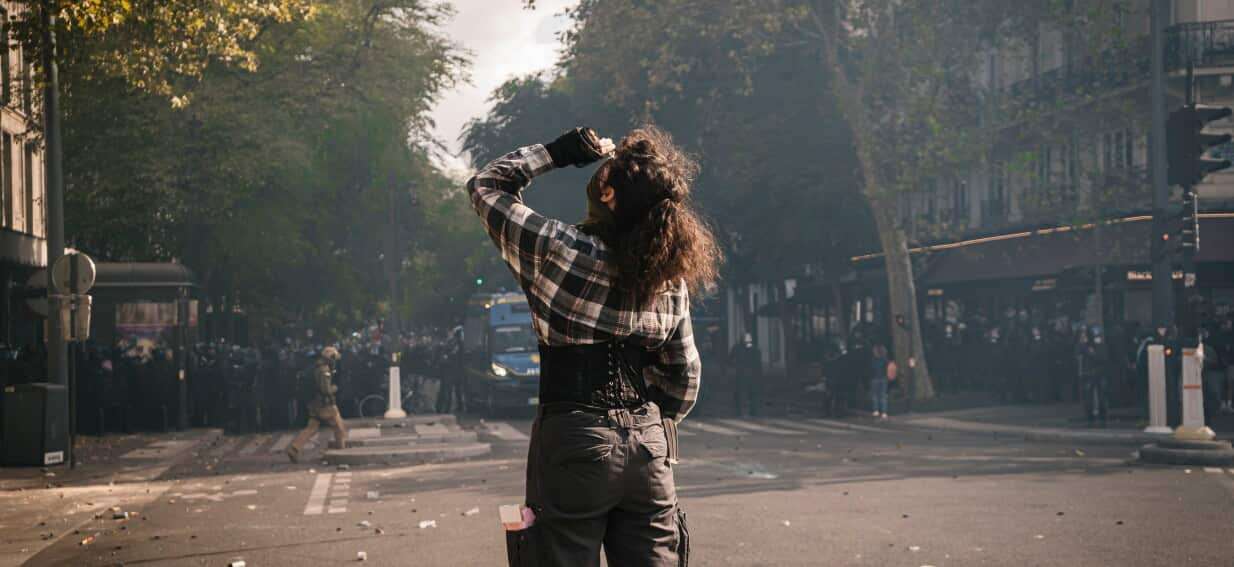
Piles of trash became beacons. Pavements were ripped up, the ancient cobblestones transformed into missiles. Riot police in full black armor, carrying shields scarred by previous battles, moved in compact lines. The tear gas canisters hissed, releasing plumes of acrid smoke that stung the eyes and choked the throat.
This is where the human element gets lost in the global headlines. We watch the drone footage on our screens thousands of miles away. We see the fires blooming like orange flowers against the night. We see the overturned cars and the shattered storefront windows. We judge the chaos.
We rarely ask what it feels like to stand in that smoke.
Imagine standing on the Boulevard Saint-Germain as night falls. The air is thick, metallic, and heavy with fear. A teenager, no older than sixteen, stands behind a makeshift barricade of burning plastic bins, his face wrapped in a scarf, his hands trembling slightly. He is not a professional revolutionary. He is a kid who dropped out of vocational school, worried that his future has already been mortgaged by a system he never agreed to.
Ten feet away stands a CRS riot officer, sweating inside twenty pounds of protective gear. He has been on duty for fourteen hours straight. He has a family waiting for him in the suburbs, a family that watches the news with the same knot in their stomachs. He didn't write the pension law. He is just trying to make it home without a brick hitting his helmet.
Two opposing forces, both trapped in a tragedy of mutual incomprehension, colliding in the cradle of Western democracy.
When the violence peaked, the state did what states have done for centuries. It drew the line. It deployed thousands of security personnel into the urban centers. It restricted gatherings. It canceled cultural events. And yes, it closed the Louvre—the ultimate symbol of national heritage, locked away from the public because the public had become too dangerous to manage.
The irony is thick enough to cut with a knife. The Louvre houses the Mona Lisa, Eugène Delacroix’s Liberty Leading the People, and the Winged Victory of Samothrace. It is a monument to human expression, to the triumph of creativity over barbarism. Yet, on these nights, the very people whose ancestors built those collections were locked outside, staring at the empty glass pyramid while sirens wailed in the distance.
Liberty, it turns out, is remarkably difficult to curate.
When a government relies on executive power to bypass legislative debate, it sends a dangerous signal. It tells the citizen that their voice only matters during election season, and even then, only if they agree with the outcome. Conversely, when protesters resort to burning their own cities to protest a democratic outcome, they erode the very institutions meant to protect them.
Nobody wins in a stalemate of smoke and stone.
The curfews lifted eventually. The garbage was slowly cleared from the boulevards. The tourists returned, shuffling back into the grand halls of the Louvre to marvel at ancient marble under pristine lighting. The surface of Paris smoothed over, polished by municipal workers and swept clean by the relentless march of time.
But the fracture remains.
You can sweep up the glass, and you can reopen the gates, but you cannot un-ring the bell of alienation. The protests over the pension age were never just about retirement brackets. They were a symptom of a deeper malaise—a quiet, gnawing panic that the social contract is broken, that the future is something happening to people rather than for them.
As the sun sets over the Seine, casting long shadows across the stone bridges, the city looks peaceful once again. The cafes are full. The wine is poured. But beneath the charm and the postcard beauty, a question hangs in the damp evening air, waiting for the next spark.
How long can a society hold together when the people at the top and the people on the ground are speaking entirely different languages?


