The bodega is the beating heart of the asphalt grid.
You know the smell. It is a precise alchemy of roasting Cuban coffee, damp cardboard boxes, sweet onions sweating under old fluorescent bulbs, and the sharp, chemical bite of chlorine used on the linoleum floor every single night at two in the morning. It is an ecosystem built on necessity. Bread, milk, lottery tickets, a nod from the guy behind the counter who has memorized your brand of cigarettes before you even learned how to smoke them properly.
And then, ruling over this kingdom from a throne of stacked Corona cases or a warm perch right beside the register, sits the heavyweights. The fur-coated emperors. The neighborhood guardians.
To call them mousers is to miss the entire point. They are urban anchors.
Ask anyone who has ever lived in New York during a three-day summer heatwave when the pavement radiates heat like a pizza oven and the subway smells like sulfur and regret. You walk into the corner store, sweat dripping down your neck, your nerves frayed by the endless honking and the shouting matches on the sidewalk. You push open the heavy glass door with its jangling brass bell.
And there he is. Heavy. Motionless. Looking at you with the profound, unearned exhaustion of a medieval monarch who has seen one too many sieges.
You reach out a finger. He doesn't move. He might allow a single, reluctant scratch beneath his left ear. For three seconds, the crushing weight of rent, bills, and the sheer hostility of the concrete wilderness lifts. You are tethered to the block.
That tether snapped last Tuesday on a quiet stretch of asphalt in Brooklyn.
Chili didn't look like a glamorous cat. He wasn’t a sleek, aristocratic Bengal with exotic markings, nor was he a fluffy white Persian out of a luxury shampoo commercial. Chili was a standard-issue Brooklyn orange tabby. He wore the battle scars of a life well-lived: notched ears, a slightly thickened nose from a long-ago territorial dispute over a dumpster buffet, and a belly that hung low to the ground like a sack of warm flour.
He belonged to the bodega. Or, more accurately, the bodega belonged to him.
He arrived six years ago as a scrawny stray darting in from a freezing November rain. The owner, a man whose hands bore the permanent flour-dust of a thousand early-morning bagel deliveries, opened a can of tuna. An alliance was forged. Over the years, Chili grew into his job description with terrifying efficiency. He greeted mailmen with a low, raspy purr that vibrated through the floorboards. He supervised inventory, curled up on bags of dog food, and stared down aggressive pit bulls through the plate-glass window with the serene confidence of a creature who knew he owned the block.
People didn't just shop there. They visited Chili.
Children coming home from intermediate school would drop their heavy backpacks on the floor just to let him knead their sneakers. Old men who hadn’t spoken a complete sentence to another human being all day would lean against the counter and talk to Chili about the Mets, pausing occasionally to let the cat bat lazily at their watch straps.
Then came the white sedan.
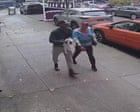
Security footage, grainy and weeping green light from the timestamp in the corner, tells the story with the cold precision of a police report. It was 3:14 AM. The street was dead. A car pulled up to the curb. A man stepped out, moved with practiced swiftness, scooped Chili off his customary crate by the front window, and vanished back into the vehicle before the door even finished swinging shut.
No ransom note. No warning. Just an empty patch of sunlight on the linoleum floor where a living piece of the neighborhood used to be.
When the news hit the block later that morning, it did not arrive as a polite piece of local gossip. It hit like a blackout in August.
By noon, handwritten flyers were taped to every lamppost, mailbox, and hydrant within a ten-block radius. The handwriting on some was frantic and ballpoint-scrawled by teenagers who skipped lunch to make copies; others were neat, laminated notices printed by the local hardware store owner who spent fifty dollars of his own money at the print shop down the avenue.
MISSING. CHILI. NOT JUST A CAT. OUR FAMILY.
I stood outside the bodega that afternoon and watched the neighborhood react. This wasn't the cynical, shoulder-shrugging New York of cinematic clichés where nobody makes eye contact and everyone minds their own business. That New York is a myth sold to tourists. The real New York is a village of eight million fiercely protective strangers who will ignore you on the subway for forty minutes and then tear apart an entire zip code to find a missing orange cat.
A woman in her sixties, carrying two bulging canvas bags of groceries, stopped dead in front of the flyer. Her face crumpled. She didn't know the owner’s last name. She didn't know the names of the cashiers who rotated through the night shift. But she knew Chili. She had buried her husband two winters ago, and she told me, her voice trembling slightly as a delivery truck rattled past, that Chili was the only living thing that hadn't looked at her with pity during those first brutal months.
"They didn't just steal a cat," she whispered, her fingers tracing the edge of the photocopied photo. "They stole our peace of mind."
We live in an era of profound, digitized isolation. We order our groceries through glowing rectangles. We work behind closed doors in remote bedrooms, listening to the hum of server racks instead of the roar of the avenue. Our neighborhoods have become transit hubs rather than communities—places we sleep between commutes, places we pass through on our way to somewhere else.
In that kind of world, public spaces lose their warmth. They become sterile, transactional zones of concrete and glass.
Unless you have a bodega cat.
Bodega cats are the ultimate social lubricant. They force us to slow down, look down, and interact with the physical reality of our surroundings and the people sharing them. To love a bodega cat is to acknowledge that you are part of a shared ecosystem. You are admitting that your street has a soul, and that soul is embodied in a lazy, shedding, four-legged creature sleeping on a stack of canned tomatoes.
When Chili went missing, the invisible architecture of the neighborhood was exposed. People who had lived across the hall from each other for twelve years without exchanging a nod were suddenly standing on the sidewalk together, arguing passionately about license plate numbers and reviewing security camera angles from the local dry cleaner.
The internet did what the internet does best: it amplified the outrage. Within thirty-six hours, a local subreddit thread had generated hundreds of comments. People from Queens, Manhattan, and even across the river in Jersey were offering to canvas the neighborhood. A GoFundMe started by a regular customer to cover a reward hit its thousand-dollar goal in less than four hours.
We were organizing. We were mobilizing. Not for politics, not for zoning laws, but for an orange ball of fur with a notched ear.
Consider what happens when a community is stripped of its small, harmless joys.
You start to notice the cracks in the pavement. You start to lock your doors a little tighter. You start to look at your neighbors not as fellow human beings weathering the storm together, but as potential threats in a crowded, indifferent city.
The theft of Chili wasn't just a petty property crime. It was an assault on the neighborhood's collective narrative. It was a reminder that even the most cherished local landmarks are vulnerable to the casual cruelty of someone passing through in a white sedan who sees only an object to be taken, rather than a life that matters.
But the reaction? The reaction was the antidote.
By Thursday night, the story had reached local news channels. Reporters with microphones were standing outside the bodega, interviewing the distraught owner, zooming in on the empty spot by the register where Chili's water bowl still sat—filled fresh every morning, just in case.
The pressure was absolute. You cannot hide an infamous orange cat in a city where every corner has eyes, every bodega has a security camera, and every resident is scrolling through social media with mounting fury.
It ended on Friday evening, just as the sun was beginning to dip below the water towers, painting the sky in bruises of purple and gold.
A battered sedan pulled up to the curb, hazard lights blinking erratically. The passenger door opened just a crack. A furry orange missile bolted out, darted across the sidewalk with undignified speed, and shot straight through the open door of the bodega, sliding across the freshly mopped linoleum before coming to a triumphant halt right beside the register.
The driver sped off into the twilight before anyone could catch a license plate. Nobody cared.
Within minutes, the street erupted. Horns blared—not in anger, but in a chaotic, joyful symphony of celebration. People poured out of apartment buildings, stepping onto stoops and cheering. Inside the store, the owner was kneeling on the floor, weeping openly into a thick orange neck, while Chili sat there with his eyes half-closed, purring with the deep, resonant satisfaction of a king who had successfully survived a brief, unpleasant exile.
He had a few new burrs in his fur. He smelled faintly of upholstery cleaner. But he was home.
As I walked past the store an hour later, the handwritten flyers were still taped to the lampposts. Nobody had taken them down yet. But someone had walked along the block with a thick black marker, drawing a massive, exuberant checkmark across every single one, right over Chili's face.
The city is vast, indifferent, and occasionally cruel. It will try to grind you down into an atomized statistic, rushing from one closed door to the next.
Don't let it.
Look down. Find the warmth. Protect your block.
And if you ever see an orange cat sleeping on a box of laundry detergent in the middle of Brooklyn, give him a scratch behind the ears for me. He’s working harder than you think.