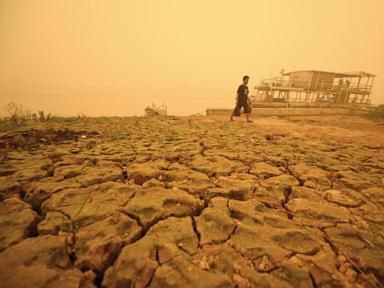
Singapore and Indonesia have officially established a bilateral task force to combat transboundary haze caused by illegal land burning across Sumatra and Kalimantan. On paper, the agreement promises tighter intelligence sharing, joint satellite monitoring, and coordinated enforcement against rogue plantation operators. In reality, this new bureaucratic body enters a thirty-year graveyard of broken promises, jurisdictional deadlocks, and deeply entrenched agricultural economics that make fire the cheapest tool in Southeast Asia.
Every dry season, the wind shifts. Smoke drifts across the Malacca Strait, blanketing Singapore’s gleaming financial district in toxic particulate matter while choking millions of Indonesian citizens closer to the source. Politicians issue stern warnings. Diplomats sign memorandums of understanding. Then the monsoon rains arrive, extinguishing the flames and washing away the political urgency until the next El Niño cycle dries out the peatlands once again.
To understand why this latest task force faces an uphill battle, you have to follow the money, the peat, and the messy reality of decentralized governance in the Indonesian archipelago.
The Economics of Slash and Burn
Fire is not an accident. It is a line item on a balance sheet.
Clearing a hectare of degraded forest or scrubland using heavy machinery—excavators, bulldozers, and chainsaws—costs roughly $800 to $1,200 per hectare, depending on terrain and labor availability. Clearing that exact same plot with a box of matches and a jerrycan of diesel costs less than $50. For smallholder farmers operating on razor-thin margins, and for mid-tier contractors hired by larger conglomerates to keep operational costs down, the math is brutal and undeniable.
Even worse, burning alters soil chemistry in the short term. The resulting ash temporarily neutralizes the high acidity of tropical soils and releases a quick burst of potassium and phosphorus, acting as a free fertilizer for the first planting cycle of oil palm or acacia.
Regulatory penalties rarely offset these immediate financial savings. While Indonesian law carries strict liability provisions for landholders whose concessions burn, proving intent in a remote district hours away from the nearest paved road is notoriously difficult. Local syndicates often hire impoverished day laborers to set fires at night, creating plausible deniability for the corporate entities that ultimately acquire the cleared land. By the time investigators arrive, the smoke has cleared, the perpetrators have vanished, and oil palm seedlings are already in the ground.
Why Peatlands Refuse to Die
If the fires only burned surface vegetation, the haze crisis would end within days. The true culprit lies beneath the surface.
Indonesia holds roughly half of the world’s tropical peatlands—waterlogged ecosystems formed over thousands of years from partially decayed organic matter. In their natural state, peat swamps act as massive carbon sinks and natural firebreaks. When agricultural developers dig drainage canals to lower the water table so oil palm roots do not rot, the exposed peat dries out and turns into volatile, carbon-rich kindling.
Once ignited, a peat fire does not behave like a forest fire. It burns underground, smoldering at depths of up to several meters for weeks or even months.
Water bombers dropping thousands of liters from the air merely wet the top crust while the subterranean fire continues to eat through ancient organic deposits, pumping massive plumes of fine particulate matter (PM2.5), carbon monoxide, and methane into the atmosphere. The only way to truly extinguish a deep peat fire is to re-wet the entire landscape by blocking drainage canals and waiting for sustained, heavy rainfall.
The Jurisdictional Trap
Singapore has the money, the satellite surveillance capabilities, and the legal framework. Indonesia has the land, the sovereignty, and the enforcement burden.
In 2014, Singapore passed the Transboundary Haze Pollution Act (THPA), a landmark piece of legislation designed to hold foreign companies criminally and civilly liable in Singaporean courts if their operations caused unhealthy haze levels in the city-state. For a brief moment, legal scholars hailed it as a breakthrough in extraterritorial environmental law.
The enforcement reality proved far messier.
To prosecute a company under the THPA, Singaporean authorities need concession maps showing exact land boundaries, corporate ownership registries, and on-the-ground forensic evidence linking a specific fire hotspot to a specific corporate entity. In Indonesia, concession maps have historically been treated as sensitive state secrets, guarded by ministries wary of foreign interference and domestic litigation. Without official map data from Jakarta, Singapore’s law enforcement agencies were left staring at thermal anomalies on satellite imagery without knowing which corporate shell company owned the dirt underneath the smoke.
The new task force aims to bridge this exact intelligence gap. By creating a formal channel for sharing geospatial data and hotspot coordinates, officials hope to eliminate the bureaucratic friction that paralyzed previous cross-border investigations.
The Supply Chain Shell Game
Even when satellite coordinates align with a known plantation boundary, corporate ownership structures are engineered to obscure accountability.
A typical mid-sized plantation in Riau or Central Kalimantan rarely belongs directly to a publicly traded agribusiness giant. Instead, it is often held through layers of local subsidiaries, nominee directors, and cooperative agreements with village-level smallholder groups (plasma schemes). When a fire breaks out on a contested boundary between a corporate concession and a community plot, both sides point fingers at the other.
Major palm oil and pulpwood conglomerates have adopted strict "No Deforestation, No Peat, No Exploitation" policies under pressure from European and North American buyers. Yet these same conglomerates continue to buy fresh fruit bunches from third-party mills and independent aggregators who source from burned land. Until traceability extends down to the individual farm gate—and until buyers refuse to touch unverified fruit—the market will continue to reward illegal clearing.
The Ghost of Agreements Past
Seasoned observers of Southeast Asian environmental politics view any new bilateral commission with earned skepticism. The region is already carpeted with overlapping frameworks that failed to stop the smoke.
Consider the ASEAN Agreement on Transboundary Haze Pollution, signed in 2002. Indonesia was the last member state to ratify it, waiting twelve years until 2014 to formally join. Despite its binding language on regional cooperation and emergency response, the treaty contains no enforcement mechanisms, no financial penalties for non-compliance, and strict adherence to ASEAN’s foundational principle of non-interference in domestic affairs.
Then came Indonesia’s creation of the Peatland Restoration Agency (BRG) in 2016 following the catastrophic 2015 haze crisis, which caused over $16 billion in economic losses in Indonesia alone and triggered widespread respiratory illness across the region. The agency achieved measurable success in building canal blocks and restoring degraded peat within state-controlled areas. However, its mandate struggled to penetrate private corporate concessions, and political momentum waned during wetter years when the skies remained blue.
What Makes This Task Force Different—Or Worse
Supporters of the new Singapore-Indonesia task force argue that two factors have shifted since the dark days of 2015.
First, commercial satellite technology has improved dramatically. Daily high-resolution imagery from constellations like Planet Labs, combined with synthetic aperture radar capable of piercing thick cloud cover and smoke, makes it nearly impossible to hide large-scale land clearing. You no longer need an informant on the ground to prove when a drainage canal was dug or when a burn scar first appeared.
Second, Jakarta has consolidated a massive spatial database through its One Map Policy, an ambitious effort to reconcile overlapping land claims from the forestry, agriculture, and mining ministries into a single authoritative reference. If the task force grants Singaporean investigators real-time access to this unified map alongside fire alerts, the days of corporate anonymity could narrow considerably.
Yet serious structural flaws remain embedded in the task force’s design.
- Lack of Prosecutorial Authority: A task force is an administrative coordination mechanism, not a court. It can share data and recommend action, but actual arrests, license revocations, and asset seizures still depend entirely on Indonesian police, prosecutors, and local district heads (bupati).
- Local Election Cycles: In Indonesia’s decentralized political system, district heads hold immense power over land permits and local enforcement. Running an aggressive crackdown against local agricultural elites right before a regional election is political suicide for a sitting bupati.
- The Smallholder Blind Spot: Roughly 40 percent of Indonesia’s oil palm acreage is managed by independent smallholders. Cracking down on multi-billion-dollar conglomerates is politically popular; fining or jailing thousands of subsistence farmers who have no access to heavy machinery or subsidized land-clearing alternatives is a recipe for rural unrest.
The Weather Wildcard
No policy framework, task force, or satellite network has ever extinguished a major haze crisis on its own. Weather remains the ultimate arbiter.
Between 2020 and 2022, a rare triple-dip La Niña weather pattern brought unusually heavy rainfall across maritime Southeast Asia during the traditional dry months of August through October. Peatlands stayed saturated. Fires failed to spread. Officials in both Jakarta and Singapore took victory laps, crediting improved fire prevention protocols and stricter law enforcement for the clean air.
Climate scientists saw a different reality. The underlying vulnerabilities—millions of hectares of drained peat, unmapped smallholder plots, and economic incentives favoring fire—remained largely intact beneath a temporary blanket of rain. When the Pacific Ocean inevitably swings back toward strong El Niño conditions, drying out the peat domes of South Sumatra and West Kalimantan, the true test of this bilateral task force will begin.
What Real Enforcement Would Actually Require
If Singapore and Indonesia want this task force to be more than a diplomatic press release, they have to move beyond monitoring hotspots and start attacking the financial and logistical infrastructure of illegal burning.
First, financial traceability must replace physical patrolling. Instead of chasing arsonists through swamps, regulators in Singapore—one of the world’s premier commodity trading and banking hubs—should require financial institutions to freeze credit lines and trade financing for any agribusiness group linked to verified burn scars, regardless of whether the fire occurred on a core concession or a third-party supplier’s plot.
Second, subsidized mechanical clearing must reach the village level. Telling a smallholder farmer not to burn without providing affordable access to shared excavators, shredders, and bio-composting equipment is an exercise in futility. Wealthier regional neighbors like Singapore could co-fund equipment pools at the sub-district level, directly undercutting the economic advantage of fire.
Third, concession data must become public by default. Secrecy protects bad actors. Publishing up-to-date vector files of all plantation boundaries allows independent researchers, insurers, and commodity buyers to spot illegal encroachment within hours rather than waiting months for bilateral committees to approve data-sharing requests.
Until capital stops flowing to burned land and smallholders have a viable alternative to matches, the task force will spend every dry season counting hotspots on a screen while the wind blows the smoke straight back toward Marina Bay.