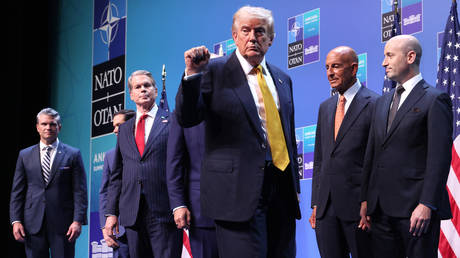
Brussels is hyperventilating again.
Every time an American election cycle shifts into high gear, the diplomatic cocktail circuit in Belgium dissolves into a collective panic attack. The latest anxiety dream making the rounds in European capitals—breathlessly amplified by mainstream outlets—is a simple, linear horror story. If Donald Trump and the Republicans suffer a brutal defeat in the midterm elections, a wounded, cornered president will lash out abroad. He will freeze aid, gut troop deployments, and clamp down on NATO to distract from domestic humiliation. In related news, take a look at: What Most People Get Wrong About the King and Slavery Reparations.
It is a neat, tidy narrative. It reads like a prestige political thriller. And it gets the structural reality of transatlantic security completely backward.
The lazy consensus in Washington and Brussels assumes that a politically secure American president is good for NATO, while a domestically weakened one is an existential threat. That logic relies on a fundamental misreading of both American constitutional mechanics and European bureaucratic psychology. For decades, European defense ministries have treated American political stability as a sedative. When Washington is calm, Brussels goes back to sleep. The Washington Post has analyzed this fascinating topic in extensive detail.
A midterm backlash against Trump wouldn't destroy the alliance. It would force the exact structural correction NATO has spent thirty years avoiding, while simultaneously activating domestic guardrails in Washington that European diplomats pretend don't exist.
The Myth of the Unchecked Executive
European commentary consistently treats the American presidency like an absolute monarchy with term limits. The assumption is that if Trump loses Congress, he will retreat into the Oval Office and unilaterally dismantle the North Atlantic Treaty with a stroke of a Sharpie.
That ignores the actual machinery of U.S. law.
First, look at the statutory locks already on the books. Under the National Defense Authorization Act (NDAA) for Fiscal Year 2024—specifically Section 1250A, championed by Senators Tim Kaine and Marco Rubio—the president is explicitly barred from suspending, terminating, denouncing, or withdrawing the United States from the North Atlantic Treaty without an act of Congress or the advice and consent of two-thirds of the Senate. Trump cannot simply walk away from Article 5 because he had a bad Tuesday in November.
Second, a midterm defeat changes the power dynamic on Capitol Hill, not in Trump's favor, but against it.
If Democrats flip the House—or even narrow the margins significantly—Trump loses the unilateral legislative runway he enjoys during a unified government. A hostile House Armed Services Committee and House Foreign Affairs Committee immediately gain subpoena power, oversight authority, and, most critically, the power of the purse. Every single dollar spent on the European Deterrence Initiative, every rotational brigade deployment in Poland, and every logistical hub in Germany runs through congressional appropriations.
I have sat in enough defense briefings in Washington and Brussels to know how this game actually works. Presidents talk in grand, sweeping threats; appropriators write the checks that dictate reality on the ground. When a president is weakened at home, his ability to bully his own party's defense hawks evaporates. Traditional Republican institutionalists in the Senate—figures like Mitch McConnell's successors on the Armed Services and Foreign Relations committees—suddenly find their spines when the White House loses its electoral aura of invincibility.
A cornered Trump doesn't get more power to dismantle NATO. He gets bogged down in domestic trench warfare, judicial battles, and legislative gridlock. The bandwidth required to systematically decouple the U.S. military from European Command (EUCOM) simply vanishes when the West Wing is fighting off congressional investigations every morning before breakfast.
Brussels Loves a Crisis Because It Hates Making Decisions
The real reason European officials are leaking their anxieties to the press isn't fear of American abandonment. It is fear of having to take responsibility for their own continent.
Let's define a term that gets thrown around diplomatic circles like confetti: burden-sharing. In theory, it means equitable distribution of military capabilities, financial costs, and operational risks among allies. In practice, for the last three decades, burden-sharing has meant Europe outsourcing its hard security to the Pentagon while lecturing Washington on soft power.
When Barack Obama and Joe Biden occupied the White House, European leaders praised American leadership, signed lofty communiqués, and quietly starved their own defense industrial bases. Even after Russia's full-scale invasion of Ukraine in 2022, European rearmament moved at a glacial pace whenever Washington signaled unconditional support. Why spend political capital cutting social welfare budgets to buy 155mm artillery shells when Uncle Sam will cover the gap?
Trump's hostility—and the threat of a "clampdown"—is the only external shock that has ever forced European capitals to move money from press releases into actual defense contracts.
Look at the numbers. In 2014, when NATO allies formally pledged to spend 2 percent of their GDP on defense, only three countries met the target. By 2024, twenty-three of the thirty-two members cleared that bar. That surge didn't happen because Brussels suddenly discovered strategic enlightenment. It happened because Russian tanks rolled toward Kyiv and Donald Trump repeatedly threatened to let Moscow "do whatever the hell they want" to delinquent payers.
If the midterms deliver a decisive blow to Trump, European officials fear two contradictory things at once: an immediate tantrum from the White House, followed by the false comfort that American politics is "returning to normal" ahead of the next presidential cycle. The second risk is infinitely more dangerous to European survival than the first.
What Happens When Washington Actually Pulls Back
Imagine a scenario where the conventional wisdom is half-right. Suppose a post-midterm Trump cannot legally exit NATO, so he does what an executive actually can do: he slows down weapon deliveries, freezes new troop rotations to the eastern flank, and demands cash-on-the-barrelhead for intelligence sharing and satellite logistics.
Panic in the short term? Yes. Catastrophe in the long term? Only if Europe remains addicted to American hand-holding.
Consider the sheer economic and demographic asymmetry between Europe and Russia. The European Union plus the United Kingdom represents an economy of roughly $22 trillion and a population exceeding 510 million people. Russia possesses an economy roughly the size of Italy's—around $2 trillion—and a population of 144 million, currently hemorrhaging men and materiel in a grinding war of attrition.
Europe does not lack money. Europe does not lack industrial capacity. Europe lacks political will.
A temporary American clampdown on NATO logistics or funding would expose the exact choke points that European defense planners have swept under the rug for years:
- Strategic Enablers: Europe relies heavily on U.S. air-to-air refueling, heavy airlift, and satellite reconnaissance. A freeze forces immediate joint procurement by Airbus and European defense primes instead of endless feasibility studies.
- Ammunition Production: Rheinmetall, BAE Systems, and MBDA have the engineering talent to outproduce Russian factories several times over, provided European governments sign multi-year, guaranteed purchase agreements rather than trickle-funding prototypes.
- Command and Control: NATO's Supreme Allied Commander Europe (SACEUR) has always been an American four-star general. Facing a disengaged White House, European militaries would finally have to build a genuine European pillar within NATO capable of running high-intensity corps-level operations without waiting for the Pentagon to turn on the lights.
When I worked with defense contractors trying to navigate European procurement ministries, the biggest obstacle wasn't technical capability—it was regulatory paralysis. Everyone waited for Washington to set the standard, fund the R&D, and absorb the initial production risk. Remove that safety net, and European defense consolidation stops being a theoretical white paper and becomes an immediate survival mechanism.
Answering the Questions Nobody Wants to Ask
Whenever this topic surfaces, the public conversation gets trapped in binary, apocalyptic framing. Let's dismantle the flawed premises behind the questions dominating the news cycle.
Can Trump unilaterally pull the U.S. out of NATO if he loses the midterms?
No. Aside from Section 1250A of the 2024 NDAA, any attempt to bypass Congress on treaty termination would trigger an immediate constitutional crisis and Supreme Court injunction. Even if he tried to hollow out the alliance by withdrawing every single U.S. soldier from Europe, Congress controls the funding required to transport those troops and equipment back to the United States—just as lawmakers blocked Trump's attempt to pull 12,000 troops out of Germany during his first term.
Would a U.S. clampdown invite immediate Russian aggression against the Baltics?
This assumes the Russian military is currently sitting in pristine condition waiting for an opening. It isn't. Moscow's ground forces are deeply degraded, reliant on Soviet-era stockpiles, and tied down in Ukraine. Furthermore, France and the United Kingdom possess independent nuclear deterrents, and Poland is rapidly building the largest, best-equipped land army in the European Union. Russia attacking a NATO member—even one with reduced U.S. troop presence—still triggers a conventional war against combined European air forces that outclass the Russian Aerospace Forces in every measurable metric.
Isn't a weakened, distracted American president bad for global deterrence?
Deterrence isn't built on the mood swings of one man in the Oval Office; it is built on capability, credibility, and industrial depth. Right now, NATO's deterrence suffers from a fatal flaw: Moscow knows that Europe cannot fight a prolonged high-intensity war without American logistics. As long as that dependency exists, Vladimir Putin only needs to wait for a chaotic American election cycle to destabilize European security. Fixing that dependency permanently strengthens deterrence far more than another four years of polite speeches from Washington.
The Flaw in the Contrarian Bet
I will be the first to admit the glaring vulnerability in this argument: timing.
Structural transformation in defense manufacturing takes years, while a sudden cut-off of U.S. intelligence, air defense interceptors, or financial aid to Ukraine creates an immediate tactical gap on the battlefield. If a wounded White House abruptly halts Patriot missile transfers or Starlink access in November, European factories cannot conjure replacement interceptors out of thin air by December. Ukraine would pay the immediate price in blood and territory before European production lines could catch up.
There is also the risk of political fracturing inside Europe itself. Instead of uniting to fill the void left by Washington, certain European capitals—Budapest, Bratislava, and potentially others facing populist surges—could use an American pullback as an excuse to cut side deals with Moscow, shattering EU consensus on sanctions and defense spending.
Those are real, dangerous friction points. Pretending they don't exist is just as naive as Brussels' current panic.
What European Leaders Should Actually Do Before November
Instead of leaking anonymous quotes to journalists about how terrified they are of the American electorate, European policymakers need to treat a post-midterm Trump clampdown as their baseline operational plan.
- Stop buying off-the-shelf American gear to appease Washington. For years, European governments bought F-35s and Patriot batteries partly as an insurance policy to keep the White House happy. If Washington is going to clamp down regardless, that political bribe no longer works. Redirect that capital immediately into European production lines for air defense, long-range strike, and drone warfare.
- Pre-fund a European-led Ukraine support mechanism. Take the financial and logistical pipeline for Kyiv out of the bilateral U.S. political crossfire. Issue joint European defense bonds specifically earmarked for Ukrainian industrial production—building weapons inside Ukraine with European cash, bypassing both American congressional gridlock and slow European assembly lines.
- Bypass the White House and lobby Capitol Hill directly. European ambassadors spend too much time trying to read the tea leaves inside the West Wing. They should be camping out in the offices of House and Senate appropriators from states where defense contractors build the weapons Europe buys. American politics runs on local jobs, not diplomatic nostalgia.
NATO does not have a Donald Trump problem. NATO has an adulthood problem. For eighty years, Western Europe enjoyed the luxury of being a strategic protectorate, outsourcing life-and-death decisions to an ocean away while criticizing the protector's manners.
If a midterm defeat turns Trump inward and forces him to slam the door on Brussels, European leaders shouldn't reach for the panic button. They should finally pick up the bill.