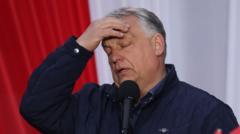
The headlines are screaming about a "landslide defeat." They are obsessing over the optics of Viktor Orbán stepping down from the Hungarian parliament as if it were a white flag. The international press is taking a victory lap, convinced that the populist era in Budapest has hit a concrete wall.
They are dead wrong.
What you are witnessing isn't the collapse of a regime. It is a strategic pivot—a controlled demolition of an old power structure to make room for something far more insulated. If you think a guy who has spent three decades rigging the system to his favor just "lost" and decided to go home, you don't understand the mechanics of power in Central Europe. You are looking at the scoreboard while Orbán is buying the stadium.
The Illusion of the Landslide
Mainstream pundits love a clean narrative. They see a dip in vote share or a lost parliamentary majority and call it the end. But in the illiberal playbook, the parliament is a theater. The real power moved long ago.
Over the last ten years, Orbán didn't just pass laws; he outsourced the state. Through the creation of "Public Interest Asset Management Foundations," billions in state assets—universities, energy interests, and infrastructure—were transferred to boards filled with loyalists. These are private entities. They don't change when the government changes.
When the opposition "wins" a parliament that has been stripped of its assets, they haven't won a country. They’ve won the right to manage a bankrupt office while the previous owners still hold the keys to the vault.
The Decentralized Autocracy
- The Competitor View: A lost election means a loss of control.
- The Reality: Losing the election offloads the blame for the coming economic crunch.
Hungary is facing massive inflation and a standoff with the EU over frozen funds. By stepping back now, Orbán effectively hands the steering wheel to the opposition just as the car is about to hit a brick wall. He isn't retreating; he is repositioning himself as the "outsider" who can criticize the inevitable chaos from the sidelines.
I have watched political consultants burn through millions trying to "restore democracy" in places where the deep state isn't a conspiracy theory—it’s the payroll. If you think the civil service, the judiciary, and the media regulators are going to suddenly flip their loyalty because of a vote count, you are dangerously naive.
Why the Parliamentary Exit is a Power Play
Stepping down from parliament isn't a resignation. It’s a liberation.
In parliament, you are subject to rules, interpellations, and the daily grind of legislative procedure. Outside of it, as the head of a movement rather than a mere MP, Orbán becomes a martyr-king. He is no longer responsible for the price of bread, yet he maintains total control over the Fidesz party machinery, which remains the only disciplined political force in the country.
History is littered with leaders who became more powerful the moment they stepped out of the formal spotlight. Look at Jarosław Kaczyński in Poland for years—governing from the back seat is far more effective than sitting in the driver’s chair where everyone can see your mistakes.
The "People Also Ask" Fallacy
People are asking: "Is Hungary returning to the European fold?"
The premise is flawed. Hungary never left the fold; it redefined it. The European Union operates on the assumption that member states want to play by the rules. Orbán proved that you can break the rules, keep the subsidies (eventually), and use the EU as a convenient punching bag to domestic audiences.
The new government, assuming they can even form a coalition, will be trapped. If they move too fast to "restore the rule of law," they will be accused of being puppets of Brussels. If they move too slow, their base will desert them. It is a win-win for the man who just "lost."
The Trap of the Coalition
Let’s talk about the "winners." A ragtag group of socialists, greens, and former far-right actors who agree on exactly one thing: they hate Viktor Orbán.
That is not a governing philosophy. That is a recipe for a circular firing squad.
The moment the champagne stops flowing, these parties have to decide on tax policy, energy subsidies, and the war in Ukraine. Orbán knows this. By stepping down, he removes the single unifying force that kept his enemies together. Without him to rail against in the halls of parliament, the opposition will devour itself within eighteen months.
I have seen this movie before in the corporate world. A CEO "resigns" after a bad quarter, leaves the mess for a successor to clean up, and then gets rehired two years later when the replacement fails to perform a miracle. It isn't a defeat; it’s a sabbatical.
The Math of the Minority
To understand why this "defeat" is a sham, you have to look at the numbers.
$$V = \frac{p}{c} + s$$
In this simplified model of illiberal survival, $V$ (Power) is a function of $p$ (Personal Loyalty) divided by $c$ (Constitutional Constraints), plus $s$ (Shadow Assets).
Even if the parliamentary vote count drops, the $s$ variable—the shadow assets—remains at an all-time high. The media landscape is still owned by the Central European Press and Media Foundation (KESMA). The procurement contracts are still held by a handful of families.
The opposition has won the right to sit in a building. The Fidesz elite still owns the ground the building is sitting on.
The Dangerous Nuance
Is there a downside to this contrarian view? Yes. The risk for Orbán is that the momentum of a loss can sometimes become a self-fulfilling prophecy. If his financial backers perceive him as truly "finished," the patronage network could crack.
But that assumes these backers have somewhere else to go. They don't. The opposition has spent years promising to throw them in jail. Their survival is tied to Orbán’s eventual return. They aren't going to flip; they are going to bunker down.
Stop Celebrating a Ghost
The international community is making a classic mistake: they are treating a change in personnel as a change in system.
The "Orbán System" was designed specifically to survive without Orbán in the Prime Minister's chair. It is a legal and economic fortress. Removing the figurehead doesn't take down the walls. It just means the figurehead is now free to walk around the outside and point out where the mortar is cracking.
If you want to know when Orbán has actually lost, don't look at parliamentary seats. Look at the bank accounts of the foundations. Look at the ownership structures of the TV stations. Until those are dismantled, any talk of a "landslide defeat" is just fan fiction for liberal optimists.
The man didn't lose his job. He just changed his title to something far more dangerous.
Stop watching the podium. Watch the shadows.