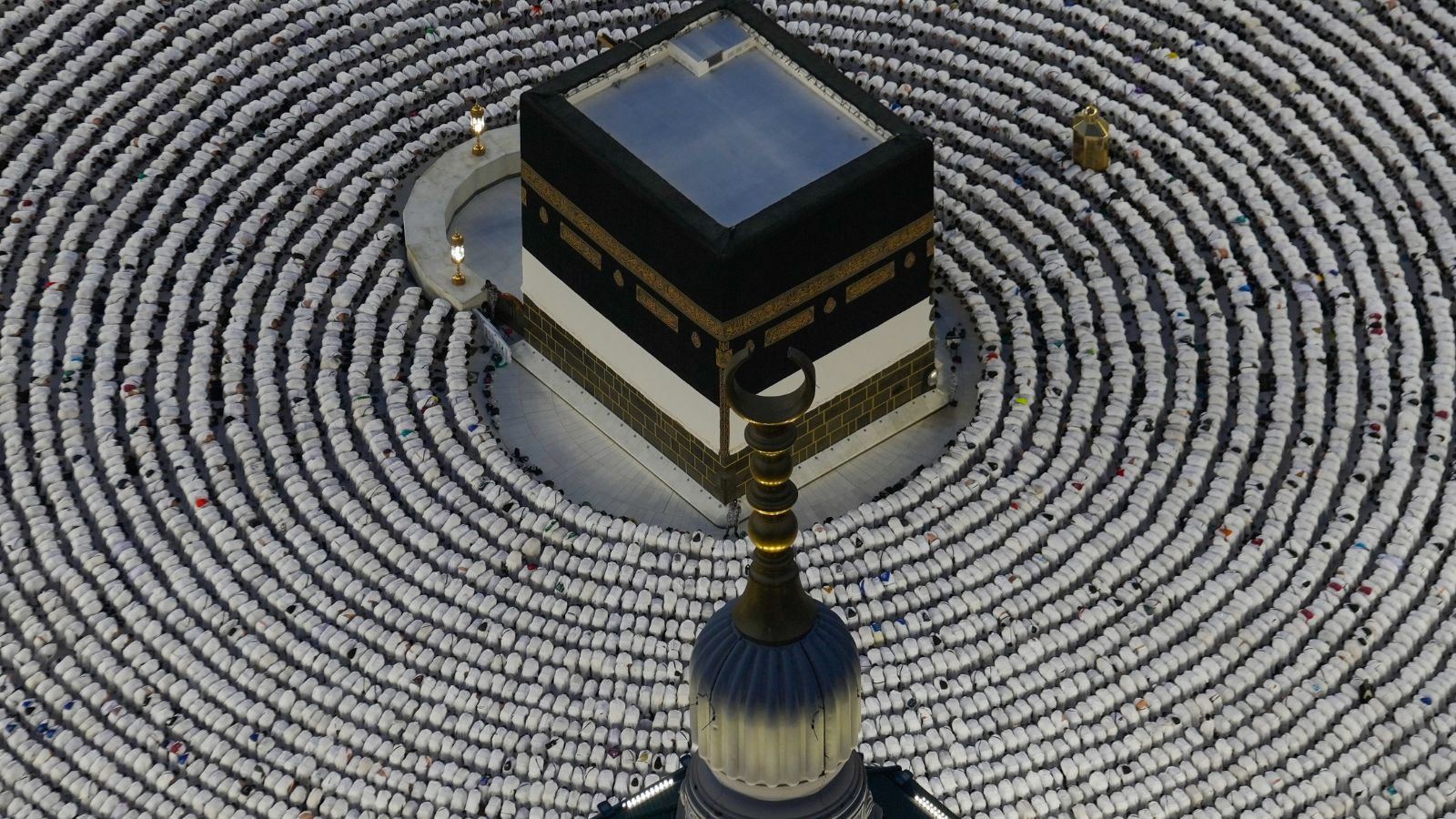
You don't just pack a bag and head to Makkah. For most of the 1.5 million Muslims gathered in Saudi Arabia right now, getting here required decades of aggressive saving, endless lottery waitlists, and immense sacrifice. But this year, the normal hurdles look small compared to what's happening outside the holy city. The annual Hajj pilgrimage is unfolding under a heavy, suffocating cloud of regional conflict.
With a fragile, tenuous ceasefire barely holding following intense US, Israeli, and Iranian military strikes earlier this year, the entire Middle East is on edge. Missile defense batteries are literally sitting on the outskirts of Makkah right now to protect the skies. Yet, international pilgrim numbers haven't plummeted. They've actually surpassed last year's arrivals. Why are people running toward the epicenter of a geopolitical powder keg just to perform a religious ritual?
The answer is simple. When your world is fracturing, the urge to find something permanent, sacred, and unifying becomes absolute. For the believers walking around the Kaaba today, the journey isn't a reckless gamble. It's the ultimate assertion of faith over fear.
The Reality of a Wartime Pilgrimage
Let's look at the actual logistics because the conflict isn't just a abstract headline. It has actively messed with global aviation. Commercial flight paths across the region are a total mess. Airlines have been forced to introduce longer, winding routes to bypass restricted airspace, sending ticket prices sky-high and adding extra fees that hit working-class pilgrims hard.
Take Farzana Begum, a retired teacher from Birmingham. She spent years watching her savings grow, hoping to make the trip before her health failed. When the conflict between Iran and Western forces escalated, her family begged her to stay home. She refused. Her reasoning represents how most older pilgrims feel: what if next year never comes?
Then there's the economic fallout. The conflict has triggered massive inflation and currency devaluations in places like Egypt and Jordan. Travel operators in Amman note that pilgrims are calling every hour, desperately asking if their flights are still cleared or if the airspace will shut down entirely while they're mid-air. It's a logistical nightmare, yet people are still boarding the planes.
Air Defenses and Forbidden Flags
Saudi Arabia is treating the security situation with extreme gravity. The Saudi defense ministry recently went public with footage of advanced air defense systems stationed right outside the holy sites. Their message was blunt: the skies are protected, and the guests are safe.
But the tension isn't just external. It's inside the crowds too. Iranian pilgrims are attending, but under highly specific conditions. Following a wave of Iranian strikes targeting infrastructure in the Gulf earlier this year, Riyadh is keeping a tight lid on things. Only around 30,000 Iranian pilgrims made it this year, down from the expected 86,000, largely due to the chaos of the wartime situation.
If you walk the streets of Makkah right now, you won't see political banners or national flags. The Saudi interior ministry explicitly banned all political or sectarian chanting. They want zero friction. In fact, authorities have tightly controlled who can interact with certain foreign delegations to prevent any localized arguments from sparking a larger incident.
An Iranian pilgrim named Qadiri, who fled bombing raids in Isfahan just months ago, summed up the bizarre contrast of the situation. He mentioned that back home, his family lived in terror of explosions. In Makkah, surrounded by security walls and thousands of strangers, he only hears the call to prayer. For him, the heavily guarded holy city is ironically the safest place on earth.
The Missing Pilgrims of Gaza
While millions celebrate, there's a gaping wound in this year's gathering. For the third consecutive year, Palestinians trapped in Gaza are completely locked out. The total closure of the Rafah border crossing means their Hajj quotas—usually around 2,500 people chosen through a meticulous lottery system—are completely wasted.
- Money spent on survival: Many elderly residents in Gaza had saved for over a decade to afford the trip. When the military offensive ruined their towns, those life savings were spent on basic food, clean water, and makeshift tents during repeated displacements.
- The emotional toll: Over 70 Palestinians who actually won the official Hajj lottery since 2013 have been killed in the violence before ever seeing the Kaaba.
- A broken industry: Local travel and Umrah service providers in the strip have completely lost their livelihoods, with offices leveled and communication networks shattered.
For the wider Muslim community, this absence is heavy. You can't separate the spiritual experience from the collective grief of the people missing from the tents in Mina.
Punishing Heat and Extreme Risks
If the threat of military flare-ups isn't enough, pilgrims are also battling brutal physical elements. Temperatures in the holy sites are already soaring past 40 degrees Celsius (104 degrees Fahrenheit) and are projected to get much worse as the week progresses.
Nobody has forgotten the tragedy of 2024, when more than 1,300 pilgrims died from heat stroke and dehydration. Saudi health officials later admitted that the vast majority of those victims were unauthorized tourists who lacked the official permits to access air-conditioned tents, cooling stations, and transport buses. They walked for miles in the direct sun until their bodies gave out.
To prevent a repeat of that disaster, the Kingdom has deployed over 50,000 healthcare workers and 3,000 ambulances specifically trained to spot early signs of heat exhaustion. But the physical demand is still staggering. Walking seven times around the Kaaba, trekking between the hills of Safa and Marwa, and standing on Mount Arafat requires intense physical stamina even in perfect weather. Doing it during a regional crisis in blistering desert heat is flat-out grueling.
Navigating Your Own Spiritual Journey Today
If you're planning for a future pilgrimage or trying to support family members who want to go despite global instability, you need to rely on practical preparation, not just optimism. Here's what actually works when organizing travel under volatile conditions.
First, stop trying to cut corners with unauthorized tourist visas or unregistered guides to save money. The tragedy of recent years proved that cheap, under-the-table packages leave you stranded without medical access or shelter when temperatures spike. Only use official, verified channels authorized by the Saudi Ministry of Hajj.
Second, purchase comprehensive, high-tier travel insurance that specifically covers regional disruptions, airspace closures, and emergency medical evacuations. Standard policies won't cut it if a local conflict forces an airline to cancel an entire flight block.
Lastly, focus heavily on physical conditioning months before your departure date. Walk at least five to ten kilometers a day in warm clothing to build up your cardiovascular endurance. The essence of the journey has always been about enduring hardship, but coming unprepared into a high-stakes environment is a mistake you can't afford to make.