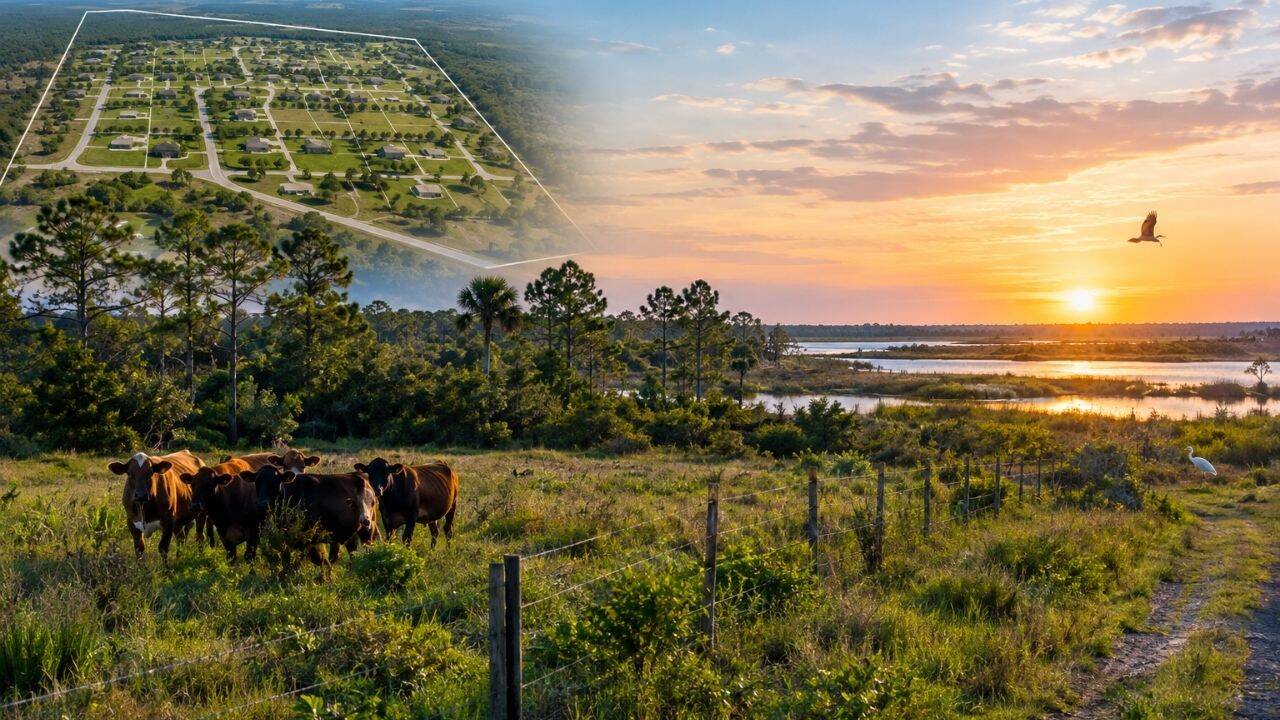
Collier County recently agreed to pay $7.8 million to purchase the 625-acre Wildflowerz Ranch in Immokalee, stopping a controversial proposal to carve the working cattle operation into 52 ten-acre residential lots. For local taxpayers, the price tag feels steep. For municipal planners, it represents an emergency ransom paid to prevent ecological collapse in the Okaloacoochee Slough, a critical freshwater drainage and aquifer recharge system for southwest Florida.
The math behind these land-acquisition battles reveals a broken dynamic across the Sunbelt. When rural acreage sits directly in the path of relentless suburban sprawl, the owner holds all the cards. Build a subdivision, and the return on investment skyrockets. Threaten to build a subdivision, and local government programs like Conservation Collier find themselves forced to bid against private developers using public funds. Two years of intense negotiations preceded the final vote, exposing how municipal acquisition boards are increasingly trapped between rising land valuations and the permanent loss of open space.
The Mechanics of Rural Sprawl
Subdividing a 625-acre working ranch into 52 parcels sounds sparse on paper. Ten-acre ranchettes do not immediately resemble high-density asphalt jungles. Yet from an ecological standpoint, fragmentation is far more destructive than concentration. Slicing continuous wilderness into private estates introduces perimeter fencing, domestic pets, septic tank seepage, and hard-packed shell rock driveways. Wildlife movement corridors fracture immediately.
The property scored an impressive 331 out of 400 on the county's conservation assessment, largely due to its positioning inside a vital overland water channel. When acreage like this is paved or parceled out, stormwater loses its natural absorption path. The county did not just buy grass and trees; they bought drainage security. Without intervention, municipal stormwater engineers would eventually face millions in downstream flood mitigation costs anyway.
The Appraisal Paradox
Appraising rural land under immediate development threat creates a perverse economic incentive. Independent evaluations for the Immokalee property ranged up to nearly $8 million. Commissioners ultimately bypassed their newer policy of choosing the absolute lowest independent valuation, recognizing that a rigid bureaucratic stance would cause the deal to collapse, immediately paving the way for heavy machinery.
This dynamic creates a moral hazard for agricultural landowners. Holding a blueprint for residential subdivision approval functions as an effective negotiation weapon against local governments. Ranchers can wave potential zoning permits like a flag, driving public acquisition prices higher by capitalizing future suburban profits into present-day conservation buyouts.
What Remains Beneath the Surface
Even after the ink dries on multi-million-dollar conservation contracts, the land carries baggage. Historical agricultural operations leave behind infrastructure that does not simply vanish when public ownership begins. Reports surrounding the Immokalee acquisition noted remnants including old cattle pens, functional barns, and a localized shooting berm.
Lead remediation at shooting ranges on preserved tracts often demands secondary public expenditures long after the initial acquisition check clears. Conservation rarely means walking onto pristine acreage; it frequently involves cleaning up decades of legacy rural industry before ecological restoration can even begin.
Public entities will continue running out of capital if every threatened parcel requires a multi-million-dollar buyout. As Florida's interior faces compounding population pressures, buying out individual landowners one by one is an expensive bandage on a hemorrhage. The $7.8 million spent in Collier County successfully bought a temporary boundary against concrete, but the underlying economic forces pushing developers deeper into the interior remain entirely unchanged.