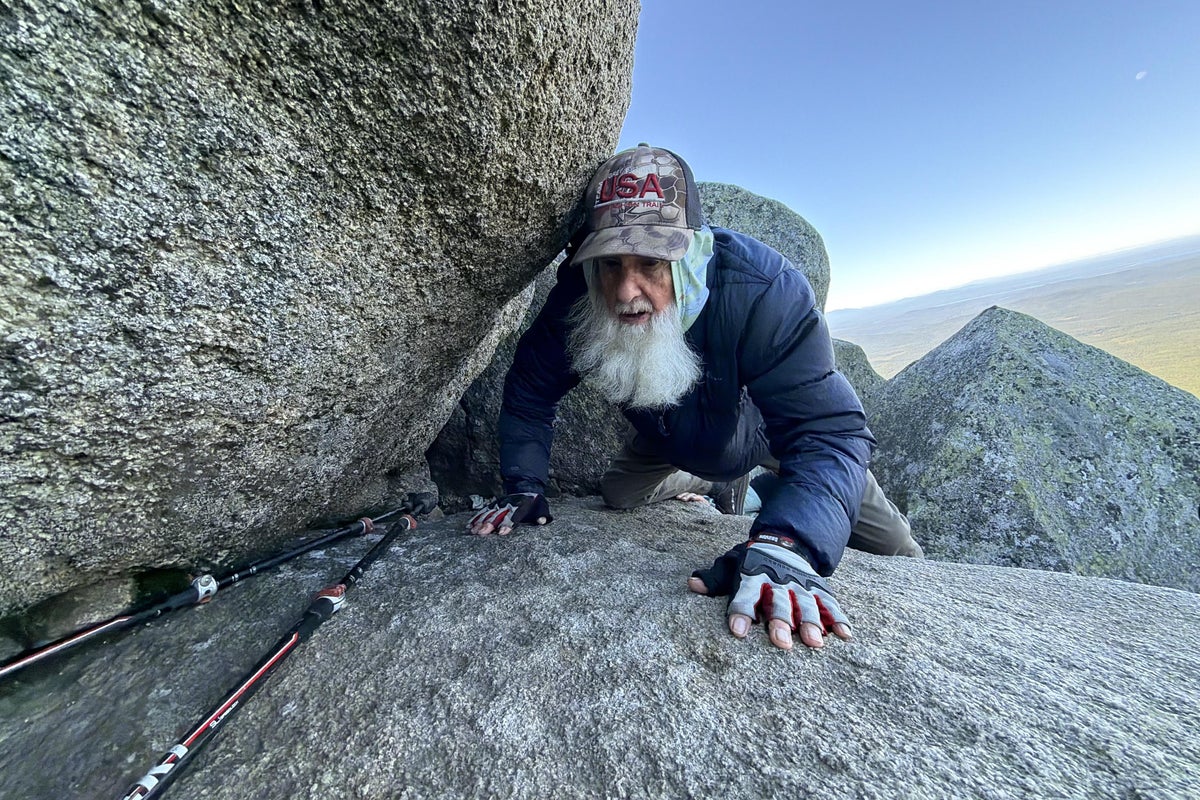
The dirt does not remember your age.
When your boot heel strikes the Georgia clay at Springer Mountain, the earth offers no special cushion for ninety-one years of living. It treats your joints with the same indifferent gravity it accords to a nineteen-year-old college dropout carrying too much water, or a middle-aged accountant trying to outrun a divorce. The granite steps of Maine do not soften because your birth certificate bears a date from the 1930s. Every root is a tripwire. Every drop of rain is cold. Every mile is five thousand two hundred and eighty feet of stubborn math.
Most people reach their eighth decade and begin measuring their world in circumferences. The distance from the armchair to the television. The boundary of the neighborhood walk. The safe, predictable perimeter of a life well-rounded and neatly put away.
Dale Sanders looked at that perimeter and decided to set fire to it. Again.
To understand what it means to walk two thousand one hundred and ninety-nines miles across the spine of the eastern United States, you have to understand the silence. Not the romantic silence of a postcard, but the heavy, grinding quiet that settles into your skull around week six. Your knees swell. Your shoulders burn from the straps of a pack that feels heavier with every passing ridge. Your fingernails turn gray with dirt that refuses to wash out.
At ninety-one, Dale did not set out to prove a point about longevity. He set out because the alternative was sitting still, and sitting still is a very slow way of dying.
Let us be entirely clear about the physical reality here. At ninety-one, cellular repair is a rumor. Cartilage is mostly a historical memory. When Sanders stepped onto the Appalachian Trail for this particular record-breaking push, he was not just fighting the mountain; he was fighting the relentless arithmetic of human biology. Muscle mass abandons the frame if you do not trick it into staying. Balance becomes a fragile negotiation with the inner ear.
Yet, he walked.
He walked through the green tunnel of the mid-Atlantic, where the humidity clings to your skin like a warm, wet wool blanket. He walked through Virginia, where the trail stretches out in cruel, teasing lines across the Blue Ridge. He walked past hikers a fraction of his age who were hobbling back to civilization with shin splints and blistered heels, nursing injuries accumulated over mere weekends.
How does a man that old keep moving when his body screams for surrender?
The answer is deceptively simple, and it has nothing to do with iron willpower. It has to do with surrender of a different kind. You stop fighting the mountain. You stop calculating the remaining distance to Katahdin. If you look at the whole map, you will weep. You look only at the next rock. Then the next root. Then the shadow of your own boot moving over the dirt.
Think of it like learning how to breathe underwater. At first, panic dictates every twitch. Your chest tightens. Your mind races for an escape hatch. But eventually, if you survive long enough in the deep end, you learn to trust the mechanics of survival. Dale Sanders had spent a lifetime accumulating those mechanics. He had already broken the record once before at eighty-five, becoming the oldest person to ever thru-hike the trail. Most men, having claimed that flag, would have framed the photo, hung it on the wall, and spent their remaining years telling stories to anyone unlucky enough to sit near them at Thanksgiving.
Most men are not Dale.
The record had been taken from him. Another hiker, older still, had raised the bar.
Consider what happens in the human brain when someone steals your crown. For a young man, it triggers ego, fury, the frantic need to dominate. For a nonagenarian, it triggers something much more dangerous: a reason to live with absolute, razor-sharp clarity. The trail does not care about your ego. The mountain will chew up your pride and spit it out into the ferns. But purpose? Purpose is lighter than goose down and stronger than titanium cable.
He packed his bags. He laced his boots. He went back to Georgia.
There is a profound misconception about aging in modern culture. We treat old age as a waiting room. We furnish it with soft chairs, large-print books, and a collective hush, as if the elderly are fragile porcelain artifacts that might shatter if the room gets too loud. We sanitize their existence, stripping away risk, uncertainty, and raw physical exertion in the name of safety.
Dale Sanders looked at that cultural waiting room and spat on the floor.
Every step he took on that long, green ribbon of earth was an act of quiet rebellion against the narrative of decline. When he crossed into North Carolina, his ankles throbbed. When he crested the ridges of Pennsylvania—aptly known as the place where boots go to die—his lungs labored for every cubic inch of oxygen. There were days when the rain did not stop for seventy-two hours. Days when his socks stayed wet for a week straight, breeding the kind of deep, rotting trench foot that makes grown soldiers weep.
If you asked him about the pain during those moments, he likely would not offer a grand philosophical speech. He would probably just grunt, adjust his trekking poles, and take another step. That is the secret of the long-distance hiker. Grandiosity dies in the first hundred miles. What remains is stubborn, unglamorous mechanics. Left, right, breathe, repeat.
We live in an era obsessed with hacks, shortcuts, and optimized longevity. We swallow handfuls of supplements, track our sleep cycles with glowing plastic bracelets, and obsess over zone-two cardio, all in a desperate bid to cheat the clock. We want a clean, clinical formula for a long life.
Dale offered a different kind of lesson, written in sweat and mud.
You do not stay alive by hiding from the elements. You stay alive by leaning directly into them. You keep your joints moving because the alternative is rust. You keep your mind sharp because you refuse to let the world stop expanding.
When he finally touched the sign atop Mount Katahdin in Maine, surrounded by the jagged granite and the cold northern wind, he didn't just reclaim a record. He redrew the boundaries of what is possible for a human body. He proved that the human spirit does not necessarily decay on a predictable schedule; sometimes, given the right fuel and the right obsession, it simply burns brighter as the container wears thin.
Down below, in the valley of ordinary life, the rest of us check our phones, complain about minor aches, and let the years slide past in a blur of comfort and compromise. We treat our bodies like heirlooms to be preserved in glass.
Up there, on the rocks, the old man kept his rhythm.
The wind howled across the peak, carrying the scent of pine and approaching winter. The mountain stood silent, ancient, and immense. And somewhere in the gray stone, the dirt kept no record of his years, only the weight of his passing.