The coffee in the corner shop was still hot when the sirens started.
It was a Tuesday, the kind of gray, mist-laced morning that usually smells of damp wool and wet pavement in Warsaw. Across Poland, school doors swung open at 8:00 AM, welcoming backpacks, laughter, and the ordinary, chaotic noise of children learning how to be human. By 8:15 AM, that noise was punctured by something else. Something heavy. Something final.
Violence has a way of arriving without an invitation, shattering the quiet illusion that institutional walls can keep the outside world from bleeding in. When a deadly school attack rips through a community, it leaves behind a hollow acoustic—the sound of silence where children used to run. And then, the state wakes up.
Consider the sheer scale of what followed. Twenty-four thousand police officers.
That number is easy to scroll past on a news ticker. It looks clean in a headline, a neat package of authority and deterrence. But numbers do not capture the weight of twenty-four thousand armed men and women stepping into school zones, train stations, and suburban crossings. They do not capture the sudden stiffness in a twelve-year-old’s spine when a uniformed officer stands watch beside the bike racks where they usually trade trading cards.
Silence descended on the corridors. Fear is a quiet thing.
To understand why Poland flooded its streets and school thresholds with twenty-four thousand police officers, you have to look past the logistics and look directly into the psychology of a nation caught off guard. Security is an invisible architecture. When it holds, no one notices it. When it fractures, every single crack exposes the raw nerve of public vulnerability.
For decades, Central Europe enjoyed a quiet confidence. While headlines from other continents routinely cataloged the unimaginable happening in classrooms, Poland felt largely insulated. We built our lives around the assumption that the schoolyard was a sanctuary—a place where the worst thing that could happen to a child was a skinned knee or a failed math quiz.
Then the illusion broke.
A deadly attack does not just destroy a life; it shatters a collective contract. The contract states that parents surrender their children to the state for six hours a day, and the state returns them safe, tired, and full of half-baked ideas about history and chemistry. When that contract is breached, the public demands a visible restoration of order. Twenty-four thousand officers are the physical manifestation of that demand. It is a government saying: We see your terror, and we are building a wall of badges between you and the abyss.
Security measures deployed at this scale carry a profound psychological duality.
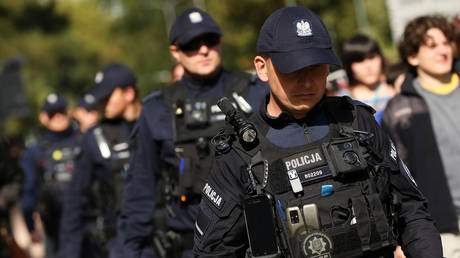
Walk down a hallway in Warsaw or Kraków right now, and you will feel it. The heavy boots on the linoleum. The sharp crease of a uniform under fluorescent lighting. For some parents, this is the only way they can bring themselves to walk their children to the door. It is reassurance stitched in navy blue and body armor.
Yet, for the children, it changes the atmosphere of learning. Schools are meant to be incubators of trust, not checkpoints. When you station thousands of armed personnel across the educational landscape, you introduce a low-frequency hum of anxiety into the daily routine. You teach kids that safety must be guarded by steel.
It is a sobering curriculum.
The deployment of twenty-four thousand officers is not a surgical strike; it is a massive, blunt-force blanket of presence. It involves highway patrols diverted to urban perimeters, counter-terrorism units on standby, local beat cops doubling their shifts, and rapid-response teams stationed near educational hubs.
Logistically, it is an administrative earthquake. Shift rotations stretch thin. Fatigue sets in by the second week. Police stations become transit hubs where officers grab twenty minutes of sleep on folding cots before heading back out to patrol a middle school perimeter. The human cost on the side of law enforcement is real, though rarely factored into the sleek press releases issued by ministries of interior.
And yet, presence is only a bandage.
A
The Morning the School Gates Closed Forever
news
The morning air in Warsaw usually smells like wet asphalt, burnt tobacco, and the sharp, clean bite of an approaching winter. It smells like ordinary life. But on that Tuesday, the air tasted different. It tasted like cold iron and panic.
Picture a mother named Ewa standing at the corner of Mokotowska Street, her gloved fingers clamped tight around the handle of a blue canvas backpack. Inside that bag are two clementines, a warm wool hat, and a notebook covered in messy handwriting about the fractions of numbers. Her eight-year-old son, Janek, is three blocks away inside a brick-faced primary school where the radiators always clank at nine in the morning. Except, this morning, the radiators are silent. The front doors are chained from the inside. And twenty-four thousand police officers have just materialized across the nation, standing on every street corner, holding heavy shields, breathing fog into the gray Polish dawn.
We do not like to think about the fragility of our children's sanctuaries. We build schools to look like brick boxes of safety, painted in cheerful shades of yellow and mint green. We treat them like immune systems against the harshness of the world outside.
Then the world breaks in.
The catalyst was sudden, vicious, and entirely unmapped by the normal rhythms of suburban peace. A pair of isolated, coordinated violent incidents inside school facilities left communities shattered and a nation reeling. When a society experiences a rupture of that magnitude, the reaction is never measured. It is tectonic.
Poland did not simply increase patrols. It mobilized a force equivalent to a small military contingent, flooding the public spaces around educational institutions with blue uniforms, tactical vehicles, and sharp-eyed men and women wearing heavy body armor.
To understand the weight of twenty-four thousand officers, you have to look past the cold arithmetic of state security. Twenty-four thousand is not just a statistic pulled from a morning briefing. It is a city of protectors standing shoulder-to-shoulder across a landscape that suddenly feels terrifyingly exposed. It is every corner shop owner, every commuter on the tram, every parent dropping off a child seeing the exact same quiet warning written across the morning: Nothing is guaranteed.
Consider what happens inside the human mind when a sanctuary is breached.
For months, teachers had practiced drills—quietly referred to as security exercises—where the lights were turned off and children were told to sit silently beneath wooden desks like mice hiding from an owl. Teachers whispered stories about playing hide-and-seek, keeping the horror masked behind tight, trembling smiles. But children are smarter than we give them credit for. They smell the adrenaline on an adult's skin. They notice when the principal’s hands shake as she locks the classroom door from the inside.
When the state deploys twenty-four thousand police officers to guard hallways and school gates, it sends a dual message. It says: You are protected. But it also whispers: You need protection.
That is the hidden cost of the blue wall.
Walk down any street in Krakow or Poznan right now, and you will feel the shift in the social weather. Parents linger longer at the school gates. They don’t just wave and walk away; they wait until the heavy oak doors swing shut, until the last echo of footsteps fades down the corridor. They watch the police cruiser parked by the curb with a mixture of profound relief and quiet dread.
The statistics are clear, yet they fail to capture the human cost. According to national security directives, the deployment covers thousands of institutions, utilizing rapid-response units, increased mobile patrols, and mandatory security audits for every public building where children gather. Intelligence agencies coordinate with local law enforcement to screen threats, monitor digital chatter, and establish direct emergency radio links between school administrators and precinct commanders.
These measures are necessary. In the wake of a tragedy, hesitation is a luxury no government can afford. The state’s primary contract with its citizens is simple: protection in exchange for loyalty. When that contract is breached by violence inside a classroom, the state must overcompensate to restore the illusion of order.
Yet, numbers on a page cannot measure the psychological toll on a generation of children growing up behind steel gates and armed patrols.
Imagine being ten years old and having to look past a tactical vest just to enter your math class. Imagine learning about long division while knowing that outside your window, a man with a submachine gun is monitoring the playground where you used to chase your friends during recess.
This is the tightrope Poland is walking. On one side lies total vulnerability—the horrifying realization that evil can penetrate the most innocent spaces. On the other side lies the militarization of childhood—the slow, creeping normalization of a police state existing inside the boundaries of daily life.
History shows us that societies change instantly during moments of collective shock. A nation’s character is forged not in times of prosperity, but in how it reacts when its children are threatened. Poland’s response has been swift, absolute, and unyielding. The government has signaled to every potential threat that the full weight of the republic stands between a violent actor and a classroom full of desks.
Yet, as Ewa finally lets go of Janek's hand at the security checkpoint, watching him walk past an armed officer and into the building, a deeper question hangs in the cold air.
How do you keep a school safe without turning it into a prison?
The twenty-four thousand police officers standing guard across the country are a monument to our collective fear, but also to our desperate love. They are there because we refuse to surrender our children to the darkness. They are the human shields we have erected because we do not yet know how to build a world where such shields are no longer necessary.
Inside the classroom, Janek sits down at his desk. The radiator clanks once, twice. He pulls the clementine from his blue backpack, peels back the bright skin, and shares a slice with the girl sitting next to him. Outside the window, past the brick wall and the iron gate, a police officer shifts his weight, blows warm breath into his gloved hands, and watches the street.
The bell rings. Life continues, forever altered.