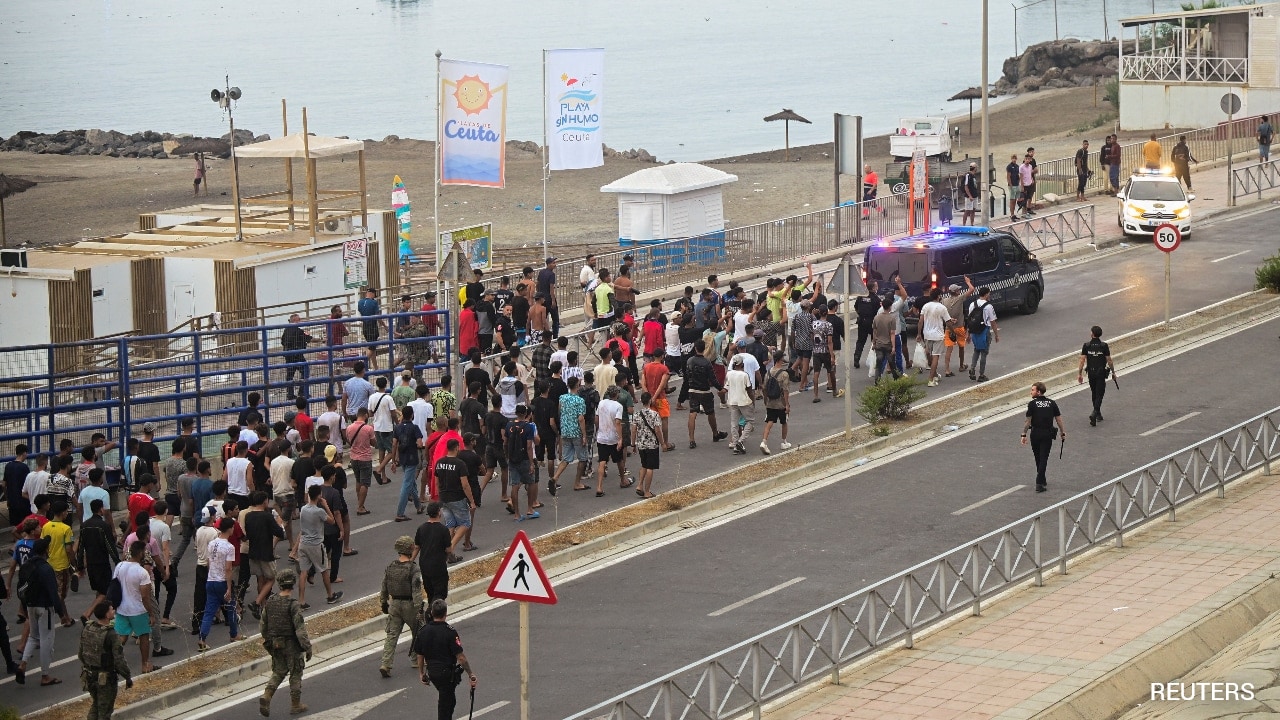
Europa has a fence problem. Actually, it has a human reality problem that it tries to solve with concrete, razor wire, and silence. If you stand on the Spanish side of the border in Ceuta, you aren't just looking at a physical barrier separating two continents. You are staring right at a geopolitical pressure cooker where human lives turn into political leverage.
Most people don't understand what happens when desperation meets bureaucracy at Europe's southern gates. They see a headline about border crossings, shrug, and scroll past. But the reality on the ground in Spanish exclaves like Ceuta and Melilla is far more complex, stark, and uncomfortable than any evening news broadcast lets on.
Let's talk about what's actually happening there.
The Geography of Limbo
Ceuta shouldn't exist as a European border zone in the way it does. It's a tiny Spanish autonomous city physically attached to the northern coast of Africa, bordered entirely by Morocco and the Mediterranean Sea. That makes it one of only two land borders shared between the European Union and the African continent.
Geography turns Ceuta into a magnet. Thousands of migrants from sub-Saharan Africa and Morocco itself arrive near these borders every year. They sleep rough in nearby forests like Mount Gurugu near Melilla or hide out in urban corners of Fnideq near Ceuta. They wait. They watch the fences. They look for fog, for a shift in guard changes, or for a moment of sheer political distraction between Madrid and Rabat.
When people ask why migrants keep trying to scale fences topped with anti-climbing mesh or swim around the breakwaters, they usually miss the baseline motivation. It is not casual tourism. It is a calculated gamble against absolute poverty, violence, or political instability at home.
And Europe's response? It's a masterclass in deflection.
The Diplomatic Tug of War
Borders are never just lines on a map. They are moving targets driven by foreign policy. Morocco holds the keys to the gates, and Spain—and by extension the European Union—knows it.
Whenever diplomatic relations between Madrid and Rabat sour, the border fences suddenly become porous. We saw this vividly when thousands of people swam into Ceuta in a matter of hours during a diplomatic dispute. Morocco basically loosened the leash to send a message. When relations are cozy, Moroccan forces crack down hard, pushing camps back from the border and using tear gas to clear out anyone getting too close.
Migrants caught in Ceuta or stranded in the surrounding no-man's-land become literal pawns in high-stakes chess matches. They aren't treated as individuals seeking asylum. They are diplomatic pressure points. If you're stuck in that loop, your fate isn't decided by immigration law or human rights treaties. It's decided in ministerial offices hundreds of miles away where politicians are arguing over fishing rights, agricultural tariffs, or counter-terrorism cooperation.
It's cynical. It's brutal. And it's entirely normalized.
Inside the Reception Centers
If a migrant manages to get past the fence or the breakwaters into Ceuta, the journey doesn't end. It shifts into a different kind of purgatory inside the Tarajal temporary immigrant transit center, known locally as the CETI.
These centers are routinely overcrowded. Designed to hold a fraction of the people currently inside them, they swell far beyond capacity whenever a surge occurs. People live in limbo for months, sometimes years. They can't move freely into mainland Spain because legal restrictions trap them in the enclave while their asylum claims crawl through an overwhelmed administrative pipeline. They can't be easily deported back to their countries of origin due to complex international non-refoulement laws and lack of readmission agreements.
So they sit. They play cards in dusty courtyards. They learn Spanish. They wait for a transfer permit that might take an eternity to arrive.
You hear stories of profound boredom mixed with acute anxiety. Mental health deteriorates quickly when your entire existence is paused by a stamp on a piece of paper. Local NGOs do what they can, but resources are stretched thin. The residents of Ceuta live with this constant humanitarian tension right in their backyards—a mix of solidarity, fatigue, and political frustration.
The Broken Asylum Promise
Europe loves to talk about human rights. It holds conferences, drafts treaties, and lectures the rest of the world on international law. But the reality at the gates of Ceuta exposes a massive hypocritical gap between rhetoric and execution.
International law guarantees the right to seek asylum. When someone reaches European soil—and Ceuta is unequivocally European soil—they have the legal right to have their claim heard. But pushbacks happen. Summary expulsions occur under the radar, bypassing due process through quick-turnaround handovers to Moroccan authorities at the border gates. Critics and human rights groups have documented these illegal expulsions for years. Governments deny them, use legal loopholes, or rebrand them as "rejections at the border" to dodge accountability.
When you look at the system honestly, it's designed to exhaust people. Make the process slow enough, make the conditions harsh enough, and people might just give up and self-deport or stop trying altogether. That's the quiet strategy. It doesn't look like a violent crackdown, but it achieves the same result through attrition.
What Needs to Change
Fixing this mess requires ditching the illusion that migration can be stopped by building higher walls or paying neighboring countries to act as border guards. It doesn't work. It just shifts routes, enriches human traffickers, and creates human suffering on an industrial scale.
Real policy shifts have to tackle the root causes while opening up safe, legal pathways for movement. If Europe needs labor—and aging European economies desperately do—then setting up functional work-visa pipelines in countries of origin would instantly choke off the black-market smuggling trade. It would stop people from risking their lives in flimsy boats or throwing themselves against razor wire.
Until politicians summon the courage to look past the next election cycle, the migrants stranded at Europe's gates will keep waiting. They will keep watching the fences. And Europe will keep pretending that the problem is out of sight and out of mind, right up until the next crisis forces the gates wide open again.