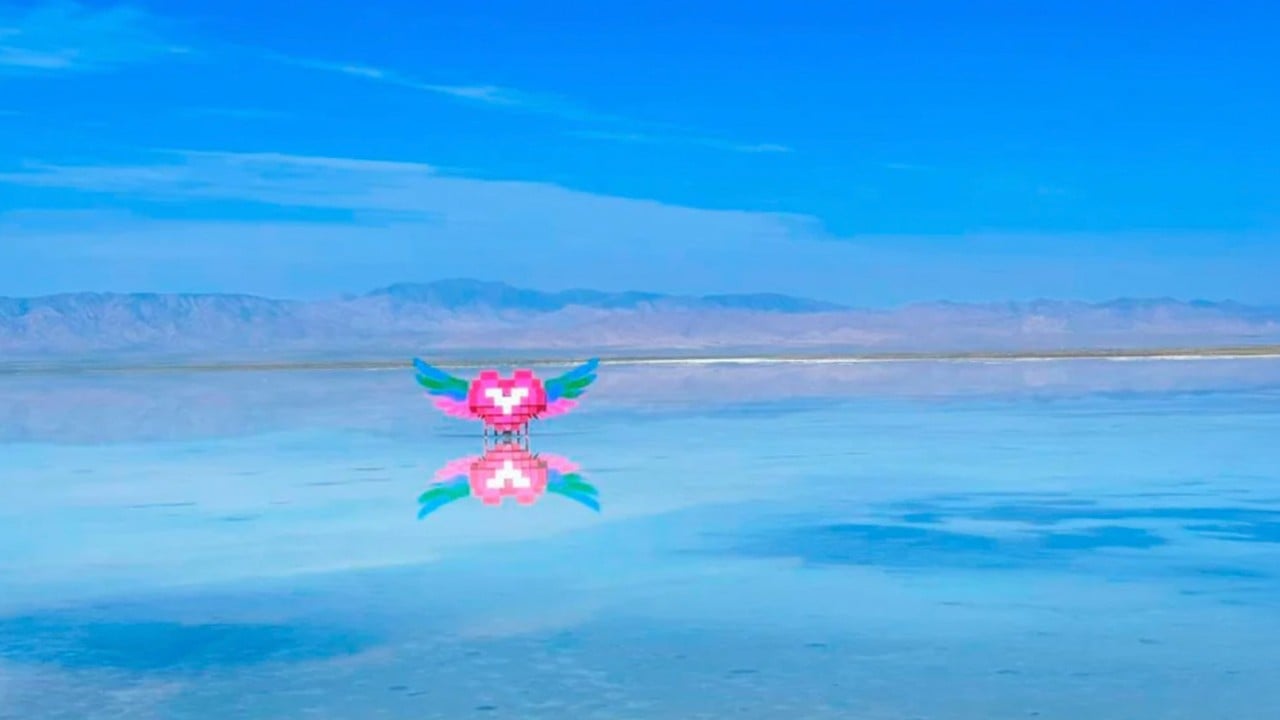
The wind at Chaka Salt Lake doesn’t just blow; it whispers. At over 3,000 meters above sea level on the Tibetan Plateau, the air is thin enough to make your heart hammer against your ribs, a constant reminder that you are standing in a place where the earth meets the heavens. For centuries, this was a sanctuary of silence. Travelers would walk out onto the crystallized salt crust, the white expanse stretching toward the horizon until the distinction between the ground and the clouds vanished. They called it the Mirror of the Sky.
When the water is still, the reflection is perfect. You see yourself twice—once in the air and once in the brine—suspended in a blue-and-white infinity. It is a fragile, natural masterpiece that depends entirely on nothingness.
Then came the statue.
It stands there now, a massive, jagged intrusion of metal and stone. It was intended to be a monument to Wangmu, the Queen Mother of the West, a figure of profound mythological weight. But as the sun rises over the Qinghai province, the shadow cast by this colossus doesn't feel divine. It feels like a scar.
The Weight of an Unwanted Gift
Architecture is often an act of ego disguised as an act of service. The developers behind the new installations at Chaka likely sat in a boardroom and looked at spreadsheets. They saw "empty space." To a developer, emptiness is a wasted opportunity, a canvas that requires a signature. They believed that by adding a towering physical presence, they were "enhancing" the visitor experience.
They were wrong.
The genius of Chaka Salt Lake was never what was there; it was what was not there. People traveled thousands of miles across the rugged Chinese interior not to see a statue they could find in any city square in Beijing or Shanghai, but to escape the clutter of the man-made world. They came for the void.
Consider the perspective of a photographer who has saved for a year to catch the sunrise at the lake. In the old days, she would set up her tripod in the biting cold, waiting for that split second when the light turns the salt into liquid silver. Now, no matter where she turns her lens, the skyline is interrupted by a hulking silhouette of industrial artifice. The "Mirror" has been cracked. The reflection now includes the very thing people spent hours on a train to leave behind: the heavy, clunky hand of "progress."
A Myth Misunderstood
There is a bitter irony in choosing the Queen Mother of the West as the subject of this disruption. In Chinese mythology, she is the guardian of the peach trees of immortality, a figure associated with the wild, untamed edges of the world. To honor her by pouring concrete and bolting steel into the heart of a delicate ecosystem is a fundamental misunderstanding of the spirit she represents.
Nature doesn't need an interpreter. It doesn't need a monument to tell us it is beautiful. When we place a massive sculpture in the center of a vista that is already perfect, we are effectively saying that the natural world is insufficient. We are claiming that the sky isn't enough, that the salt isn't enough, and that our human hands can somehow improve upon the work of ten thousand years of geological patience.
The backlash from the public wasn't just a murmur of aesthetic disagreement. It was a roar of grief. Social media platforms were flooded with images of the "before" and "after." The "before" shots looked like dreams—ethereal, haunting, and vast. The "after" shots looked like a theme park.
The Cost of Every Sight
This isn't an isolated incident. Across the globe, we are witnessing the "Disneyfication" of the wild. From glass skywalks over ancient canyons to neon lights inside prehistoric caves, there is a frantic urge to monetize the sublime. The logic is simple: if people are coming to look at something, we should give them something more to look at. We should build a platform. We should sell a ticket. We should put up a statue.
But beauty is not a resource to be mined until it is hollow.
When you stand on the shores of Chaka today, the silence is different. It’s no longer the silence of the clouds; it’s the silence of a gallery. You are no longer a pilgrim in a sacred space; you are a consumer in a curated environment. The stakes are invisible but massive. Every time we "improve" a natural wonder, we lose a piece of our ability to be small.
There is a profound psychological necessity in being small. We spend our lives in boxes—our apartments, our offices, our cars—convinced that we are the center of the universe. Places like Chaka Salt Lake serve as a vital correction to that delusion. They remind us that the world is vast, indifferent, and breathtakingly ancient. They offer us the chance to disappear for a moment into the reflection.
The Mirror's Memory
The salt continues to crystallize. The water still ripples under the Tibetan wind. But the statue remains, a permanent resident in a landscape that was never meant to be settled. It serves as a reminder of our restlessness, our inability to leave well enough alone.
Some visitors now walk further, trekking miles past the tourist hubs, desperate to find a corner of the lake where the horizon remains unbroken. They are looking for the ghost of the old Chaka. They are searching for a mirror that isn't showing them a monument, but is instead showing them the sky, the clouds, and the terrifying, beautiful emptiness of the world.
The metal stays cold in the high-altitude sun. It does not breathe. It does not change. It only stands, an unblinking eye in the center of the salt, watching as the very beauty it was meant to celebrate retreats further and further away, into the places where the cranes haven't reached yet.
The sky still looks down at the lake, searching for its twin. It finds it, eventually, but only in the small, quiet spaces between the shadows of the things we built.