The ocean floor was supposed to be a graveyard of mud.
For generations, humanity looked at the vast blue expanses of the planet and imagined a static, unchanging expanse. Mountains rose on land. Rivers carved canyons. Earthquakes shook continents. But down there, beneath thousands of feet of crushing, freezing blackness, lay an eternity of undisturbed sediment. At least, that was the story we told ourselves. We thought the earth beneath the waves was a fixed stage, a solid foundation built once and never touched again.
We were entirely wrong.
To understand how we found out, you have to go back to a time when the world was tearing itself apart in the dark.
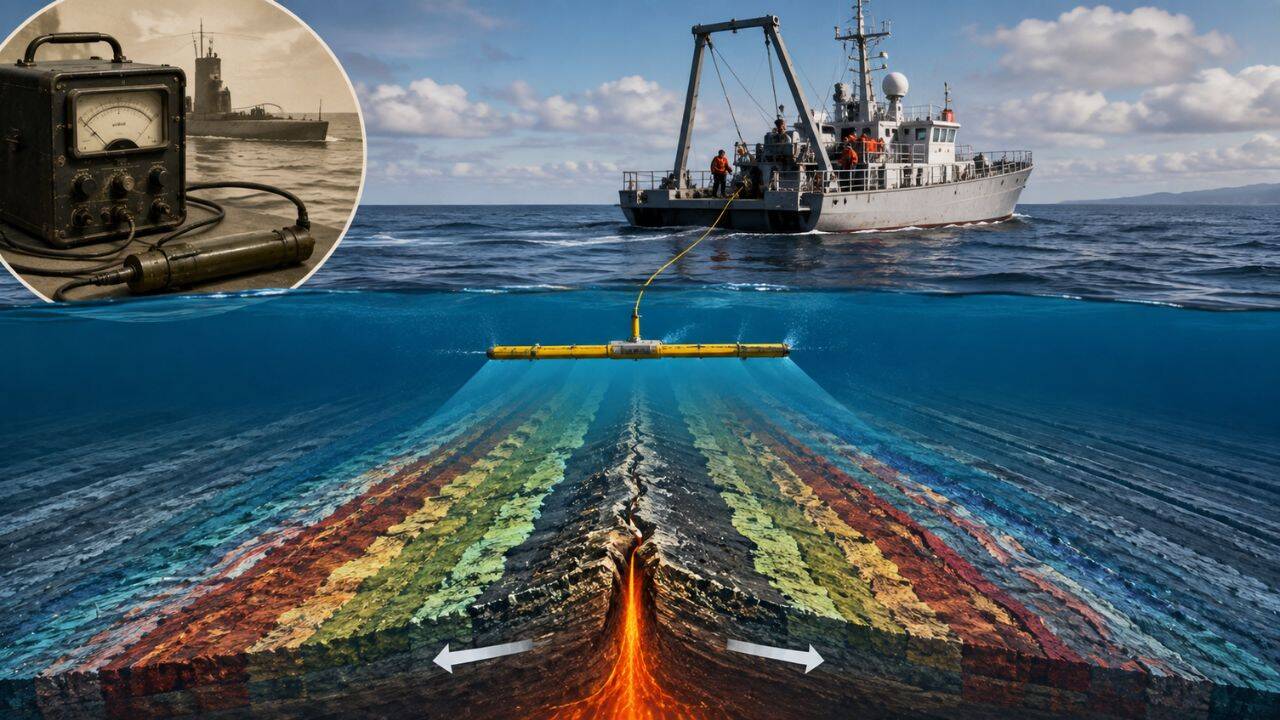
It is 1943. The Atlantic Ocean is a killing floor. Wolfpacks of German U-boats hunt Allied shipping lanes, choking supply lines and starving Britain of food and fuel. Above the water, destroyers sweep the surface with sonar. Below the water, something new is listening. It is a magnetometer, adapted for military use to hunt the massive magnetic anomaly of a steel submarine hull hidden beneath the waves.
Imagine sitting in the cramped, freezing control room of a naval vessel. The air smells of diesel, sweat, and damp wool. The hum of electronics fills your ears. A needle scratches frantically across a roll of paper, recording invisible fluctuations in the earth's magnetic field. To the young naval officers watching that pen twitch, it meant one thing: death lurking in the depths. A submarine was near. Drop the depth charges.
They won the war with those machines. But when the shooting stopped, the hardware didn't vanish. Instead, scientists inherited the ghosts of a conflict.
Enter men like Fred Vine, Drummond Matthews, and Lawrence Morley. Geologists with grease on their hands and stubborn questions in their heads.
They took the military magnetometers—the very instruments designed to sniff out iron death machines—and towed them behind research ships across the open ocean. They weren't looking for U-boats anymore. They were looking at the rocks.
What they found looked like madness.
As the ships crawled across the mid-ocean ridges, the magnetometer needles danced. Up. Down. Positive. Negative. Stripe after parallel stripe of magnetic anomalies etched into the basaltic crust of the seafloor, perfectly mirrored on either side of underwater volcanic mountain ranges. It was a giant, planetary bar code.
Why?
Because the earth has a heartbeat, and it keeps a diary in iron.
Picture molten rock erupting from the fiery cracks of the mid-ocean ridges. As this magma cools, tiny crystals of iron-rich minerals line up like microscopic compass needles, pointing straight toward the magnetic North Pole of the day. The rock hardens. It locks that moment in stone.
Then, every few hundred thousand years, something strange happens. The planet's magnetic poles flip. North becomes south. South becomes north. The compass needles reverse. The next batch of erupting magma records the new direction, facing the opposite way.
Band by band. Stripe by stripe. A continuous, ticking tape recorder of planetary history.
When Vine and Matthews pieced this together in the early 1960s, the implications were staggering. If the seafloor was striped like a zebra, and those stripes were symmetrical, it meant only one thing. The floor was moving. New crust was being born at the ridges, pushing the older crust outward, sideways, away from the center.
The continents weren't static monuments anchored in place. They were passengers riding on massive, shifting plates of rock, driven by thermal engines churning deep within the mantle.
Before this, the idea of continental drift was laughed at. Mainstream science mocked it as a fairy tale. How could Africa and South America have ever been joined? How could solid rock plow through the ocean floor?
The magnetometer provided the missing physics. It gave teeth to a rejected hypothesis. It turned a wild theory into an undeniable, mathematical certainty.
Consider what that means for the ground beneath your feet right now.
You think it is solid. You trust the pavement, the foundations of your house, the stone of the mountains. But you are standing on a raft. We all are. We live on thin, fractured crusts floating on a simmering, convective soup of molten rock, constantly tearing apart and slamming back together in slow motion.
The device built to kill in wartime ended up saving our understanding of the planet.
That is the strange irony of discovery. We build tools to conquer our enemies, and instead, we end up decoding the secrets of the earth. We set out to find steel hulls in the dark, and we mapped the breathing pulse of a living world.
The needle twitches. The paper feeds. Somewhere beneath the waves, a mountain is splitting open, a new strip of iron is cooling in the abyss, and the continents are drifting apart, millimeter by millimeter, right this very second.