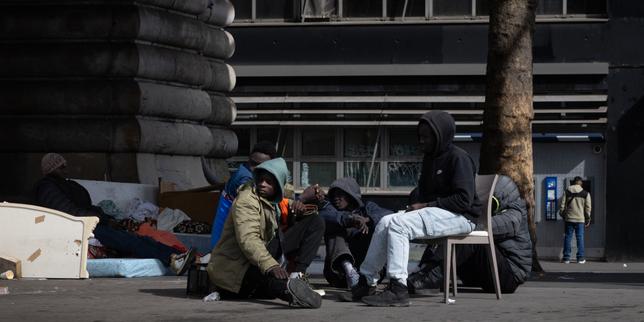
The persistent concentration of displaced populations around the Stalingrad metro station in Paris is not an accidental gathering; it is the predictable output of a structural bottleneck. When asylum seekers and undocumented migrants congregate under the aerial tracks of lines 2 and 5, public discourse frequently labels the phenomenon as "endless wandering" or a "humanitarian crisis." This terminology obscures the underlying operational mechanics. The camp at Stalingrad is a systemic equilibrium point where the inflow velocity of unhoused individuals intersects with the processing constraints of the state's administrative and housing infrastructure.
Understanding this phenomenon requires moving past descriptive narratives of suffering and instead analyzing the specific structural failures, geographic drivers, and economic feedback loops that sustain the encampment.
The Geography of Supply and Demand: Why Stalingrad is a Natural Transit Hub
Migrant encampments do not form randomly across an urban landscape. Their location is governed by a strict spatial logic that optimizes for survival efficiency, resource access, and regulatory blind spots. The Stalingrad intersection operates as a high-density node due to three distinct geographic variables.
1. Intermodal Transit Efficiency
The Stalingrad station serves as a major intersection for lines 2, 5, and 7, offering rapid, low-cost transit across the capital and directly linking to major international rail terminals like Gare du Nord and Gare de l'Est. For a population whose legal status requires high mobility and whose survival strategy relies on distributed urban resources—such as food distribution points, legal aid clinics, and informal labor markets—minimizing transit friction is an economic necessity. The physical architecture of the aerial metro line provides immediate overhead shelter from precipitation, reducing the capital expenditure required for basic survival infrastructure like tents and tarpaulins.
2. Proximity to Administrative Ingestion Points
The northern quadrants of Paris historically host the administrative infrastructure responsible for processing asylum claims and managing vulnerable populations. The proximity to the Préfecture de Police branches and authorized day centers creates a powerful anchoring effect. Because the French asylum system operates under strict chronological queues, individuals must remain physically near the bureaucratic machinery to exploit administrative windows, register claims, or attend mandatory appointments. Distance from these hubs introduces a high risk of missing critical appointments, effectively invalidating months of waiting.
3. Regulatory Inforcement Thresholds
Urban spaces are subject to varying degrees of surveillance and municipal enforcement. The complex geometry of the Stalingrad area—divided by canals, overhead rail pillars, and heavy vehicular traffic arteries—creates jurisdictional friction between municipal cleanup crews, national police units, and transit authority security (SUGE). This friction delays coordinated enforcement actions. The resulting administrative inertia creates a predictable window of stability for informal settlements, making it a lower-risk environment for individuals vulnerable to identity checks and immediate eviction.
The Structural Bottleneck: A Blueprint of Administrative Failure
The persistence of the Stalingrad camp cannot be understood without examining the state’s housing and processing infrastructure through the lens of queueing theory. The system operates as a multi-stage pipeline with a severe capacity mismatch between the entry rate and the exit rate.
[Inflow: New Arrivals / Re-entries]
               │
               ▼
┌────────────────────────────────────────┐
│   Stage 1: PADA / SPADA Registration    │ ◄── High Friction / Long Delays
└──────────────┬─────────────────────────┘
               │
               ▼
┌────────────────────────────────────────┐
│     Stage 2: CADA / DNA Housing        │ ◄── Structural Capacity Deficit
└──────────────┬─────────────────────────┘
               │
               ▼
┌────────────────────────────────────────┐
│   Stage 3: Legal Resolution (Exit)     │ ◄── Low Outflow Velocity
└────────────────────────────────────────┘
The primary friction point occurs at the transition between initial registration and the allocation of dedicated housing. By law, asylum seekers in France are entitled to accommodation within the National Reception Network (Dispositif National d'Accueil or DNA), primarily via Reception Centers for Asylum Seekers (CADA). The operational reality diverges sharply from this legal mandate due to three systemic constraints.
The Registration Bottleneck
Before accessing housing, individuals must navigate the First-Step Asylum Reception Centers (PADA or SPADA). These platforms manage initial appointments and distribute the telephone appointments required to access the official asylum tracking system. Demand routinely outstrips the processing capacity of these centers, creating an immediate, unhoused waiting class. Individuals are trapped in an administrative limbo: they are recognized by the state as being in the process of seeking registration, but they lack the formal status required to unlock housing rights.
The Structural Housing Deficit
The total volume of available CADA beds is structurally insufficient to accommodate the volume of annual applicants. This creates a permanent deficit. Because priority is systematically given to families, single isolated men—who constitute the overwhelming majority of the Stalingrad population—are pushed to the bottom of the allocation hierarchy. The state relies on emergency winter accommodation (Plan Grand Froid) or hotel vouchers as a secondary buffer, but these measures are temporary, reactive, and subject to immediate budget exhaustion.
Low Outflow Velocity
The exit rate from the housing system is artificially restricted. Individuals who receive refugee status (statut de réfugié) frequently remain in CADA beds long after their claims are approved because they cannot find affordable housing in the saturated Île-de-France private rental market. Conversely, those whose claims are definitively rejected (déboutés) often refuse to leave or cannot be legally deported due to geopolitical realities or administrative hurdles with their countries of origin. Both scenarios freeze bed turnover, choking the intake pipeline and forcing new arrivals directly onto the asphalt of northern Paris.
The Economics of the Informal Encampment
An encampment like Stalingrad is not merely a residential site; it functions as an informal, self-sustaining micro-economy that lowers the marginal cost of destitution. This economic ecosystem generates its own gravity, drawing in individuals who might otherwise be scattered across less visible parts of the region.
The core capital of this economy is information. In a highly volatile legal environment, survival depends on real-time data regarding police movements, changes in asylum legislation, employment opportunities in the informal sector (such as unregistered construction, food delivery, or domestic labor), and the schedule of non-governmental organization (NGO) distributions. The physical concentration of hundreds of peers creates a high-bandwidth information network that cannot be replicated digitally or remotely.
Furthermore, the concentration of population allows NGOs and independent volunteer groups to achieve economies of scale. Delivering medical care, legal counsel, hot meals, and clothing is logistically viable when the target population is clustered within a 500-meter radius of a metro station. For the individual, this concentration guarantees access to basic caloric and hygiene needs without the energy and financial costs associated with traveling across the city.
This creates a systemic paradox: the humanitarian interventions designed to alleviate the immediate suffering within the camp inadvertently lower the friction of remaining in the camp, reinforcing Stalingrad’s status as a permanent geographic anchor.
The Eviction-Reoccupation Loop: A Failed Management Model
The public policy response to the Stalingrad camp has historically relied on a cyclical strategy of evacuation and dispersion. This operational model is fundamentally flawed because it treats a systemic flow problem as a static accumulation problem.
The cycle unfolds through four distinct phases:
- Accumulation: The population of the camp grows as the inflow of new arrivals exceeds the capacity of local support structures, leading to deteriorating hygiene conditions, increased public visibility, and political pressure from local residents.
- Evacuation: Law enforcement cordons off the area, and municipal buses transport residents to temporary gymnasiums, hotel rooms, or regional reception centers outside of Paris (SAS régionaux). The physical site is cleared, cleaned, and often blocked with temporary urban furniture or metallic barriers.
- Dispersion and Friction: The temporary housing solutions provided during the evacuation typically expire within a window of days to weeks. Regional centers often lack the specialized administrative support needed to process claims quickly, or individuals find themselves isolated from their legal counsel and social networks in Paris.
- Reoccupation: Lacking long-term housing solutions or legal pathways to employment, individuals migrate back to the capital. They return to the geographic node that offers the highest survival efficiency: Stalingrad.
This eviction-reoccupation loop is highly inefficient. It consumes significant municipal and police resources while failing to address the structural deficit in permanent housing or the processing bottlenecks in the asylum system. The strategy does not dissolve the population; it merely redistributes it temporarily across the geography of France before gravity pulls it back to the center.
Systemic Limitations and Data Gaps
Any rigorous analysis of the Stalingrad transit node must acknowledge the constraints of the available data. Accurate policy design is severely hampered by two primary information deficits.
First, there is a total absence of precise, longitudinal data tracking individual trajectories through the camp. Because census efforts within the camp are conducted sporadically by NGOs or during police operations, it is impossible to accurately differentiate between a static population that has been stranded at Stalingrad for months and a highly fluid population that uses the camp as a short-term three-day transit point before moving to other European destinations.
Second, the exact size of the informal labor market operating around the northern transit corridors is unquantified. It remains an educated hypothesis that the camp acts as a recruitment hub for underground economies. Without hard data on the cash flows generated by these informal networks, the economic incentives pulling individuals back to Stalingrad after every police evacuation cannot be fully mapped or countered.
Operational Blueprint: Restructuring the Inflow-Outflow Equation
Resolving the Stalingrad bottleneck requires shifting from a policy of spatial management (evacuations) to a policy of structural flow optimization. If the state intends to permanently decommission the informal settlement, it must execute a coordinated strategy that addresses the pipeline mechanics directly.
Decentralize Administrative Intake
The anchoring effect of northern Paris must be broken by decentralizing the physical infrastructure of the asylum application process. The state should establish integrated, regional intake hubs outside the Île-de-France region that combine registration, legal processing, and immediate housing allocation in a single, co-located facility. By removing the administrative necessity of visiting Paris to maintain a valid claim, the primary operational incentive for remaining near Stalingrad is eliminated.
Implement a Tiered Outflow Strategy
To clear the bottleneck within the CADA network, the state must implement a differentiated strategy for the two groups currently blocking bed turnover:
- For approved refugees: Establish an expedited transition pipeline into social housing or subsidized regional employment programs, utilizing public-private partnerships to bypass the saturated Parisian rental market.
- For definitive rejections: Streamline the legal and consular processes required for dignified return or readmission procedures, minimizing the period during which individuals exist in legal limbo without housing or the right to work.
Transition to Continuous High-Capacity Processing
The reactive model of massive, televised police evacuations must be replaced by a continuous, low-visibility intake model. Small-scale, daily outreach teams equipped with immediate administrative and housing placement authority must operate within the transit corridor. By processing individuals as they arrive, the state can prevent the formation of the critical mass necessary to establish an informal economy and its accompanying geographic permanence. Failure to implement this operational shift guarantees that the physical site under the Stalingrad metro tracks will remain a permanent monument to administrative equilibrium.