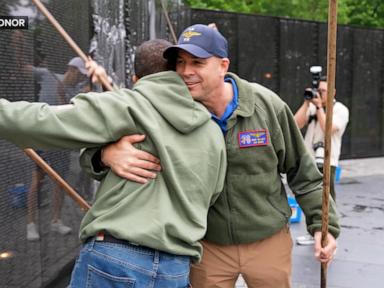
Political action operates through two distinct vectors: systemic policy generation and symbolic signaling. While systemic policy requires legislative consensus, institutional funding, and bureaucratic execution, symbolic signaling relies on highly visible, low-cost actions designed to project shared institutional values. The annual assembly of the Congressional For Country Caucus to hand-wash the Vietnam Veterans Memorial Wall represents a deliberate intersection of symbolic governance and asset preservation.
Analyzing this event through structural frameworks reveals the underlying operational mechanisms, the cost-benefit calculus of non-legislative civic alignment, and the physical requirements of preserving national commemorative infrastructure.
The Dual-Value Framework of Bipartisan Cohesion
In an era defined by high legislative polarization, the cost of generating traditional bipartisan policy is prohibitive. The expenditure of political capital often yields diminished returns due to ideological gridlock. Non-legislative civic alignment solves this efficiency problem by shifting the focus from structural negotiation to shared historical reverence.
                  ┌──────────────────────────────┐
                  │ Bipartisan Cohesion Activity │
                  └──────────────┬───────────────┘
                                 │
         ┌───────────────────────┴───────────────────────┐
         ▼                                               ▼
┌─────────────────────────────────┐             ┌─────────────────────────────────┐
│     Inward-Facing Alignment     │             │     Outward-Facing Signaling     │
├─────────────────────────────────┤             ├─────────────────────────────────┤
│ • Shared operational baseline   │             │ • Public trust recalibration    │
│ • De-escalation of polarization │             │ • Subsidized physical labor     │
│ • Cross-party trust generation  │             │ • High visibility, low capital  │
└─────────────────────────────────┘             └─────────────────────────────────┘
Inward-Facing Alignment
For the participating lawmakers—primarily military veterans representing opposing parties—the physical act of maintaining the monument establishes a shared operational baseline. By stepping out of legislative chambers and into the early morning execution of physical labor, participants decouple their shared identity as veterans from their divergent identities as partisans. This creates a temporary psychological state where cross-party trust can be generated without policy compromise.
Outward-Facing Signaling
The public distribution of media documenting lawmakers manually scrub the monument serves as a trust recalibration mechanism for the electorate. The signal communicates stability, institutional continuity, and the existence of a baseline consensus on national sacrifice. This output is achieved at zero fiscal cost to the taxpayer, maximizing the return on invested legislative time.
The Preservation Calculus of Commemorative Infrastructure
Behind the symbolic narrative lies a strict material reality: the preservation of polished black granite. The Vietnam Veterans Memorial consists of 140 panels of reflective Bangalore granite, inscribed with more than 58,000 names. Preserving this infrastructure requires a specialized maintenance protocol to prevent environmental degradation without causing structural micro-abrasions.
The physical maintenance process follows a precise four-stage operational sequence managed in coordination with the National Park Service:
- Hydrological Pre-saturation: The granite surface must be thoroughly saturated with water before any mechanical contact occurs. Applying friction to dry, particulate-heavy stone acts as an industrial abrasive, permanently degrading the reflective finish and dulling the crisp edges of the engraved text.
- Chemical and Mechanical Agitation: Maintenance teams utilize non-ionic, residue-free surfactants specifically calibrated for sensitive stone preservation. Standard commercial detergents are banned; they leave chemical films that trap airborne pollutants and accelerate the accumulation of hard water scale. The physical scrubbing must utilize soft-bristled brushes applied with controlled, low-pressure mechanical force.
- Sequential Rinsing: The washing occurs in structural blocks of ten panels, beginning at the outer extremities and converging systematically at the central apex. This progression prevents the premature drying of chemical solutions on adjacent panels, which would introduce streaks and mineral deposits.
- Hydrological Evacuation and Drainage: The runoff water carries away ambient particulate matter, soot from urban transit corridors, and organic debris. The visual effect of water cascading down the reflective surface mimics human tears—a psychological byproduct that reinforces the emotional weight of the task—but its functional purpose is the absolute evacuation of surface contaminants.
Institutional Limitations of Symbolic Capital
While the manual washing of the monument provides high symbolic yield, strategic analysis requires defining the explicit limitations of non-legislative actions. Symbolic capital does not automatically convert into policy throughput.
The primary limitation of this alignment strategy is its inability to resolve systemic friction point bottlenecks. Lawmakers can achieve complete consensus while washing stone, yet return to the House or Senate floor and remain completely divided on structural appropriations, such as Department of Veterans Affairs (VA) health system modernizations or military housing subsidies. The operational field of the monument is insulated from fiscal reality; the legislative floor is not.
A secondary risk is the potential for commoditization. If symbolic signaling events are executed too frequently or with excessive partisan framing, the public value of the signal degrades. The efficacy of the action depends entirely on its perception as an authentic, solemn duty rather than a pre-engineered public relations asset.
The strategic trajectory of groups like the For Country Caucus relies on leveraging these brief windows of non-partisan alignment to anchor actual legislative partnerships. By establishing a baseline of mutual respect at the monument's apex, the friction encountered during subsequent policy debates on national security and veteran welfare can be marginally reduced. The physical wash clears the stone; the structural objective is to clear the legislative bottleneck.