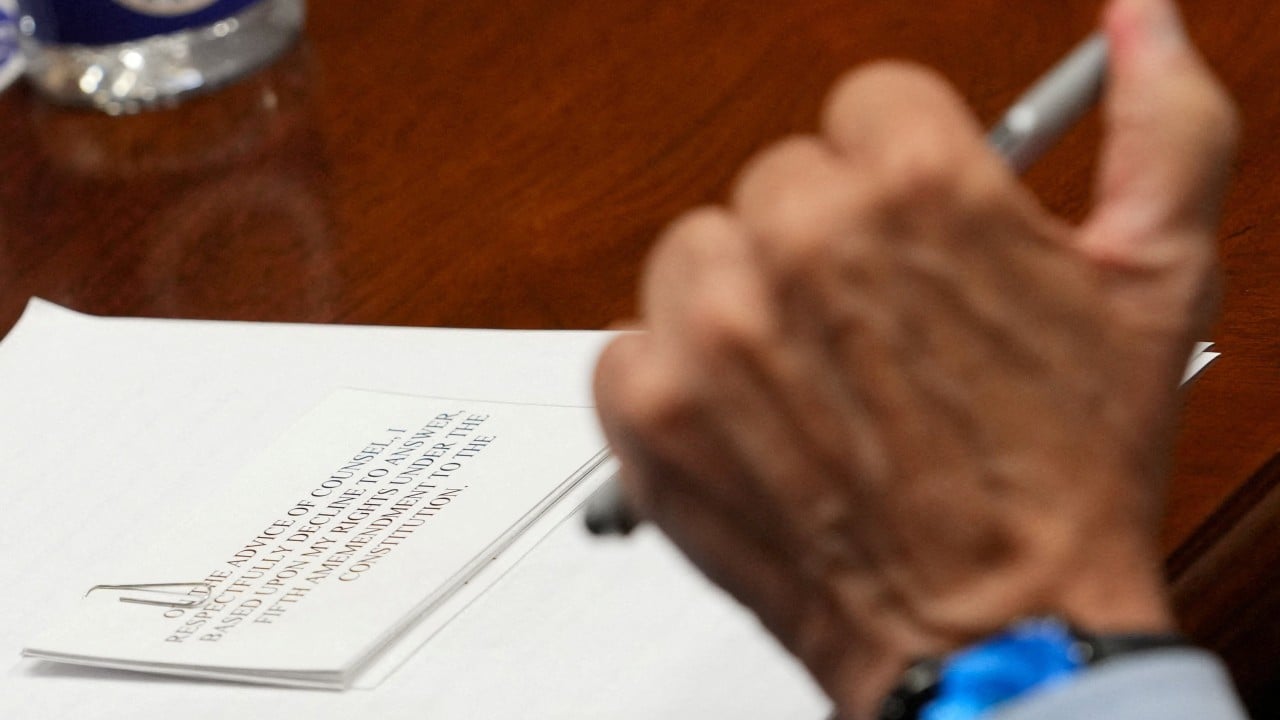
When high-profile figures invoke the Fifth Amendment during congressional inquiries, the immediate public reaction divides along predictable tribal lines. Supporters view it as a necessary shield against politically motivated theater, while critics interpret it as an admission of guilt. Both perspectives miss the structural reality. Pleading the Fifth is not a moral verdict; it is a calculated risk management tool deployed within an adversarial legal and political framework. Understanding why individuals in high-stakes positions choose silence requires examining the incentive structures, information asymmetry, and legal exposure that govern modern congressional investigations.
The decision to remain silent under the protection of the self-incrimination clause is rooted in a specific operational calculus. In a high-stakes legislative hearing, a witness faces three primary variables: the certainty of legal jeopardy, the ambiguity of congressional questioning, and the absence of traditional judicial safeguards. Unlike a court of law governed by strict rules of evidence and presided over by a neutral judge, a congressional hearing is inherently political. Committee members operate with dual incentives: extracting factual disclosures and maximizing media visibility for partisan constituents. For a witness tangled in complex regulatory or criminal scrutiny, speaking under these conditions introduces unnecessary variance. Silence acts as a hard stop against self-inflicted legal exposure.
The Operational Mechanics of Legislative Testimony
To deconstruct why witnesses refuse to answer questions, one must analyze the architecture of congressional inquiries. These forums are designed to generate narratives, not necessarily to uncover objective truth. Members of Congress utilize stacked questioning, hypothetical scenarios, and loaded premises to back witnesses into conceptual corners.
When a witness sits before a committee, their legal team calculates the exposure threshold using a straightforward risk matrix:
- Evidentiary Precision: The degree to which prior statements can be misconstrued, taken out of context, or weaponized by prosecutors in subsequent criminal proceedings.
- Perjury Traps: The risk of inadvertently misremembering a timeline, document date, or meeting participant, which can trigger independent federal charges for lying to Congress under Title 18, Section 1001 of the United States Code.
- Asymmetric Information: The committee often possesses cherry-picked internal communications or emails obtained via subpoena, placing the witness at a disadvantage because they cannot review the entire documentary record in real time.
Under these conditions, answering questions introduces unbounded downside risk with virtually zero upside. A witness cannot talk their way out of a criminal investigation during a five-minute legislative questioning window, but they can easily talk themselves into an indictment. Invoking the constitutional privilege truncates the threat vector entirely.
The Constitutional Intent Versus Institutional Reality
The Fifth Amendment states that no person shall be compelled in any criminal case to be a witness against themselves. Framed originally as a protection against the Star Chamber tactics of early English courts, the provision prevents the state from outsourcing its burden of proof by extracting confessions through coercion.
However, applying this judicial protection to legislative oversight creates an inherent tension. Congress possesses constitutional authority to conduct investigations in aid of its legislative function. When a witness pleads the Fifth, that legislative function stalls. Committees lose the ability to gather primary-source testimony, forcing investigators to rely on circumstantial evidence, whistleblowers, and subpoenaed documents.
Public perception often conflates this constitutional refusal with civil liability or guilt. In civil trials, a judge or jury is permitted to draw an adverse inference from a witness invoking the Fifth Amendment. In criminal proceedings, this is strictly prohibited; prosecutors cannot argue to a jury that a defendant's silence proves their guilt. Congressional hearings occupy an ambiguous space between these two extremes. They are not criminal trials, yet the ultimate threat facing the witness is often criminal referral to the Department of Justice. Consequently, witnesses must treat the hearing room as a pretrial arena, where minimizing legal exposure supersedes public relations.
The Cost Function of Transparency
Choosing to testify instead of invoking the privilege carries severe institutional and personal costs. In high-stakes regulatory or political controversies, public testimony is rarely a forum for nuance. Complex scientific, financial, or bureaucratic decisions are compressed into soundbites.
Consider the cost function of cooperation:
- Reputational Damage: Even if a witness has committed no crime, an aggressive legislative cross-examination can permanently damage professional standing, corporate valuation, or organizational trust.
- Legal Fragmentation: Testimony given in one committee can contradict depositions given to inspectors general, grand juries, or civil litigants, creating a patchwork of conflicting statements that prosecutors can exploit to establish a pattern of deception.
- Resource Drain: Preparing a witness for a congressional hearing requires hundreds of hours of legal review, costing millions of dollars in counsel fees while diverting executive leadership from core operational duties.
When these costs are aggregated, the rational economic and legal strategy for a risk-averse individual under investigation is almost always non-cooperation via constitutional protection. The system rewards silence because the penalties for speaking vastly outweigh the rewards of compliance.
Systemic Ramifications for Oversight
The routine deployment of the self-incrimination clause in high-level inquiries degrades the efficacy of legislative oversight. When key decision-makers decline to answer substantive questions, Congress is forced to rely on indirect methods of investigation. This shifts the burden of proof onto investigative journalists, internal whistleblowers, and lengthy Freedom of Information Act disclosures, lengthening the timeline between institutional failure and public accountability.
At the same time, this dynamic accelerates the partisan polarization of investigations. Without direct testimony from the central figures, both sides fill the vacuum with pre-existing narratives. Committees devolve from fact-finding bodies into political theater stages, where the invocation of the Fifth Amendment is treated as a weaponized talking point rather than a constitutional safeguard.
Reforming this dynamic would require structural adjustments to how congressional hearings are conducted, such as implementing judicial-style evidentiary rules or granting immunity more selectively to secure vital testimony. Until the incentive structure of legislative oversight changes, the constitutional shield of silence will remain the primary defense mechanism for figures caught in the crosshairs of political and legal warfare.
Implement a systematic legal triage protocol prior to any high-profile appearance, prioritizing document preservation and absolute alignment across all prior public and private statements to minimize vulnerability before a legislative subpoena is ever issued.