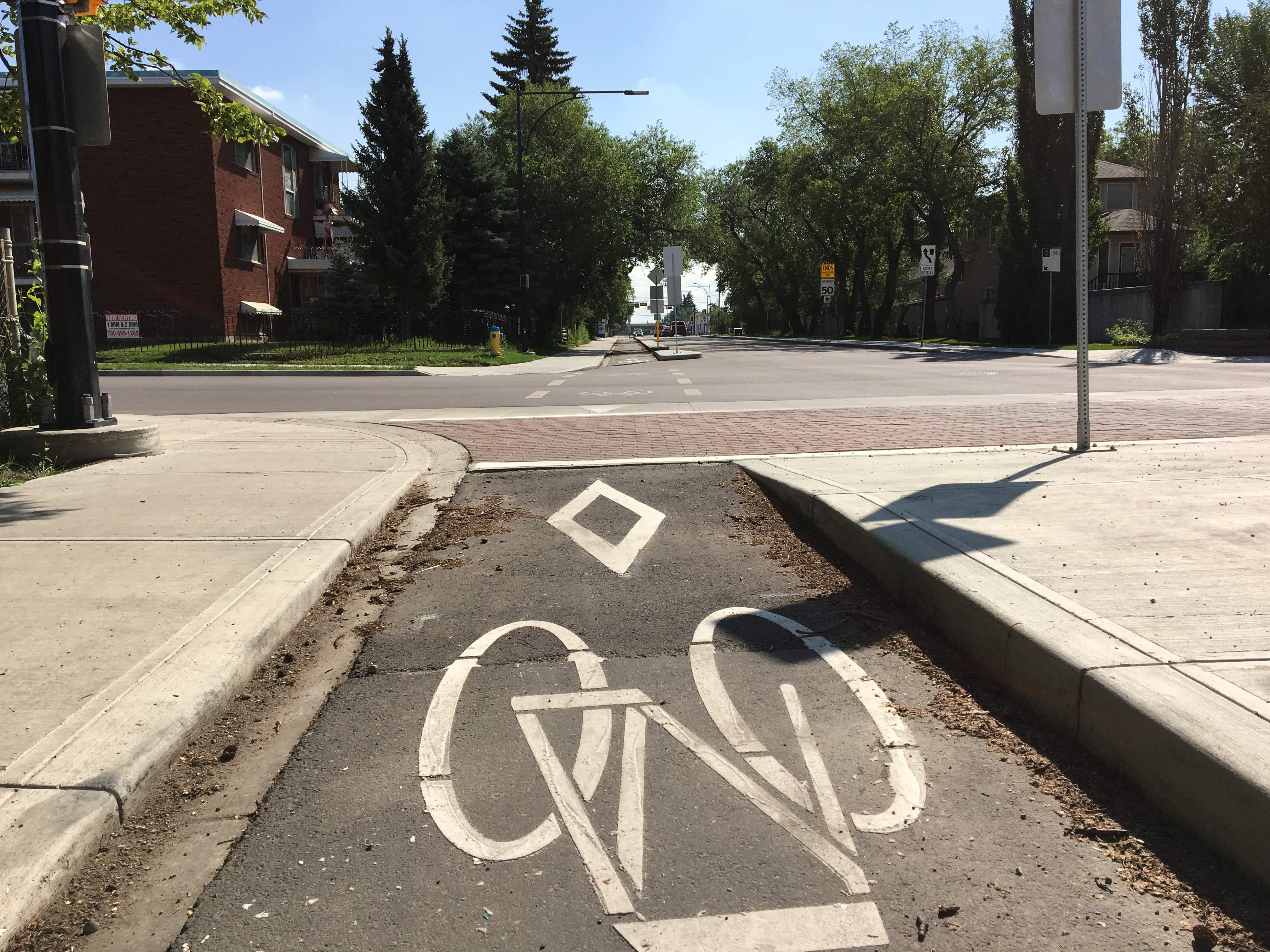
Alberta’s Bill 43 alters the constitutional and operational boundary between provincial authority and municipal infrastructure management by converting local street-space allocation from a decentralized municipal planning function into a centralized provincial veto. Tabled on November 19, 2026, by Transportation Minister Devin Dreeshen, the legislation prohibits municipalities from constructing new bicycle lanes that remove or restrict motor-vehicle traffic lanes or on-street parking without explicit ministerial exemptions, while simultaneously empowering the province to mandate the physical removal of existing cycling infrastructure at municipal expense. Standard news reporting frames this intervention as a localized dispute over commuter convenience and partisan culture wars. Viewed through the lenses of public finance, traffic engineering, and institutional economics, Bill 43 operates as an unfunded regulatory mandate combined with an asymmetric jurisdictional override.
The Three Mechanisms of Provincial Preemption
Bill 43 does not merely express a policy preference for motor vehicles; it establishes three distinct legal and administrative levers that restructure how Calgary, Edmonton, and smaller Alberta municipalities manage public rights-of-way.
- Ex-Ante Construction Prohibition: The bill institutes a blanket statutory ban on any future cycling infrastructure that reduces motor-vehicle lane count, narrows roadway capacity, or eliminates street parking. To bypass this restriction, a municipality must submit an exemption application supported by empirical traffic rationale. This reverses the administrative burden of proof. Previously, municipal councils weighed localized trade-offs under delegated statutory authority. Under Bill 43, local planners must justify network connectivity to a provincial cabinet minister whose stated policy baseline prioritizes vehicular throughput.
- Ex-Post Retroactive Demolition Authority: Beyond halting expansion, the legislation grants the Minister of Transportation unilateral authority to order the removal of existing, fully built cycling corridors. Public statements from the ministry have already identified specific operational targets, including Hermitage Road and Victoria Park Road in Edmonton, alongside 100 Avenue in Calgary. By pairing retroactive demolition powers with a previously launched public complaint portal, the ministry has created an administrative feedback loop where localized driver dissatisfaction can trigger provincial review of municipal capital assets.
- Cross-Modal Transit Centralization: Bill 43 functions as an omnibus transportation statute. Alongside cycling restrictions, it expands provincial oversight over municipal Light Rail Transit (LRT) systems, requiring cities to notify and align with the province on LRT planning, design, project delivery, passenger safety, and asset management. The stated rationale is alignment with long-term provincial intercity high-speed rail concepts between Calgary and Edmonton. Operationally, this strips municipal transit authorities of autonomous capital planning across both active transportation and mass rapid transit.
The Fiscal Asymmetry of Unfunded Removals
A defining structural feature of Bill 43 is the separation of decision-making authority from financial liability. Minister Dreeshen confirmed upon tabling the bill that the province maintains no provincial bike lane budget and will not reimburse municipalities for the demolition of existing lanes or the restoration of motor-vehicle roadbeds. Instead, the province cites the existing capital budgets of Edmonton and Calgary as evidence that cities possess the fiscal capacity to absorb removal costs.
In public finance, separating the authority to mandate an expenditure from the obligation to fund it creates a classic moral hazard. When a provincial government faces zero marginal cost for ordering the removal of a protected bike lane, its political incentive to exercise that power is unconstrained by fiscal trade-offs. Conversely, the municipality absorbs a triple financial penalty:
- Sunk Capital Destruction: Municipalities forfeit the initial engineering, consultation, and construction expenditures already incurred to build the protected corridors.
- Direct Demolition and Remediation Outlays: Removing concrete curbs, bollards, raised medians, and specialized traffic signals requires active civil engineering contracts, asphalt milling, and line repainting.
- Opportunity Cost on Capital Budgets: Because municipal debt limits and property tax revenues are finite, every dollar diverted to demolishing existing active-transportation assets is a dollar stripped from arterial road maintenance, pothole remediation, or transit expansion.
This fiscal structure also introduces acute construction friction. As public sector unions and municipal officials have noted, tearing out established streetscape geometry generates secondary waves of lane closures, detours, and traffic disruption—the exact congestion outcomes the legislation purports to eliminate.
Traffic Engineering Realities and the Induced Demand Paradox
The stated engineering premise of Bill 43 is that reallocating road space from private automobiles to bicycles "cripples" urban road capacity. This framing treats urban road networks as static hydraulic pipes where adding a lane permanently increases flow velocity. Decades of transportation engineering research demonstrate that urban road capacity is governed instead by dynamic equilibrium and Braess's Paradox.
In dense urban grids, travel times across parallel corridors equalize because drivers continuously adjust their routes to minimize delay. When a municipality converts a four-lane arterial into a two-lane road with a center turn lane and protected bike lanes—commonly termed a road diet—vehicular throughput frequently remains stable or experiences only minor peak-hour adjustments because removing left-turning vehicles from through-lanes eliminates mid-block bottlenecks.
Conversely, restoring a single motor-vehicle lane by removing a bike lane rarely yields a permanent reduction in congestion. Under the fundamental law of road congestion, expanding vehicular road capacity lowers the immediate time-cost of driving, which induces latent demand: commuters shift departure times, abandon transit, or switch from cycling back to single-occupancy vehicles until congestion returns to its prior equilibrium.
Furthermore, the spatial geometry of urban streets creates a sharp divergence in person-throughput per meter of right-of-way:
- Private Motor Vehicles: A standard 3.5-meter urban traffic lane carries roughly 600 to 1,000 vehicles per hour under interrupted signalized flow. At an average urban occupancy of 1.1 to 1.2 persons per car, that lane moves between 660 and 1,200 people per hour.
- Protected Cycle Tracks: A 2.0-meter unidirectional protected bike lane can accommodate 1,500 to 2,500 cyclists per hour without reaching saturation.
- Network Continuity Effects: Cycling networks exhibit non-linear utility. Unlike cars, which can easily detour onto secondary collectors without severe safety penalties, cyclists face high kinetic risk when forced out of protected corridors onto high-speed arterial traffic. As municipal planners and riders in Edmonton have pointed out, routing cyclists exclusively onto disconnected residential side streets fails to provide direct access to commercial nodes, employment centers, and schools. Removing a single two-kilometer link in a downtown or arterial cycle track degrades the utility of the entire surrounding network by severing safe origin-to-destination paths.
Constitutional Precedent and the Ontario Litigation Blueprint
Alberta’s legislative strategy did not emerge in a vacuum; it is a direct structural adaptation of Ontario’s Bill 212, the Reducing Gridlock, Saving You Time Act, which targeted protected bike lanes on Bloor Street West, Yonge Street, and University Avenue in Toronto. Minister Dreeshen explicitly referenced Ontario’s legal trajectory as validation for Alberta’s approach.
Understanding the litigation risk surrounding Bill 43 requires examining the two distinct legal tracks that unfolded in Ontario:
- Constitutional Division of Powers: Under Section 92(8) of Canada’s Constitution Act, 1867, municipal institutions fall exclusively under provincial jurisdiction. Cities are legal creatures of the province with no inherent constitutional autonomy. Consequently, legal challenges arguing that a province has overstepped its jurisdictional boundary into local affairs almost universally fail. From a strict federalism standpoint, Alberta possesses the plenary legislative authority to override municipal bylaws and dictate local street design.
- Charter Section 7 Claims (Life and Security of the Person): Because federalism arguments are non-viable, cycling advocates in Ontario challenged bike lane removals under Section 7 of the Canadian Charter of Rights and Freedoms, arguing that state-mandated removal of proven safety infrastructure measurably increases the risk of severe injury and death for vulnerable road users. While a lower court initially sided with the applicants, the Ontario Court of Appeal overturned that ruling, finding that the removal of bike lanes did not infringe Section 7 rights in a manner inconsistent with the principles of fundamental justice. That dispute has since been appealed to the Supreme Court of Canada.
Alberta’s policymakers drafted Bill 43 to capitalize on the Ontario Court of Appeal’s deference to provincial legislatures. However, the inclusion of a case-by-case exemption mechanism and a pledge to collect municipal data prior to ordering removals serves a critical administrative law function. By framing removals as discretionary, data-reviewed ministerial decisions rather than arbitrary statutory edicts, the province insulates itself against judicial review applications alleging procedural unfairness or bad faith.
Operational Vulnerabilities and Strategic Limitations
While Bill 43 grants the Alberta government sweeping formal authority, executing the legislation across Calgary and Edmonton carries severe operational constraints and political risks that neither provincial proponents nor municipal critics have fully accounted for:
- Data Verification Bottlenecks: The Ministry of Transportation currently lacks granular, real-time telemetry on municipal intersections, pedestrian volumes, and seasonal cycling counts. Reviewing every municipal exemption request and auditing existing corridors requires specialized urban traffic engineering staff that provincial highway departments—traditionally focused on rural highways, freight corridors, and interchanges—do not maintain at scale.
- Liability Exposure on Corridors Ordered Stripped: If the Minister of Transportation overrides a municipal engineering safety assessment to force the removal of a protected bike lane, and a subsequent fatal collision occurs involving a cyclist on that exact corridor, the political and civil liability dynamics shift. Even if statutory immunity shields the Crown from tort damages, the direct causal chain between a ministerial demolition order and a preventable fatality creates acute reputational risk.
- Municipal Passive Resistance and Permitting Friction: Cities control the operational execution of civil works. A municipality ordered to remove a bike lane at its own expense can legally deprioritize the work within its multi-year capital tendering schedule, bundle the removal with complex underground utility replacements, or apply strict procurement timelines that delay physical demolition beyond a single provincial election cycle.
Strategic Playbook for Municipal Planners and Infrastructure Stakeholders
Because constitutional challenges based on municipal autonomy will not halt Bill 43 once enacted in the spring, municipal transportation departments and urban infrastructure stakeholders must shift from political rhetoric to rigorous administrative compliance and engineering documentation.
- Standardize Multi-Modal Level of Service (MMLOS) Audits: Municipalities must immediately transition from volumetric vehicle counts to standardized MMLOS metrics for every existing and proposed corridor. Exemption applications submitted to the minister should quantify total person-throughput, emergency vehicle response times, collision reduction rates, and adjacent transit reliability rather than relying on climate or active-living narratives that carry zero weight with the current ministry.
- Isolate Arterial Bottlenecks from Network Spine Corridors: Cities should proactively audit their cycling networks to identify low-utilization, high-friction segments—such as seasonal closures or poorly integrated suburban connectors—and offer targeted geometric modifications (e.g., consolidating parking to one side of the street or adjusting signal timing) before the province issues unilateral demolition orders. Trading peripheral adjustments preserves the core downtown and inner-city protected grids.
- Enforce Formal Engineering Sign-Off Protocols: For any corridor where the province mandates removal, municipal traffic engineers should formally record the pre-removal safety baseline and require explicit written directives from the Ministry of Transportation acknowledging the projected change in vulnerable road user risk. Establishing an unambiguous administrative paper trail transfers institutional accountability directly to the decision-making authority.
You can watch a news broadcast covering the tabling of this legislation in Alberta government tables bill aimed at bike lane removal in cities for additional context on how Transportation Minister Devin Dreeshen and municipal leaders framed the initial debate.