Large-scale cultural events are routinely evaluated through a superficial lens of gross visitor footfall and headline-grabbing economic multipliers. When Belfast hosted Fleadh Cheoil na hÉireann for the first time in August 2026, initial models projected a conservative draw of 700,000 to 800,000 visitors. The final tally shattered these baseline assumptions, pulling over 1.65 million people into the metropolitan core, generating an 89 percent year-over-year surge in footfall, and driving hotel occupancy rates to 84.6 percent.
Yet, treating these figures as a standard tourism windfall misses the structural mechanics of the event. A metropolitan center with a history of acute sociopolitical fragmentation cannot be analyzed through the same formulas used for a seaside resort town or a traditional festival circuit. Evaluating the true return on investment requires examining the operational friction points, the spatial distribution of economic yield, and the precise transmission mechanisms that turn temporary street-level activation into durable urban capital.
The Economic Transmission Mechanism
The primary distortion in event economics lies in confusing gross revenue with net economic value. When evaluating the Belfast Fleadh, standard econometric tracking breaks down into three distinct layers of impact: direct, indirect, and induced.
Direct impact is the initial liquidity injection. In Belfast, this was driven by over 5,000 competing musicians from 22 countries, alongside more than 1.65 million attendees purchasing hospitality, retail goods, and transport services. Commercial bednights spiked across formal hotels, student accommodation blocks, and temporary pop-up campsites at the Titanic Quarter, Ormeau Park, and Falls Park. Translink recorded over 1.7 million passenger journeys, representing an increase of more than 620,000 compared to normal operating baselines, underpinned by high-frequency park-and-ride infrastructure.
Indirect impact measures the supply-chain response. When hospitality venues and outdoor stages experience a surge in demand, their procurement requirements scale upward. Local wholesalers, regional farms, and security providers capture this secondary spend. However, in a regional economy like Northern Ireland, the leakage rate—the proportion of revenue that immediately leaves the local ecosystem to pay external suppliers, multinational corporate chains, or out-of-market capital owners—dictates the true retention ceiling. Because major hotel stock and supply chains in urban cores feature high foreign ownership structures, the gross economic multiplier is substantially lower than nominal figures suggest.
Induced impact captures the household expenditure of workers whose wages were sustained by the event. Temporary bar staff, event stewards, sanitation crews, and public transport operators redeployed their earnings into everyday retail and service sectors. The critical takeaway is that the economic velocity of the Fleadh was not merely a function of total bodies in the street, but of the operational capacity of local transit and supply chains to capture and retain that cash flow without triggering severe bottlenecks.
Infrastructure Strain and Capacity Thresholds
Urban hosting capacity is bounded by physical and logistical constraints. When daily footfall spikes past 289,000 individuals—as recorded on the peak Saturday of the festival, marking the busiest day in Belfast since data collection began in 2018—the city encounters severe operational stress tests:
- The Public Transport Bottleneck: While Translink successfully processed millions of journeys, regional corridors faced severe capacity constraints. Arterial routes, such as inbound buses from Derry, reached saturation before hitting intermediate transit hubs, exposing the vulnerability of regional feeder networks to sudden demand shocks.
- Spatial Distribution Friction: City-centre pedestrian zones and designated quarters (such as the Cathedral Quarter and areas surrounding City Hall) absorbed the density effectively due to aggressive nightly street-cleaning protocols. However, neighborhood-level dispersion outside the immediate core relied heavily on local venues, creating an uneven distribution of yield between central commercial real estate and peripheral districts.
- Crowd Control and Resource Allocation: Crowd management efficiency varied. While public-private coordination between Belfast City Council, business improvement districts, and over 1,300 volunteers prevented major security failures, the speed of crowd clearing exposed friction points that require automated telemetry rather than reactive manual stewardship for future iterations.
Social Capital and the Cost of Past Division
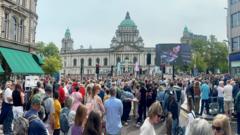
In any post-conflict city, cultural events carry a heavy sociopolitical subtext. The visual of over 1.65 million people moving freely through pedestrianized streets without systemic civil unrest provides a profound qualitative dataset. Traditional economic metrics completely fail to capture this shift in public sentiment and urban confidence.
Decades of sectarian division created spatial silos within Belfast. The integration of public spaces during the Fleadh—where diverse demographics crossed historical neighborhood boundaries to engage with traditional music, language, and fringe events—acts as a stress test for civic resilience. When public infrastructure is successfully neutralized by shared cultural engagement, the perception of urban risk among international investors and corporate risk assessors drops. This reduction in perceived risk lowers the cost of capital for future urban development projects far more effectively than traditional municipal marketing campaigns.
Strategic Play for Future Iterations
With confirmation that the Fleadh will return to Belfast for a consecutive year, municipal authorities and event organizers must transition from reactive crowd management to systematic optimization.
The primary strategic directive is to institutionalize the operational template developed during this edition. This requires establishing a permanent logistics taskforce—comprising city transit operators, district business improvement groups, and event curators—to codify street closures, automated waste management loops, and regional rail capacity scaling into a repeatable annual playbook. By locking in these operational efficiencies, Belfast can transform a transient cultural festival into a permanent engine for structural economic resilience.