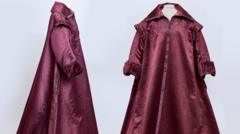
The survival of a mid-17th-century silk and silver-tissue gown represents a statistical anomaly in textile archaeology, occurring at the intersection of extreme material durability and fortunate environmental stasis. While public interest centers on the aesthetic "glamour" of the garment, the technical significance lies in the structural integrity of the metal-wrapped threads and the specific biochemical conditions required to prevent the autocatalytic degradation of organic fibers over a 400-year horizon. Understanding this artifact requires moving beyond the narrative of "rarity" toward a rigorous analysis of seventeenth-century textile engineering and the modern thermodynamics of conservation.
The Structural Mechanics of Silver Tissue
Silver tissue is not a singular material but a composite engineering feat designed for maximum light reflectance and tensile strength. The gown's construction relies on a high-density silk warp and weft, where the "metal" component consists of a silk core wrapped in a flattened silver or silver-gilt ribbon (lamella).
The Composite Thread Anatomy
The longevity of the gown is dictated by the three-part interaction of its core components:
- The Proteinaceous Core: The silk filament (fibroin) provides the structural "spine." Silk is chosen for its high tensile strength and elasticity, which allows it to bear the weight of the metal without snapping.
- The Metallic Lamella: Fine silver or gold leaf is hammered and slit into ribbons. These are wound around the silk core at a specific pitch (angle). If the winding is too tight, the metal shears; if too loose, the silk core is exposed to UV and oxygen, accelerating degradation.
- The Metallic Salt Interface: Over centuries, the silver reacts with trace sulfur in the atmosphere to form silver sulfide ($Ag_{2}S$). While this causes "tarnish," it also creates a thin passivation layer that can, in specific low-moisture environments, shield the underlying metal from further oxidation.
The gown’s primary failure point is not the metal itself, but the acid-hydrolysis of the silk. As the silk fibers age, they release acidic byproducts that corrode the silver from the inside out. This internal corrosion creates a "brittle-break" profile where the garment appears intact but will disintegrate if subjected to mechanical stress or changes in relative humidity.
Environmental Variables and the Preservation Paradox
The fact that this gown exists today implies it was sequestered in a "Goldilocks" environment—conditions that were neither too dry (which causes silk to desicate and shatter) nor too humid (which triggers fungal growth and aggressive metallic corrosion).
The Degradation Calculus
Textile decay is governed by the Arrhenius equation, where the rate of chemical reaction increases exponentially with temperature. For every $10^\circ\text{C}$ increase in storage temperature, the rate of natural aging approximately doubles. The survival of the silver tissue suggests a long-term storage environment characterized by:
- Thermal Stability: A constant low temperature, likely within a stone structure or unheated chest, which slowed the kinetic energy of degradative molecules.
- Anoxic or Near-Anoxic Conditions: Limited air exchange restricted the supply of oxygen and atmospheric pollutants like sulfur dioxide, which are the primary catalysts for metallic tarnish and silk yellowing.
- Mechanical Quiescence: The gown was likely stored flat. Gravity is a constant force that causes "creep" in vertical textile displays. In a 400-year-old garment, the weight of the silver-wrapped thread is sufficient to tear the weakened silk warp if the gown is hung on a standard mannequin.
The Economics of Seventeenth Century Luxury Production
To analyze the gown as a data point in economic history, one must quantify the labor-to-material ratio. In the 1660s, the cost of the raw silver and the labor required to draw it into wire and beat it into lamella represented a capital investment equivalent to several years of a skilled craftsman’s wages.
Resource Intensity Framework
The production of silver tissue involved a specialized supply chain:
- The Wire-Drawer (Le Tireur d'Or): Responsible for the mechanical reduction of silver ingots through progressively smaller dies. This requires high-purity alloys; impurities like lead or copper introduce weak points that cause the wire to snap during the weaving process.
- The Spinner: A specialist who wound the metal ribbon around the silk thread. The uniformity of this wrap determines the "hand" (texture) and luster of the finished fabric.
- The Master Weaver: Operating a drawloom, the weaver managed thousands of individual threads. The complexity of silver tissue requires a slow weaving cadence to prevent the metal from catching or fraying.
The scarcity of these gowns today is not merely due to the passage of time, but to the historical practice of "recycling." Because the metal content held intrinsic bullion value, most silver and gold garments were burned at the end of their fashion cycle to recover the precious metals. The survival of this specific gown indicates a break in the standard economic lifecycle of luxury goods—a transition from a functional asset to a sentimental or ceremonial heirloom.
Modern Conservation as a Risk Management Protocol
Displaying a 400-year-old silver gown is an exercise in managed destruction. The act of placing an artifact on display introduces variables that are fundamentally hostile to its continued existence.
The Display Risk Matrix
| Risk Factor | Mechanism of Damage | Mitigation Strategy |
|---|---|---|
| Photochemical Action | UV and visible light break the peptide bonds in silk. | Strictly limited lux hours (often <50 lux) and UV filtration. |
| Hygroscopic Stress | Fluctuations in humidity cause fibers to swell and contract, causing the metal wrap to flake. | Micro-climate control within the display case at 50% $\pm$2% RH. |
| Gaseous Pollutants | Sulfur and ozone accelerate silver tarnish and "acid rot." | Use of activated carbon filters and sacrificial scavengers (silver cloth) in the plinth. |
| Structural Fatigue | Static load of the metal thread on aged silk. | Custom-molded internal supports to distribute weight across the surface area. |
Technical Limitations of Restoration
A critical distinction must be made between "restoration" and "conservation." Restoration attempts to return the object to its original appearance, often through invasive means like re-weaving or chemical cleaning. Conservation focuses on stabilization.
For the silver tissue gown, chemical cleaning of the tarnish is high-risk. The tarnish (silver sulfide) is often structurally integrated with the remaining silver. Removing it can thin the metal lamella to the point of collapse. Modern protocols prioritize "passive conservation," accepting the dark patina as a protective layer and focusing on structural reinforcement using archival-grade supports and ultra-fine silk crepeline overlays.
Historical Context: The Politics of Radiance
In the mid-17th century, specifically the period following the English Civil War and during the reign of Louis XIV in France, the "Silver Age" of fashion was a calculated display of political stability. Silver tissue was a visual shorthand for "liquidity." To wear the gown was to demonstrate that one possessed enough surplus capital to weave it into a non-functional, highly fragile form.
The gown’s design, likely featuring a stiffened bodice and voluminous skirts, utilized the reflective properties of the silver to maximize visibility in candlelit environments. In a pre-electric era, silver tissue acted as a primitive light-amplification system, ensuring the wearer remained the focal point of a room. This "radiance" was a deliberate tool of aristocratic branding.
Strategic Analytical Forecast
The future of the silver tissue gown depends on the transition from physical display to digital preservation. Given the irreversible nature of entropy on 400-year-old silk, the physical garment has a finite "display life" before the structural integrity of the silk reaches a point of catastrophic failure.
- Non-Invasive Documentation: The immediate priority is high-resolution multispectral imaging and 3D photogrammetry. This captures the weave structure and metallic pitch at a level of detail that will survive the physical degradation of the fibers.
- Chemical Fingerprinting: Using X-ray fluorescence (XRF) to identify the specific alloy of the silver. This data can pinpoint the geographical origin of the metal and the specific techniques used by the wire-drawers, providing a map of 17th-century industrial capabilities.
- Curatorial Rotation: The garment must adhere to a strict "rest-to-display" ratio, likely one month of display for every five years of dark storage. Failure to observe these ratios will result in "light-bleeding," where the silk loses its remaining elasticity and the garment becomes too fragile to move.
The gown is no longer a piece of clothing; it is a high-maintenance biological and metallic specimen. Its value lies in the data it provides about 17th-century material science and the extreme limits of textile endurance. Long-term preservation strategy must prioritize the stabilization of the silk-metal interface over aesthetic "renewal," accepting the artifact’s current state as the final baseline for its existence.