The room smelled of cold coffee and damp wool. Outside, Washington was doing what Washington does best—ignoring the rain, pretending the rest of the map didn't bleed. Inside, across a mahogany table that felt entirely too wide, Najib Mikati sat.
He was a man holding an umbrella while standing inside a hurricane.
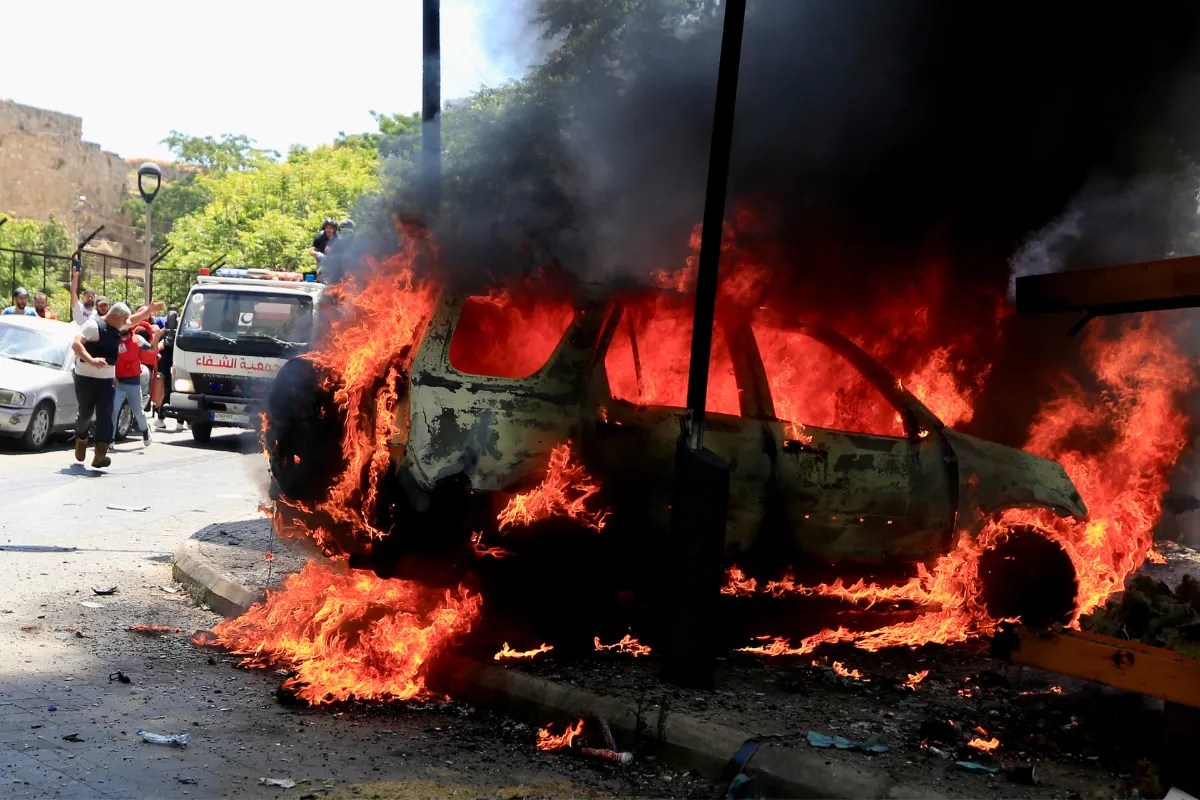
As the Prime Minister of Lebanon explained the geometry of his country's collapse to American officials, thousands of miles away, the geometry shifted. Not on paper. In fire.
In Tyre, the ancient city where Phoenician purple once dyed the robes of kings, the sky tore open.
Consider what happens when a map becomes a target. You are sitting in a suit, speaking the dry, bureaucratic language of diplomacy—humanitarian corridors, security frameworks, ceasefire resolutions. You are measuring your words so as not to offend the superpower across the table. You are begging for a tether. And then your phone buzzes against your thigh. A single notification. Tyre. An air strike.
It is a cruel choreography. Diplomacy moves at the speed of footnotes; ordnance moves at the speed of sound.
I have smelled that cordite. I know the specific, sickening copper tang it leaves on the back of the tongue when an old neighborhood ceases to be a place where people bought bread and becomes a coordinate on a targeting screen. It is an erasure disguised as strategy.
For months, the coastal city of Tyre had lived in the shadow of the inevitable. Families packed bags they refused to close. Fishermen looked out at the Mediterranean, wondering if the horizon would bring a sardine haul or a missile. When the strike hit, it didn't just shatter masonry; it shattered the fragile illusion that a prime minister's words in Washington could build a shield in the south.
Power is a strange thing when you look at it up close. We imagine leaders pulling levers, moving divisions like pieces on a felt board. But sitting across from those American officials, Mikati looked less like a commander and more like a translator trying to explain a language that the listeners refused to learn.
What can an ambassador offer a nation that is unraveling at the seams? Press releases. Deep concerns. Urgency without teeth.
The diplomats talk of restraint. Restraint is easy when your ceiling isn't about to cave in.
Let us walk the narrow streets of Tyre for a moment. Imagine a hypothetical baker named Samir, though a hundred Samirs exist right now. He has baked bread in the same alleyway for thirty years. His oven runs on a generator that splutters on expensive diesel. When the warning came—if it came at all—he didn't consult international law. He grabbed his grandchildren. He ran.
That is the human cost behind the Reuters ticker. Every strike reported in a dry bullet point is a lifetime packed into the trunk of a battered sedan. It is a grandmother leaving behind a brass coffee pot she carried through the civil war of her youth. It is a child learning to categorize the whistle of falling steel by its pitch.
Mikati's mission to Washington was supposed to be a plea for intervention, a desperate attempt to bridge the gap between American leverage and Israeli action. But geopolitics has a cold arithmetic. Small nations are often treated as friction points between larger ambitions—collateral friction in a regional chess match where the board is perpetually on fire.
The meeting room in Washington was quiet. The air conditioning hummed a steady, indifferent note.
In Tyre, the dust was still settling over the ruins of homes, burying the history of a city that has survived empires only to be flattened by the precision tools of the modern age.
We talk of stability as if it were a product you could import, something to be ordered from a catalogue and delivered via diplomatic courier. We forget that stability is rooted in soil, in water, in the quiet confidence that tomorrow morning you will wake up in your own bed.
When the prime minister finally walked out of those doors in Washington, stepping back into the grey drizzle, the silence of the city felt deafening. The handshakes had been polite. The nods had been sympathetic. But the jets were still in the air.
The map remains stained. The smoke over the southern coast rises straight and black, indifferent to the communiques, untethered from the mercy of men in suits.