The hum of a transformer on a wet Tuesday evening sounds remarkably like the future.
If you stand close enough to the chain-link fence of any ordinary electrical substation in eastern Poland, you can hear it. A low, persistent thrum that vibrates through the soles of your shoes and settles somewhere behind your ribs. Most people walk past without turning their heads. They are thinking about dinner, or the wet chill in the air, or whether their umbrella is going to hold together for another block. Meanwhile, you can read similar stories here: The Anatomy of Institutional Misconduct When Regulatory Officers Break the Rules They Enforce.
I used to be one of those people. Then I spent a winter talking to defense analysts whose eyes never quite fully focus on you because they are always calculating wind shear, fuel payload capacities, and radar cross-sections.
They taught me how to look at a map differently. To explore the full picture, we recommend the recent report by USA Today.
You stop seeing borders as thick black lines drawn by diplomats in velvet-draped rooms. You start seeing them as permeable membranes. You see concentric circles spreading outward from hidden concrete hangars, stretching five hundred, eight hundred, a thousand miles across forests, rivers, and sleeping suburbs.
Right now, those circles are widening.
According to recent intelligence reports, Moscow is quietly expanding a network of heavily guarded, clandestine installations designed with a singular, terrifying purpose: launching long-range autonomous drone swarms capable of striking deep inside the heart of NATO territory.
These are not the small, buzzing quadcopters you buy at a consumer electronics store to film weddings. These are heavy, long-range loitering munitions. Metal birds with wingspans wider than a family car, packed with guidance systems that do not rely on GPS—systems that stubbornly refuse to be jammed because they navigate by matching the wrinkles of the earth below them against pre-loaded topographical maps.
They fly low. They fly slow. And they do not get tired.
Consider what happens next: a cold dawn over a quiet Baltic airfield. No sirens wail beforehand. No dramatic countdown blares across the television screens. Just a sudden, violent tearing of the morning air, followed by a concussive shockwave that shatters every window within a half-mile radius.
Panic. Confusion. Sirens that arrive too late.
This is the reality being engineered behind the wire at these expanding bases. And the most unsettling part is not the technology itself. It is the silence surrounding it.
The Architecture of Invisibility
Secrecy in the twenty-first century looks remarkably mundane.
You do not need a smoking volcano lair or a monolithic underground bunker carved out of a James Bond villain’s imagination. You need old timber yards, abandoned Soviet-era tractor repair facilities, and disused radar outposts overgrown with birch trees and wild brambles.
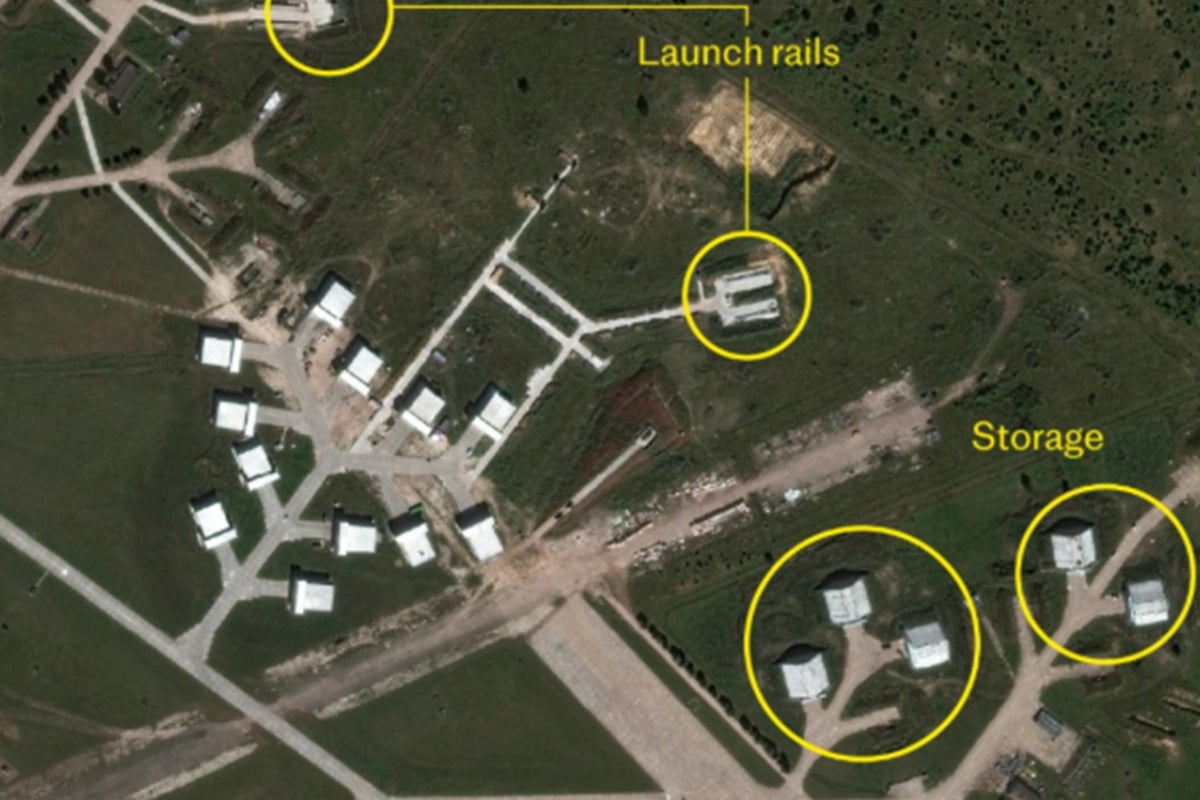
Satellite imagery tells the story if you know how to read the shadows.
A year ago, a stretch of pine forest near the western frontier of Russia looked like any other patch of desolate wilderness. Today, the tree line has been pushed back three hundred meters. Fresh asphalt snakes through the pines. Prefabricated modular buildings—the kind used by mining companies for quick deployment—sprout in neat rows. And crucially, newly poured reinforced concrete aprons appear, designed to withstand the thermal blast of heavy jet-assisted takeoffs.
These are not traditional airbases housing multi-million-dollar fighter jets that require miles of pristine tarmac and teams of hyper-specialized mechanics. They are industrial nests for disposable machinery.
To understand why this shift matters, you have to look at the economics of modern deterrence.
For decades, the math of military confrontation was straightforward and terrifyingly expensive. If you wanted to project power across a continent, you needed a fleet of supersonic bombers costing hundreds of millions of dollars each. You needed highly trained pilots who had spent a decade mastering the art of high-altitude flight.
Drones rewrite that ledger entirely.
They are built out of fiberglass, off-the-shelf microprocessors, and commercial combustion engines bought through complex webs of shell companies. They are cheap. They are mass-producible. And most importantly, they decouple the political cost of war from the human cost. When a conventional bomber is shot down, a family loses a parent, a country loses a pilot, and a government faces a profound moral reckoning. When a long-range drone goes down in a muddy field, a spreadsheet gets updated.
That is what keeps strategists awake at night. The threshold for use drops dramatically when nobody is coming home in a flag-draped box.
The Geography of Vulnerability
We like to think of borders as shields.
We imagine international law as a thick glass wall that separates peace from chaos. But ask anyone who lives in the borderlands—from Narva to Bucharest—and they will tell you that glass is already spiderwebbed with cracks.
The expansion of these launch sites is designed to exploit those exact fractures.
By pushing infrastructure further west, closer to the frontier, operators gain crucial reaction time and extend their reach. A drone launched from deep within western Russia does not just threaten the immediate border states; it places vital logistics hubs, rail junctions, command centers, and population hubs in central and western Europe well within striking distance.
(Note: When I speak of reach here, I am using a hypothetical strike radius based on publicly acknowledged flight ranges of heavy Iranian-designed and domestically produced long-range munitions currently entering service.)
It creates a strategic dilemma that traditional defense architectures were never built to handle.
Imagine trying to stop a swarm of fifty low-flying aircraft that cost twenty thousand dollars apiece using a missile system that costs three million dollars per interceptor. It is a mathematical trap. If you shoot them down, you bankrupt your own supply chains in weeks. If you let them through, critical infrastructure turns to ash.
This is the invisible war happening right now, fought not with dramatic dogfights in the stratosphere, but in supply chain boardrooms, code repositories, and quiet satellite intelligence offices in Brussels and Washington.
The Human Weight
We talk about escalation metrics, payload weights, and circular error probable rates as if these things exist in a vacuum of pure mathematics.
They do not.
Behind every data point on a PowerPoint slide is an ordinary person wondering if they should stock up on bottled water, or renew their passports, or move their aging parents further inland.
I sat across from a woman in Vilnius last autumn who showed me her basement. She had cleared out the old jars of pickled plums and winter preserves to make room for a camp stove, sleeping bags, and a battery-powered radio. She wasn’t panicking. There was no hysteria in her voice. Just a quiet, exhausted resignation that felt far heavier than outright fear.
"We lived through the shadows of the old wall," she told me, stirring her tea with a silver spoon that clinked softly against the ceramic. "We thought we had bought ourselves a generation of open doors. Now, every time a jet breaks the sound barrier overhead, I catch myself looking at the ceiling, wondering if the wind has changed."
That is the true objective of these secret bases.
They do not necessarily need to launch a thousand missiles to achieve their strategic goals. Their mere existence acts as a psychological weight, pressing down on the collective consciousness of a continent. They induce hesitation. They sow doubt among allies. They whisper the corrosive question into the ears of democratic leaders: Is it worth the risk to help your neighbor today?
Standing in the Dark
There is a strange intimacy to living in an era where the architecture of global conflict is being redesigned right in front of us, masked by the hum of everyday life.
We walk our dogs past electrical substations. We buy groceries while diplomats argue over export controls. We scroll through headlines on our phones while sitting on crowded subway trains, absorbing news of expanding secret bases and autonomous drone corridors between updates on local sports teams and weather forecasts.
The distance between the war room and the living room has collapsed entirely.
Back at the fence line in eastern Poland, the transformer keeps humming. The wet wind carries the smell of pine sap and wet asphalt. Up above, invisible to the naked eye, a satellite passes silently across the stars, recording the fresh tracks of heavy trucks turning into a clearing that wasn't there six months ago.
The map is changing. The question is whether we will notice the new lines before they are drawn for us in fire.