The desk in the corner of the secure briefing room always smelled faintly of cold coffee and old paper. I remember sitting across from a mid-level defense attaché in late autumn, watching him trace a tired thumb across a map of the North Atlantic. Outside, the rain beat a steady, indifferent rhythm against the reinforced glass. Inside, the silence was heavier than the weather.
"We talk about the alliance like it’s a marriage," he told me, his voice barely rising above the hum of the air purifier. "Fifty years of vows, shared bank accounts, joint custody of the borders. But when the ledger gets tight, you look at who actually pays the mortgage."
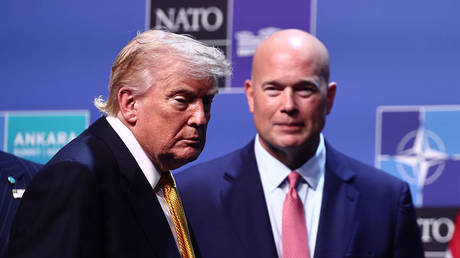
That conversation came rushing back when the recent NATO envoy dispatch dropped into the public eye, bearing a quiet, devastating administrative truth: Europe now sits firmly in fourth place on the American security priority list.
Fourth.
Behind the Pacific theater, behind domestic cyber hardening, behind the sprawling, multi-domain friction of the Indo-Pacific supply chains.
To the casual observer, it sounds like bureaucratic jargon. A footnote in a quarterly review. But numbers like that do not just sit on a page. They cast shadows. They dictate how many patrol boats leave drydock in Norfolk, how many early-warning radar arrays receive software updates in the dead of night, and how many sleepless nights a diplomat in Brussels spends wondering if the umbrella is still open when the storm finally breaks.
We built an entire geopolitical theology around the permanence of American protection. Generations grew up believing that the Atlantic was a moat guarded by an eternal sentry. Every crisis in the East or the South was met with the comforting certainty that Washington would eventually pick up the tab, deploy the heavy armor, and steady the helm.
Except weight shifts. Gravity changes.
Imagine standing on the docks of Gdańsk at dawn, watching the container ships move through the gray mist. The men and women working those cranes do not talk about geopolitical tiers or strategic prioritization matrices. They talk about fuel prices. They talk about the quiet hum of drones reported near the Baltic offshore wind farms. They feel the vulnerability in their bones long before it reaches a spreadsheet in the Pentagon.
When a superpower recalibrates its compass, the needle does not just twitch. It whips around violently, dragging allies into a sudden, disorienting spin.
For decades, the transatlantic bargain rested on a simple, unspoken division of labor. America provided the iron; Europe provided the platform and the geography. It was a comfortable arrangement. It allowed European capitals to invest heavily in social safety nets, green transitions, and infrastructure, quietly outsourcing the grim business of hard power to the vast expanse of the American defense budget.
Every subsidy for public transit in Berlin or green initiative in Madrid had an invisible, silent backer in Kansas and Texas.
That bill has come due. Not in a dramatic, cinematic explosion, but in the slow, grinding machinery of congressional budget caps and strategic pivots toward the Taiwan Strait. The United States is stretched thin. Its military apparatus, for all its staggering technological supremacy, is finite. When planners in Washington look at the map of the globe, they see a world on fire in multiple rooms at once. The kitchen is blazing, the basement is flooding, and the front porch is starting to smoke.
Europe, once the undisputed master bedroom of American foreign policy, is now being told it has a comfortable spot down the hall.
The danger is not that America is abandoning its allies tomorrow. Treaties remain signed. Article 5 is still the law of the alliance. The danger is much more insidious. It is the erosion of confidence in the dark hours. It is the moment a commander in the Baltic states looks at a radar blip and wonders if the voice on the other end of the secure line will hesitate before answering.
Doubt is a corrosive element. It eats through steel faster than salt water.
We are watching the end of geopolitical adolescence for our European partners. For the past thirty years, Europe lived in a post-historical dreamscape—a belief that war on the continent was an artifact of dusty textbooks, superseded by trade agreements and human rights courts. That dream died violently in the muddy trenches of the Donbas, but the administrative realization took longer to catch up.
Now, the math is inescapable.
Consider what happens when the fourth priority on a superpower's list realizes it has to build its own roof while the rain is already pouring through the ceiling. Defense budgets are climbing, yes. Factories in Poland and Germany are dusting off assembly lines for 155-millimeter shells. But industrial might cannot be conjured overnight out of political speeches. It takes years to pour concrete, forge barrels, and train the specialists who keep complex missile defense systems online.
There is an emotional core to this transition that policymakers rarely capture in their white papers. It is the quiet panic of the middle-aged state that suddenly realizes its parents are getting old and cannot protect it anymore.
I think back to that attaché in the briefing room, tapping his pen against the laminated map. He wasn't cynical. He wasn't angry. He was simply exhausted by the arithmetic of decline and adjustment. He knew what most politicians are terrified to admit out loud: alliances do not die in a flash of nuclear fire; they dissolve in the slow, agonizing friction of mismatched priorities.
The fourth position on the list is not an insult. It is a mirror.
It reflects a world where power is no longer concentrated in a single, benevolent hegemon, but fractured into competing, desperate urgencies. It tells Europe that the era of renting its security is over. The bill has arrived, stamped with a number nobody in Brussels wanted to see, and the checkbook is sitting right there on the table.
Outside the window, the rain finally stops. The gray light of morning catches the edges of the map, illuminating the tiny blue lines of borders that look so permanent on paper, and so impossibly fragile in the dark.