The Cold Sweat of 1993
Quentin Tarantino was sitting in a cramped trailer, clutching a screenplay that most of Hollywood thought was too talky, too violent, and far too strange. He had a problem. The problem was Jules Winnfield. In the script, Jules was a philosopher-hitman with a towering presence, a man who could turn a discussion about cheeseburgers into a theological debate. Tarantino had written the part for Samuel L. Jackson after the actor narrowly missed out on a role in Reservoir Dogs. But when the first round of auditions for Pulp Fiction began, something went sideways.
Paul Calderón walked into the room and gave a performance so electric that the producers were ready to hand him the keys to the kingdom. If you liked this article, you should read: this related article.
Samuel L. Jackson, meanwhile, was 3,000 miles away. He thought the role was already his. He had the confidence of a man who had spent years in the trenches of New York theater, a man who had finally beaten a crack cocaine addiction just weeks before his breakout role in Jungle Fever. When he heard that some other guy was "stealing" his part, the fury that erupted wasn't just professional. It was existential.
He flew to Los Angeles on his own dime. He walked into the audition room carrying a bag of takeout—a burger and fries—and he glared at the casting directors with a look that could melt lead. He didn't just read the lines. He weaponized them. Between bites of a greasy burger, he stared down the men who held his future in their hands. He was Jules Winnfield before the cameras even started rolling. For another perspective on this event, see the recent coverage from IGN.
He didn't just get the part. He claimed it.
The Theology of the Jheri Curl
We often talk about Pulp Fiction as a masterpiece of non-linear storytelling or a pop-culture explosion. But at its beating, bloody heart, it is a story about the grace of God and the choice of a man.
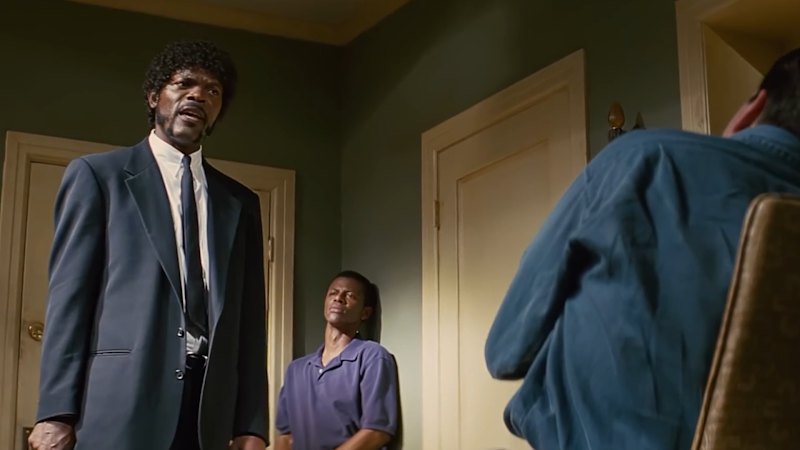
Jackson’s Jules starts the film as a creature of habit and violence. He is a professional. He moves through the world with a terrifying, rhythmic precision. When he enters the apartment of Brett—the poor soul who tried to double-cross Marcellus Wallace—he isn't just a killer. He’s a preacher.
The famous Ezekiel 25:17 monologue wasn't something Tarantino invented out of thin air; it was a patchwork of various Bible verses and martial arts movie tropes. In the hands of a lesser actor, it would have been campy. It would have been a joke. But Jackson understood the invisible stakes. He performed it like a Shakespearean soliloquy delivered in a cheap suit.
The genius of the performance lies in the transition. Jules goes from a man who uses the Bible as a terrifying prelude to murder, to a man who actually listens to the words he's saying. Most actors play a "hitman with a heart of gold." Jackson played something much more complex: a hitman having a nervous breakdown in the face of the divine.
Consider the "divine intervention" scene. A man empties a "hand cannon" at Jules and Vincent from point-blank range. Every bullet misses. Vincent Vega, played by John Travolta, sees it as a fluke. A lucky break. Sh*t happens. But Jules sees the hand of God.
This is where the human element takes over. In that moment, Jules ceases to be a caricature. He becomes every person who has ever stood at a crossroads, wondering if the coincidence they just experienced was a sign or just noise. He chooses to believe it’s a sign. That choice—to stop being the "tyranny of evil men" and start trying to be the "shepherd"—is the most radical thing in a movie filled with radical things.
The Haircut That Changed Cinema
There is a small, hilarious detail that defines the look of Jules Winnfield. In the script, Jules was supposed to have a giant, glorious afro. It was meant to be a symbol of 1970s power.
A production assistant was sent out to buy a wig. They came back with a Jheri curl wig instead.
When Jackson put it on, the room went quiet. It wasn't what they planned. It looked slightly ridiculous, oily, and dated. But Jackson looked in the mirror and realized it was perfect. It added a layer of specificity to the character—a man who was slightly out of time, a man who took pride in a look that was already fading.
This is the essence of why Samuel L. Jackson became the highest-grossing actor of all time. He understands that humans are defined by their contradictions. A man can be a cold-blooded killer and still care deeply about the maintenance of his soul—and his hair.
The Diner as a Cathedral
The final scene of the film, which takes place in a nondescript Los Angeles diner, serves as the ultimate test of Jules's new faith. He is confronted by "Pumpkin" and "Honey Bunny," two low-level thieves who have picked the wrong morning to rob a restaurant.
In any other movie, Jules would have ended the conflict in three seconds with a volley of gunfire. Instead, he uses his wallet. The one that says "Bad Mother F*cker" on it.
He gives the thief his money. Not out of fear, but as a ransom for the thief’s life. He explains the monologue he’s been reciting for years. He admits he never really thought about what it meant. He just thought it was "some cold-blooded sht to say to a motherfcker before I popped a cap in his ass."
But now? Now he's trying.
The tension in that diner is unbearable because we know what Jules is capable of. We’ve seen him execute people without blinking. Watching him choose peace is more thrilling than any car chase or shootout. It’s the sound of a man's soul shifting gears.
Beyond the Suit and Tie
Samuel L. Jackson’s performance didn't just launch a thousand imitators; it fundamentally changed how we view "cool" in cinema. Before 1994, cool was often silent. It was Clint Eastwood’s squint. It was Steve McQueen’s shrug.
Jackson made cool verbal. He proved that a character could talk their way into legend. He used language as a percussion instrument. Every "d*mn," every "please," and every "sir" was placed with the timing of a master jazz drummer.
But look past the memes. Look past the t-shirts and the soundboards. What remains is a portrait of a man who decided to be better.
We live in a world that often feels like that diner—chaotic, violent, and filled with people who want to take what we have. We are all, at various times, the shepherd, the weak, and the tyranny of evil men.
Jules Winnfield reminds us that the "miracle" isn't the bullets missing. The miracle is the moment you decide to put the gun down.
He walked out of that diner, tucked his gun into his waistband, and wandered off into a future that was uncertain, dangerous, and entirely new. He didn't have a plan. He just had the walk.
That walk is the sound of a man who has finally found his rhythm. It is the stride of someone who no longer needs to prove he’s the baddest man in the room, because he’s finally brave enough to be the kindest.
The sun was hitting the pavement of the Hawthorne Grill parking lot. Jules Winnfield stepped out into the light, disappeared into the crowd, and left us wondering if we were brave enough to do the same.