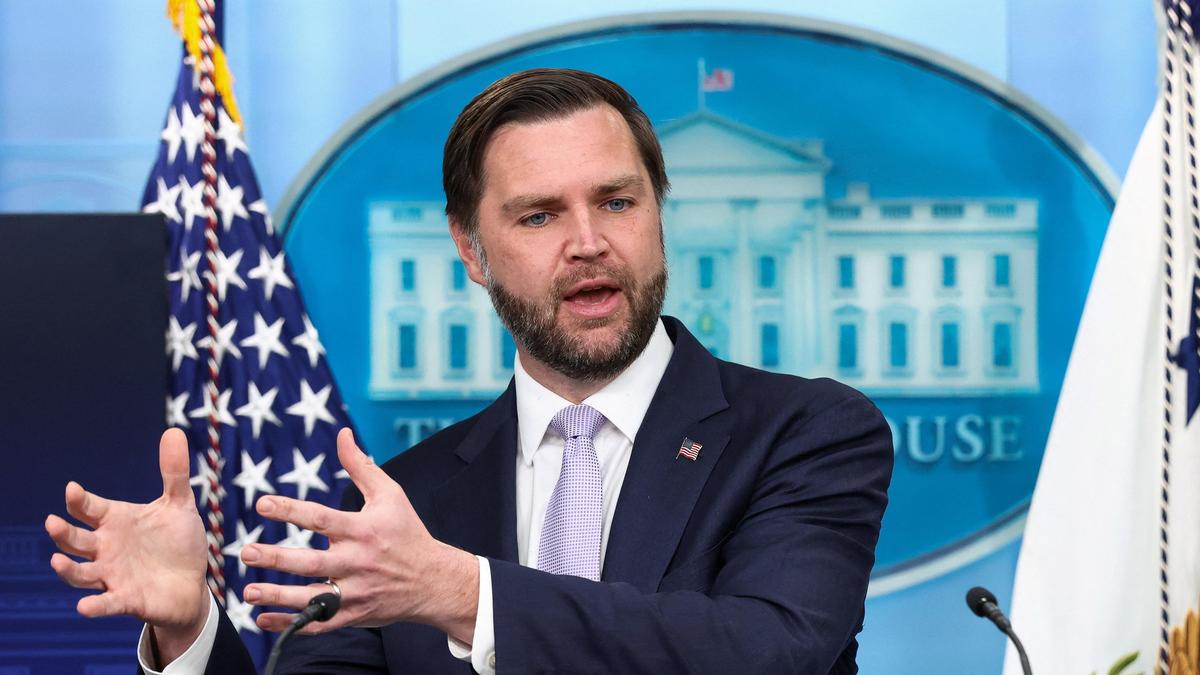
The air in the White House briefing room usually tastes like stale coffee and nervous energy. It is a room of polished wood and bright lights, a place where the jagged edges of the world are supposed to be smoothed over by careful phrasing. But when Vice President JD Vance stepped to the lectern to discuss the escalating tensions with Iran, the atmosphere shifted. He wasn't just talking about troop movements or strategic depth. He was talking about time.
Time is the one currency the American public feels it has spent into bankruptcy over the last quarter-century. You might also find this connected coverage useful: Calculated Restraint and the Geopolitical Cost Function of Iranian Containment.
Vance’s message was a sharp departure from the open-ended doctrines of the past. He looked into the cameras and insisted that if a conflict with Iran were to break out, it would not be "forever." It was a bold claim, a promise whispered to a nation that has spent decades watching its children depart from sun-drenched tarmac strips, only to see them return years later with eyes that have seen too much and hearts that have grown cold to the quiet rhythms of civilian life.
The Ghost in the Briefing Room
To understand the weight of Vance’s words, you have to look past the policy charts. Consider a man we will call Elias. Elias isn't a general or a senator. He is a mechanic in a small town in Ohio, the kind of place where the evening air smells of cut grass and woodsmoke. In 2003, Elias was nineteen. He believed in the mission. He believed in the clarity of the fight. As reported in recent reports by NBC News, the implications are notable.
Twenty years later, Elias sits on his porch and watches his own son, now nineteen, look at the news coming out of the Middle East. The cycle feels predatory. For men like Elias, "forever war" isn't a political buzzword found in a think-tank white paper. It is the missing decade of his youth. It is the way he flinches when a car backfires. It is the permanent, hollow ache of friends lost to desert sands in a conflict that seemed to have no exit ramp.
When Vance says this war won’t be forever, he is speaking directly to the ghost of Elias’s youth. He is attempting to dismantle the expectation of the eternal deployment. The administration is signaling a shift toward a "lethal and fast" philosophy, an attempt to prove that the United States can protect its interests without sinking into the metaphorical quicksand of nation-building.
The Mechanics of a Finite Conflict
The skepticism in the room was palpable. Reporters pushed for specifics, their pens hovering over notebooks, waiting for the slip-up that would reveal another quagmire in the making. How do you fight a country like Iran—a nation with a sophisticated military, a vast geography, and a network of proxies—without it becoming a generational struggle?
Vance’s argument hinges on a specific, cold logic: objectives must be defined by what we can destroy, not what we can build.
The "forever" quality of previous wars stemmed from the ambition to reshape entire societies. We tried to plant the seeds of Western democracy in soil that had its own ancient, complex nutrients. Vance is suggesting a return to a more primal form of statecraft. In this framework, military force is a hammer, not a trowel. You hit the target. You break the capability. You leave.
But the "invisible stakes" of such a strategy are high. If you break something and leave, you create a vacuum. History hates a vacuum. It fills them with chaos, with newer and more radical actors, or with the bitter resentment of a population left to sift through the rubble. The human cost of a "short" war can sometimes be just as devastating as a long one, packaged into a more intense, concentrated burst of violence.
The Weight of the Promise
There is a specific kind of exhaustion that settles into a country when it is always at war. It shows up in the way we fund our schools, the way we talk to our neighbors, and the way we view our place in the world. We become a garrison state, even when we are at the grocery store.
Vance is betting that the American people are tired of being a garrison. He is betting that the promise of an "end date" is the only way to sell a new conflict to a weary public.
Consider the logistical reality of what he is proposing. A war that isn't forever requires an exit strategy that is as robust as the entrance plan. It requires a level of discipline that few administrations have shown. It means saying "no" to the mission creep that inevitably follows the first shot. It means watching an enemy regroup and choosing not to re-engage because the "finite" clock has run out.
Is that even possible in the modern age?
The Middle East is a place of long memories and deep grievances. Iran does not view time the way Washington does. For the leadership in Tehran, the struggle is existential and historical. They play a game of centuries. Vance is trying to play a game of months or years. The friction between those two clocks is where the danger lies.
The Quiet Reality of the Stakes
If you walk through any VA hospital, you see the physical manifestation of the "forever" policy. You see it in the prosthetic limbs and the service dogs. You see it in the quiet, desperate conversations in the hallways. These people are the living ledger of our foreign policy.
Vance's briefing was an attempt to close that ledger, or at least to promise that no new pages would be added that we couldn't finish writing quickly. It was a performance of confidence, a hand on the shoulder of a nervous nation. Yet, the history of the 21st century is a graveyard of "short" wars. Every conflict starts with the promise of a swift resolution and a hero’s welcome. Every conflict starts with the assurance that this time, it’s different.
The Vice President spoke with the cadence of a man who knows the cost of the alternative. He knows that the American heartland—the place he calls home—is the one that pays the highest price when "short" becomes "indefinite." He is trying to bridge the gap between the necessity of national defense and the reality of national exhaustion.
The Shadow of the Next Day
War is never just about the fighting. It is about the morning after.
If a conflict with Iran begins, the first few days will be a whirlwind of technical jargon. We will hear about "surgical strikes," "intercepted assets," and "command and control centers." The maps on the news will glow with red and blue icons. It will look like a game. It will look clean.
But for the families waiting at home, the map doesn't matter. The only thing that matters is the calendar. They will be counting the days, wondering if this is the start of another twenty-year cycle. They will be looking at their children and wondering if they are raising the next generation of "forever" soldiers.
Vance’s words in that briefing room were an attempt to stop that clock before it even starts ticking. It was a high-stakes gamble on the idea that power can be used with precision and then put back in the holster. It was a rejection of the idea that America must be the world’s permanent policeman, patrolling the same beats decade after decade.
The room eventually emptied. The cameras were turned off. The wood-paneled walls held the echoes of his promises. Outside, the world continued its messy, complicated rotation. The tension with Iran remains a coiled spring, ready to snap at the slightest provocation.
We are left waiting to see if a war can truly be finite, or if "forever" is simply the natural state of a world that refuses to be tamed by even the most confident of briefings. The mechanic in Ohio is still sitting on his porch. He is watching the horizon, waiting to see if the sunset brings peace or just the long, familiar shadow of another beginning.
The truth of Vance’s words won’t be found in the transcripts of a press conference. It will be found in the silence of the years to come, and whether or not that silence remains unbroken by the sound of boots marching toward another distant shore.